Hook: How Material Science Elevates Stainless Steel Initial Charm Keychains
For boutique-brand charm programs, performance starts with the right base metal, reliable finishes, and repeatable manufacturing. Focusing on the 316L stainless steel baseline helps ensure durability, corrosion resistance, and design fidelity across markets. This guide outlines how material choices, finishing technologies, and in-house production capabilities come together to deliver consistent results for OEM/ODM charm manufacturing and private-label collaborations.
Stainless steel initial charm keychain: main topic
H3 Sub-points: 316L composition, finishes, and manufacturability
316L stainless steel is selected for its corrosion resistance, formability, and compatibility with durable decorative treatments. The base material used by Lancy Jewelry aligns with global expectations for longevity, consistent plating performance, and cross-market reliability. Typical composition emphasizes chromium for the passive oxide layer, nickel for stability, and molybdenum for enhanced resistance in chloride environments. This combination supports precise machining, laser marking, and high-quality finishes suitable for charm programs aimed at boutique brands and private-label buyers.
Key to surface performance is the relationship between the base alloy and finishing technologies such as PVD plating, enamel color filling, and crystal inlay. PVD plating yields durable hues and protective layers that withstand handling and display. Enamel fills provide vibrant color with strong adhesion to the 316L substrate, while crystal inlays are seated with controlled fixation to preserve edge detail and legibility of initials. When selecting a finish, consider chemical exposure from cleaners, salt spray, mechanical wear from handling, and cleaning routines typical of a charm bar or gift program.
From a manufacturability perspective, Lancy Jewelry’s facilities—featuring CNC machining, laser cutting, laser marking, welding, and polishing—enable tight tolerances for bail loops, jump rings, and attachment holes. Prototypes translate CAD designs into machined parts quickly, enabling rapid iteration before private-label packaging or bulk orders. This capability also supports custom logo charms and other branding elements without sacrificing cycle time or dimensional fidelity.
Material processing decisions influence testing requirements. SGS certifications (RoHS, REACH, EN1811 Nickel Release, Salt Spray 240H) provide a framework for regulatory qualification and risk assessment across markets. In practice, material and process choices should align with these test criteria to minimize risk during scale-up and to support reliable OEM/ODM engagements.
Benefits/Why it matters
Key benefits (with certifications)
- Consistent plating quality: The 316L base supports reliable PVD coating adhesion and predictable finish performance, reducing batch-to-batch variation for boutique-ready aesthetics in private-label programs.
- Ultra-precise motif details: CNC and laser processes enable faithful reproduction of initials and symbols at small sizes typical for keychain charms, ensuring legible engravings and clean edges.
- SGS-certified compliance: RoHS, REACH, Nickel Release EN1811, and Salt Spray 240H testing underpin risk management and global market access for OEM/ODM partners.
- Low MOQ support and scalable production: A practical path from prototype to production that accommodates private-label launches and limited-run collaborations without delaying lead times.
- Finish versatility: Enamel, crystal inlay, and PVD color options expand design space while preserving base-material integrity for multi-market environments.
From a market perspective, these capabilities translate into clear advantages for global buyers. Boutique brands evaluating a new initial charm concept can partner with a supplier possessing a robust material foundation and disciplined processes to deliver consistent results, whether the program targets wholesale distribution, private-label packaging, or OEM/ODM collaboration. With SGS-certified workflows and an in-house fabrication line, Lancy can streamline the journey from concept to validated samples to full-scale orders. For catalog exploration or integrated program development, browse the All Products page at /products. To pursue dedicated manufacturing pathways, access our OEM service at /oem and begin RFQ workflows at /cart or through /contact.
Detailed analysis/Guide
H3: Material science foundations for 316L stainless steel
316L stainless steel, a low-carbon variant, improves weldability and reduces sensitization during fabrication. The alloy typically contains chromium (~16-17%), nickel (~10-14%), and molybdenum (~2-3%), with trace elements that influence grain structure and surface behavior. In charm applications, this chemistry provides a stable platform for plating and decoration while retaining ductility for small bail loops and tight features around initials. The corrosion resistance is advantageous in consumer-use environments with cosmetics, humidity, and display exposure.
When designing initials or alphabet motifs, designers should consider grain size, heat-treatment windows, and surface finish compatibility. For example, polished, brushed, or satin textures have different visual preferences across markets. PVD and enamel systems are preferred for preserving color fidelity and wear resistance. Engineering teams should define an alloy tolerance envelope and validate plating thickness to maintain functional clearances around holes or bail interfaces.
H3: Process sequence for 316L stainless steel initial charm keychains
The typical production sequence for an OEM/ODM program comprises the following stages:
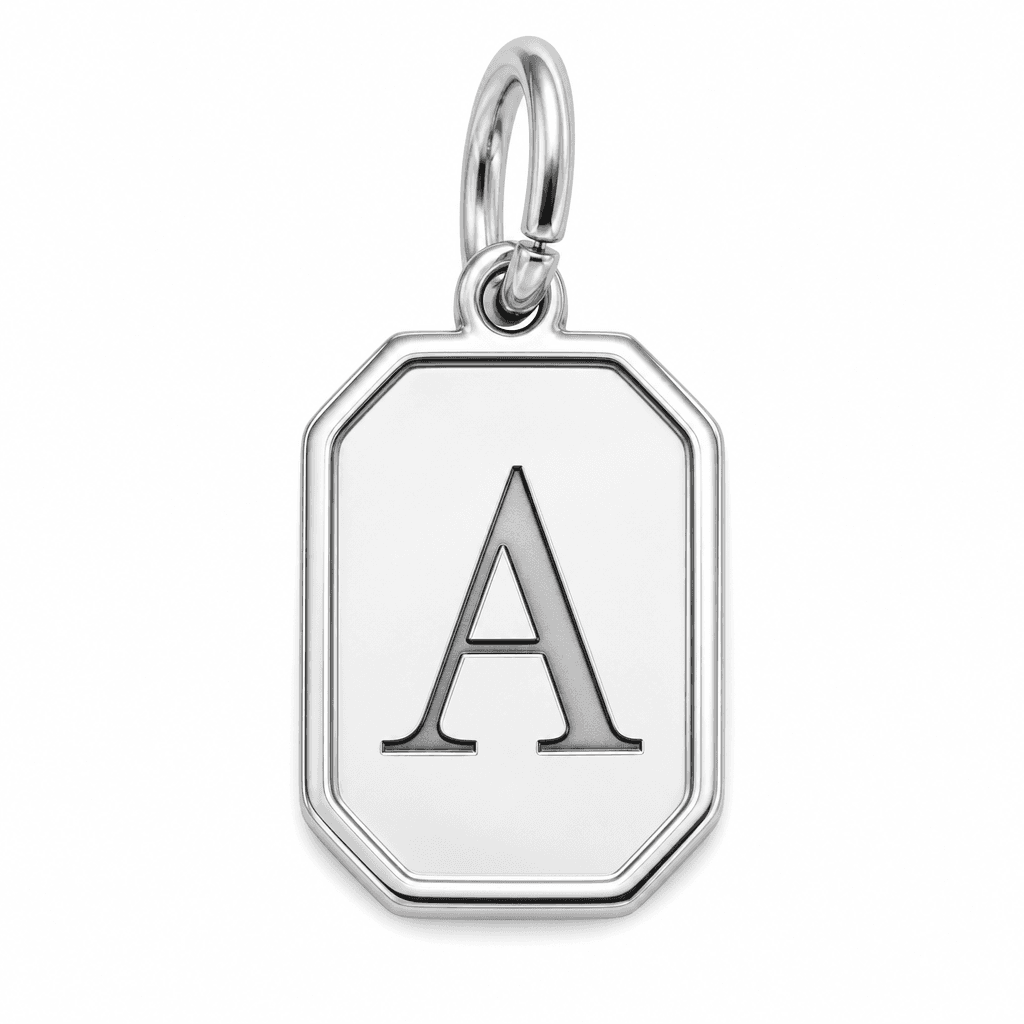
- Design transfer and CAD detail: Capture the exact front-face motif, initials, and edge geometry. Ensure hole diameter and bail alignment suit the intended jump ring or clasp system.
- Machining and forming: 316L blanks are machined with CNC to tight tolerances, followed by deburring and surface finishing to achieve the silhouette and smooth edges around cutouts.
- Surface preparation: Standard cleaning and pickling remove oxidation and residual oils before applying decorative finishes, setting the stage for robust adhesion with PVD or enamel fills.
- Decorative finishing: Apply PVD plating for durable color layers, then perform enamel filling or crystal inlay as required. Each finish must be inspected for uniformity, edge coverage, and fill depth.
- Quality validation: Conduct dimensional checks, adhesion tests, salt spray exposure, and nickel-release screening to confirm compliance with EN1811 and related standards before approving prototypes for sample development and private-label packaging proofs.
- Private-label packaging and labeling: Align packaging with brand standards, add laser-engraved logos, batch codes, and SKU identifiers, and prepare for MOQ-appropriate packaging configurations.
- DFS and pilot run: Execute a small-batch run to verify production stability and finalize lead times for bulk charm orders.
Lead times vary by finish and volume. An integrated facility enables tighter cycles by reducing external handoffs, shortening the feedback loop between design changes and production readiness. Buyers should consider milestones for sample development to keep timelines aligned with product launches.
H3: Prototyping, testing, and cross-market readiness
Prototyping provides a bridge from concept to commercial viability. The sample development process involves machining, applying the intended finish, and performing targeted tests that reflect real-world use. For 316L stainless steel initial charm keychains, informative tests include:
- Salt spray corrosion testing to simulate humid retail environments and coastal exposure.
- Nickel release screening for skin-contact safety across European and North American markets.
- Adhesion and hardness checks for enamel or crystal inlay to ensure long-term color retention and decorative integrity.
- Dimensional stability checks after plating and filling to verify bail clearance, hole diameters, and alignment for jump rings or clasps.
Cross-market readiness requires understanding regional preferences for finishes and packaging. The ability to offer private-label packaging and consistent finish quality supports global rollouts while maintaining the same material core and production standards. To explore the catalog, visit /products and consider the OEM path at /oem. When ready, start a quote at /cart or contact the team via /contact.
FAQ
Q1: What makes 316L stainless steel suitable for initial charm keychains?
A1: 316L stainless steel provides strong corrosion resistance, good formability for small features, and compatibility with durable finishes like PVD plating and enamel. Its low carbon content supports reliable welding and forming for bail loops while maintaining structural integrity during daily use, which is important for private-label and wholesale programs seeking consistent results.
Q2: How long does prototyping and sample development typically take?
A2: Prototyping timelines depend on design complexity, finish options, and validation requirements. A typical cycle includes CAD-to-CAM preparation, first-cut prototypes, finish validation, and initial testing, followed by a sample review. Lancy’s in-house capabilities aim to shorten this process. For precise timelines, request a formal lead-time estimate through /cart or /oem, referencing target MOQ and finish choices.
Q3: What finishes are available for 316L stainless steel initial charms?
A3: Finish options include PVD plating in gold, rose gold, and silver tones, as well as enamel color filling and crystal inlay. Finishes are designed to complement the base 316L stainless steel and preserve edge detail on small motifs. All finishes are validated through SGS testing to meet regulatory expectations across major markets.
Q4: What about MOQ and private-label packaging?
A4: Lancy supports low MOQ charm production to minimize risk in early launches and private-label programs. Private-label packaging options are available, with branding elements, SKU packaging, and labeling aligned to market needs. For specifics, contact through /oem or request a quote at /cart.
Call to action: Partner With Us
If you’re evaluating a stainless steel initial charm keychain program for private-label collections or wholesale catalogs, Lancy Jewelry offers a proven, technically rigorous path from concept to production. As a dedicated stainless steel charms manufacturer with in-house CNC and plating capabilities, we support OEM/ODM development, logo engraving, enamel filling, crystal work, and private-label packaging—focusing on consistent finish quality and reliable lead times. Let’s align on design intent, material specs, and packaging strategy to accelerate your time-to-market. Reach out through /oem to start an engineering brief, or initiate your RFQ using /cart. You can also explore the catalog via /products to see compatible charm families, including Birthstone Collection, Alphabet Series, Zodiac Signs, and more. For direct inquiries, the /contact page connects you with the sales team to discuss private-label arrangements, sample development, and bulk charm orders.