Finding a reliable supplier for stainless steel tassel bag charm wholesale orders involves more than comparing unit prices. For boutique retailers, gift companies, and private-label buyers, product durability, attachment reliability, finish consistency, and repeat-order performance directly influence customer satisfaction and profit margins. A visually attractive sample means little if the production batch arrives with inconsistent plating, loose connections, or poor finishing.
The most effective sourcing strategy combines material verification, measurable quality standards, supplier capability checks, and realistic cost calculations. This checklist explains how North American wholesale buyers can evaluate suppliers, compare quotations, establish quality expectations, and build a dependable supply program for stainless steel tassel bag charms.
Stainless Steel Tassel Bag Charm Wholesale: What Buyers Should Evaluate
Understand the Product Construction
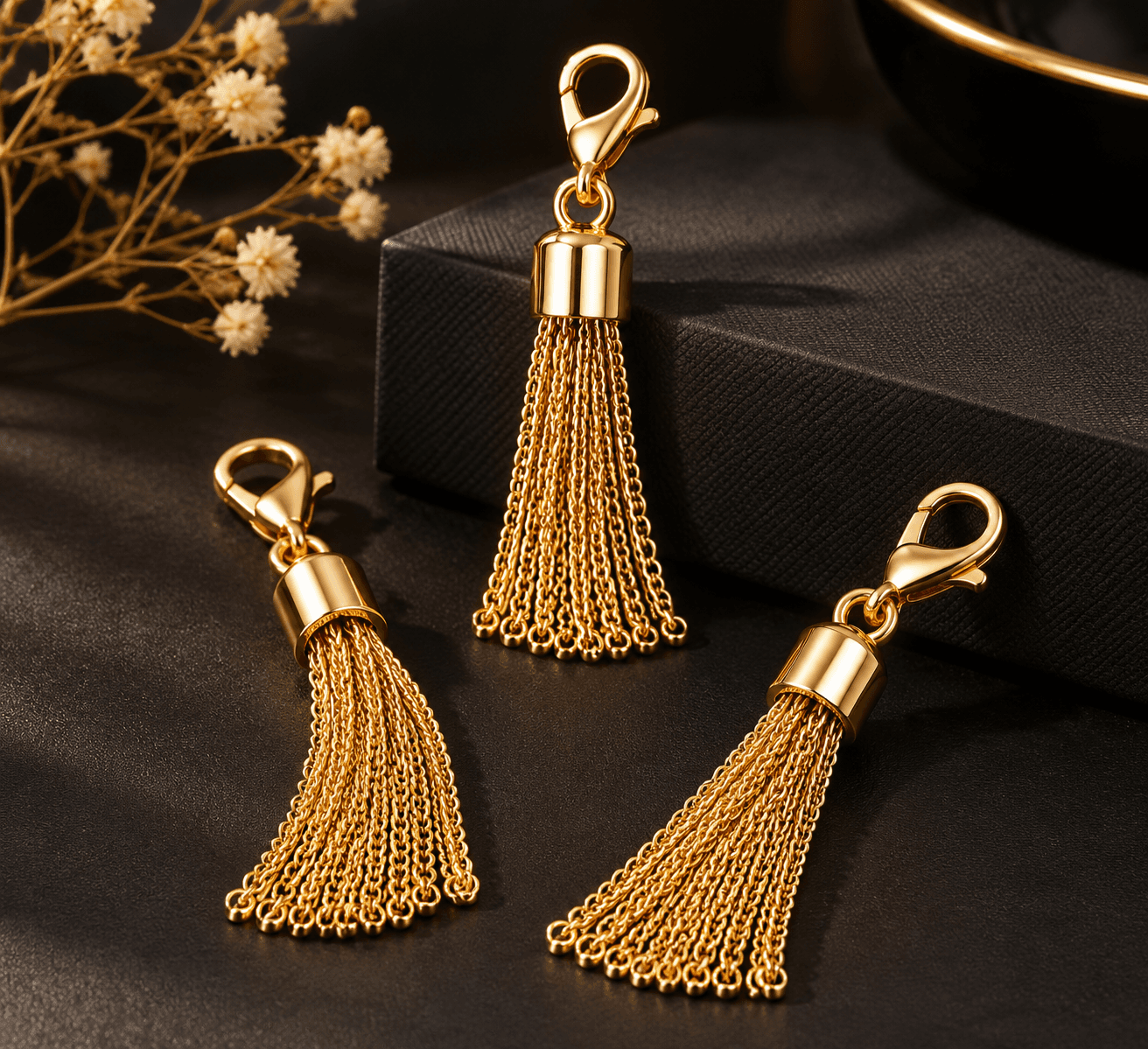
A tassel bag charm typically combines a decorative 316L stainless steel charm component, a tassel element, and functional attachment hardware. Each component contributes to the finished product's appearance and performance. Buyers should evaluate the complete assembly rather than inspecting only the decorative front.
For Lancy Jewelry, the primary decorative charm structure uses 316L stainless steel. Available finishing and customization options include PVD gold plated finishes, silver finish, rose gold plating, enamel color filling, crystal inlay, and custom logo engraving.
Before requesting a quotation, establish the following specifications:
- ☐ Charm dimensions, thickness, weight, and overall silhouette.
- ☐ Front and reverse design requirements.
- ☐ Tassel dimensions, color, texture, and attachment method.
- ☐ Jump ring, connector, or clasp configuration.
- ☐ Required surface finish and color consistency.
- ☐ Logo engraving, decorative details, and packaging requirements.
- ☐ Individual packaging and bulk carton specifications.
Define the Intended Retail Application
North American buyers should consider how customers will actually use the product. A bag charm may experience frequent handling, friction against bags, exposure to outdoor conditions, and repeated attachment or removal. The attachment mechanism must therefore be evaluated as carefully as the decorative component.
For boutique collections, coordinated colors, recognizable decorative themes, practical dimensions, and attractive gift-ready packaging can improve merchandising opportunities. Avoid choosing oversized or unnecessarily complicated designs when a lighter, more versatile product would better suit the intended customer.
Why 316L Stainless Steel Quality Matters for Wholesale Buyers
1. Corrosion Resistance and Long-Term Performance
316L stainless steel is valued for its corrosion resistance and suitability for products that experience regular handling. Its material characteristics make it a practical foundation for decorative bag charm components intended for long-term retail use.
However, specifying 316L stainless steel alone does not guarantee the quality of a finished product. Manufacturing precision, polishing, surface preparation, plating conditions, and assembly quality also influence the final result.
Buyers should request material documentation and establish acceptance requirements before production. A dependable stainless steel charms manufacturer should be able to explain how incoming material verification and production inspections are managed.
2. Surface Finish and Wear Resistance
PVD finishing is an important consideration for buyers sourcing gold plated bag charms. Consistent surface preparation and controlled finishing processes help create an attractive appearance and support finish durability.
During supplier evaluation, ask how the manufacturer controls:
- ☐ Surface polishing before finishing.
- ☐ Plating color consistency between production batches.
- ☐ Coating coverage around edges, recesses, and detailed areas.
- ☐ Surface defects, scratches, and visible discoloration.
- ☐ Adhesion and resistance to everyday handling.
Request physical samples and compare them under consistent lighting. Color variation can become especially noticeable when several matching charms are displayed together in a retail collection.
3. Safety and Compliance Documentation
For US and Canadian wholesale distribution, buyers should request relevant product documentation rather than relying on general supplier assurances. Lancy Jewelry has SGS certification covering RoHS, REACH, Nickel Release EN1811, and Salt Spray 240H testing.
These documents support a more structured sourcing evaluation:
- RoHS: Provides information about restrictions on specified hazardous substances within its applicable scope.
- REACH: Addresses applicable chemical safety and regulatory requirements for products supplied to relevant markets.
- Nickel Release EN1811: Evaluates nickel release using a recognized test method relevant to applicable skin-contact requirements.
- Salt Spray 240H: Provides corrosion-resistance testing information under specified laboratory conditions.
Buyers should check certificate validity, test scope, sample identification, and whether the tested specifications correspond to the products being purchased. A test result should not automatically be interpreted as a guarantee of identical performance under every real-world condition.
For FDA considerations, ordinary decorative bag charms should not be marketed as FDA-approved simply because they are manufactured for the US market. FDA requirements depend on the intended product use and applicable regulatory scope. Buyers should also review relevant consumer product, chemical disclosure, labeling, and state-level requirements for their distribution channels.
Wholesale Supplier Evaluation Checklist: Seven Essential Steps
Step 1: Verify Manufacturing Capabilities
Choose a supplier with direct manufacturing capabilities rather than relying exclusively on trading arrangements. A factory with control over development, processing, finishing, and inspection can provide clearer accountability when specifications need adjustment.
When evaluating a potential ODM charm supplier, request information about its equipment, production workflow, sample development process, and quality-control responsibilities.
Lancy Jewelry operates a modern manufacturing facility equipped with CNC processing, laser cutting, laser marking, welding, and polishing capabilities. These processes support accurate decorative detailing, logo customization, and controlled product development.
- ☐ Confirm that the supplier controls the relevant production stages.
- ☐ Review actual production samples.
- ☐ Ask how defects are identified and corrected.
- ☐ Confirm whether finishing and assembly specifications are documented.
Step 2: Request a Complete Material Specification
Do not accept a quotation that identifies the product only as stainless steel. Ask the supplier to confirm the specific grade used for the charm structure and provide supporting documentation.
For Lancy production, the specified base material is 316L stainless steel. Buyers should also document finish type, decorative components, dimensions, and any special processing requirements.
- ☐ Confirm 316L stainless steel as the base material.
- ☐ Request relevant material verification documentation.
- ☐ Specify the required PVD or other approved surface finish.
- ☐ Record approved colors and design references.
Step 3: Test Samples Before Approving Bulk Orders
Sample development is one of the most valuable stages of wholesale sourcing. It gives buyers an opportunity to identify design, functional, and finishing problems before committing to larger production quantities.
Evaluate each sample using a repeatable inspection procedure:
- ☐ Inspect the front, reverse, edges, and decorative details.
- ☐ Check that the attachment ring is properly closed and securely connected.
- ☐ Examine tassel attachment and overall assembly stability.
- ☐ Check for sharp edges, rough surfaces, and visible manufacturing defects.
- ☐ Compare plating color and surface appearance against the approved reference.
- ☐ Conduct appropriate handling and wear evaluations.
For functional testing, establish a reasonable handling and attachment-removal procedure based on the product design. Record the inspection results and retain an approved reference sample for subsequent production comparisons.
Step 4: Establish Measurable Durability Standards
Terms such as durable, premium, and long-lasting are not sufficient quality specifications. Wholesale buyers should translate these expectations into measurable inspection requirements.
Consider establishing the following quality-control checkpoints:
| Inspection area | What to evaluate | Buyer requirement |
|---|---|---|
| Material | 316L identification and documentation | Match approved specifications |
| Surface finish | Color, coverage, and visible defects | Consistent approved appearance |
| Corrosion resistance | Relevant salt spray test results | Review applicable 240H documentation |
| Nickel release | EN1811 test documentation | Review applicable requirements |
| Attachment | Ring closure and connection stability | No loose or visibly defective connections |
| Assembly | Tassel positioning and overall construction | Match approved sample |
| Packaging | Product protection and labeling | Meet agreed packing specifications |
Salt spray testing is useful for evaluating corrosion behavior under specified conditions, but it does not reproduce every aspect of daily consumer use. Similarly, a successful laboratory result does not eliminate the need for production inspections. Ask the supplier to explain the test conditions and acceptance criteria.
Step 5: Evaluate MOQ and Bulk Pricing
MOQ can significantly influence the profitability of a wholesale bag charm program. A low initial order quantity may help boutique retailers test customer demand, while larger orders can provide more favorable unit pricing when production processes and material purchasing become more efficient.
Request a quotation with several quantity levels instead of evaluating only one order size. For example, compare initial sampling, a small commercial order, and a larger replenishment order.
Ask suppliers to separate the following cost components:
- ☐ Product manufacturing cost.
- ☐ Design development or customization charges.
- ☐ Logo engraving and decorative processing costs.
- ☐ Packaging and labeling expenses.
- ☐ Sampling charges and applicable setup fees.
- ☐ Shipping, duties, and other landed costs.
Also confirm whether MOQ applies per design, finish, color, or combined order. This distinction is important when developing coordinated collections with several variations.
Step 6: Check Supplier Reliability and Production Control
Reliable supply is essential for retailers that need predictable inventory replenishment. A supplier should provide realistic production schedules, communicate potential delays, and maintain documented specifications for repeat orders.
Evaluate supplier reliability using these questions:
- ☐ Is there a clear contact responsible for order coordination?
- ☐ Can the supplier provide a documented production schedule?
- ☐ Are sample approval and bulk production clearly separated?
- ☐ Does the factory maintain inspection records?
- ☐ Can it explain its process for handling defective products?
- ☐ Are repeat-order specifications retained and checked?
Ask for written confirmation of delivery expectations and agreed remedies for nonconforming products. A practical quality agreement should specify inspection methods, acceptable defect limits, replacement or credit procedures, and responsibility for verified production issues.
Step 7: Confirm Private-Label and Packaging Support
For North American boutique brands and gift companies, packaging is part of the product experience. A well-presented charm can be easier to merchandise, organize, and sell as a gift accessory.
Discuss packaging card dimensions, logo placement, barcode requirements, product protection, and carton labeling before production begins. If several designs form one collection, request a coordinated packaging approach that keeps the presentation consistent.
Lancy supports private-label packaging and custom logo development, helping buyers coordinate product appearance with their own retail presentation requirements.
Wholesale Pricing, Margins, and Order Planning
Calculate the True Landed Cost
The lowest factory quotation does not necessarily produce the best commercial result. Buyers should calculate the complete landed cost per saleable unit before approving an order.
A practical formula is:
Landed cost per unit = (Product cost + Sampling allocation + Packaging cost + Freight + Duties + Inspection expenses) ÷ Saleable units received.
For example, if a wholesale order includes 500 units, the buyer should divide total landed expenses by the number of units that pass the agreed incoming inspection, not simply the quantity originally ordered.
Next, estimate gross margin using the intended wholesale or retail selling price:
Gross margin (%) = (Selling price − Unit cost) ÷ Selling price × 100.
Include realistic allowances for damaged inventory, promotions, fulfillment, and returns when planning profitability. This provides a more reliable comparison between suppliers offering different prices and production terms.
Balance MOQ Against Inventory Risk
For boutique retailers, ordering too many variations can tie up working capital. A more controlled strategy is to launch a focused collection with a manageable number of designs and finishes, then replenish proven performers.
Buyers should compare the cost of a smaller initial order with the savings offered by larger quantities. The right MOQ is the quantity that supports acceptable margins without creating excessive inventory exposure.
Plan for Repeat Production
Repeatability is especially important for private-label programs. Retain approved samples, product drawings, finish references, packaging specifications, and inspection criteria. These records help reduce misunderstandings when ordering additional quantities.
For wholesale stainless steel charms programs, a documented specification sheet is often more valuable than a verbal promise of consistent quality.
Frequently Asked Questions
What should wholesale buyers look for in a stainless steel tassel bag charm supplier?
Prioritize verified 316L stainless steel specifications, documented finishing processes, relevant SGS testing, sample development capabilities, reliable attachment construction, clear MOQ terms, and consistent production control. Also review packaging support and the supplier's process for managing quality issues.
What certifications should buyers request for 316L stainless steel bag charms?
Relevant documentation may include RoHS, REACH, Nickel Release EN1811, and corrosion testing records. Lancy Jewelry has SGS certification covering these areas, including Salt Spray 240H testing. Buyers should verify each document's validity, scope, and applicability to the purchased product.
How can buyers evaluate the durability of gold plated bag charms?
Inspect the surface preparation, plating coverage, color consistency, and finishing quality. Request applicable PVD process information and relevant test documentation. Evaluate samples through appropriate handling and wear tests, and compare finished bulk production against the approved reference sample.
Can Lancy Jewelry support low MOQ and private-label orders?
Lancy Jewelry supports low MOQ sourcing discussions, OEM and ODM development, custom logo engraving, finishing customization, sample development, and private-label packaging. Final quantities, sampling arrangements, and production schedules depend on the selected design, customization requirements, and order specifications. Buyers can submit an RFQ to discuss their project.
Partner With Lancy Jewelry for Reliable Wholesale Charm Sourcing
Successful wholesale sourcing depends on finding a manufacturing partner that understands both product quality and commercial requirements. Material verification, controlled finishing, reliable assembly, documented inspection procedures, and clear communication should form the foundation of every purchasing decision.
Lancy Jewelry is a B2B OEM/ODM 316L stainless steel charms manufacturer supporting boutique jewelry brands, gift companies, charm bar retailers, distributors, and private-label buyers. Our manufacturing capabilities include CNC processing, laser cutting, laser marking, welding, polishing, PVD plating, enamel color filling, crystal setting, and custom logo engraving.
Whether you are developing a new tassel bag charm collection or expanding an existing wholesale program, our team can support product specifications, sample development, low MOQ discussions, bulk production, and private-label packaging.
Start with a clear product brief. Share your preferred charm dimensions, decorative design, finish, tassel requirements, estimated order quantity, and packaging expectations. Our team can review the requirements and help establish a practical development and production plan.
Explore our 316L stainless steel product catalog, learn more about our OEM and ODM manufacturing services, or contact Lancy Jewelry to discuss your sourcing requirements and request an RFQ.
Choose a supplier based on verifiable quality, transparent commercial terms, and repeatable manufacturing performance. These are the foundations of a profitable and dependable wholesale charm program.