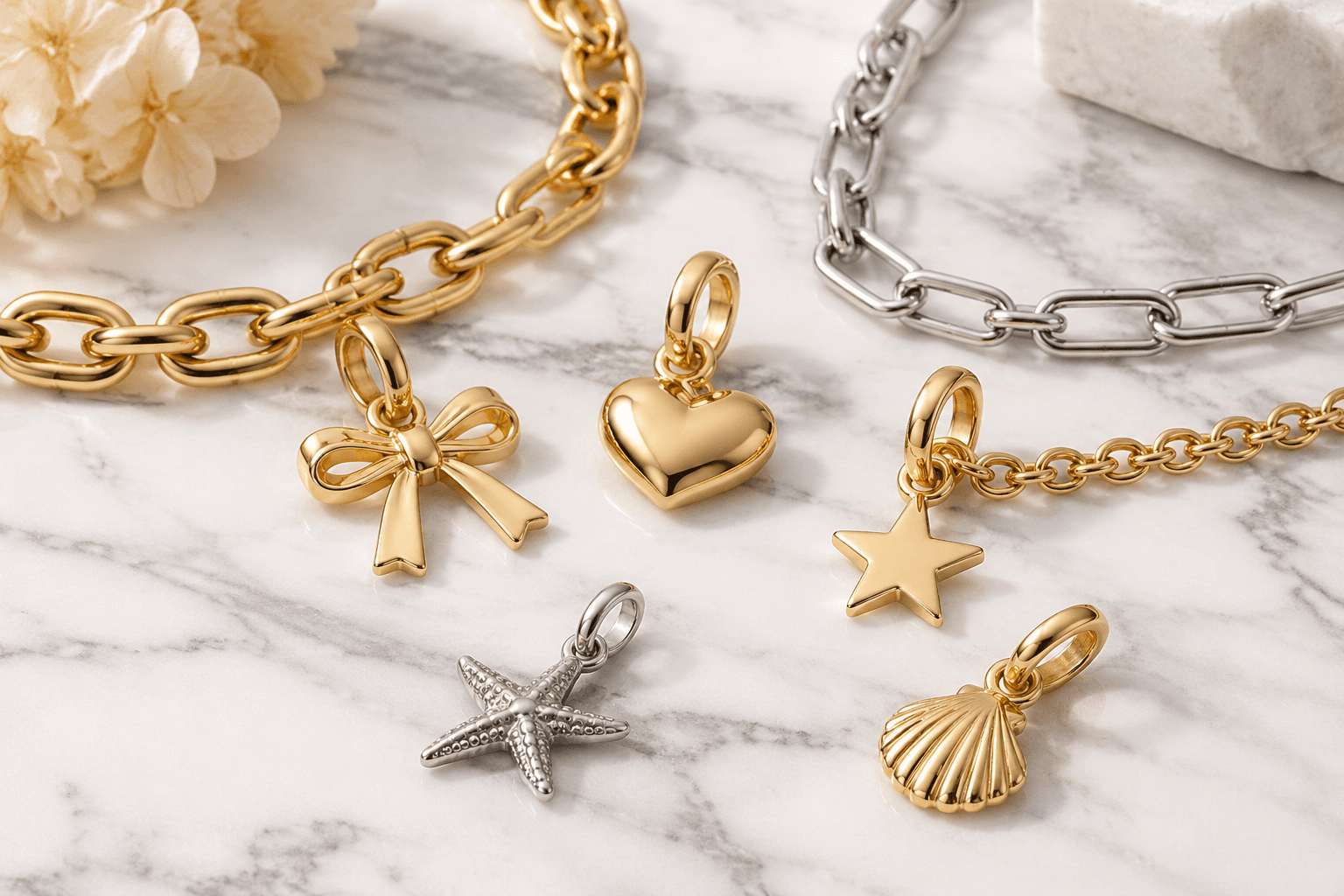
Choosing a supplier for stainless steel wholesale bag charms and keyrings requires more than comparing unit prices, reviewing product photographs, or checking delivery estimates. Procurement teams must establish whether a manufacturer can consistently deliver verified materials, durable finishes, reliable attachment hardware, documented compliance, and repeatable production quality across bulk orders. A sourcing decision that overlooks these factors can create costly quality disputes, customer complaints, shipment delays, and unnecessary inventory losses.
This checklist provides a structured framework for evaluating manufacturers and managing procurement risk. It covers material verification, dimensional accuracy, surface durability, attachment reliability, testing documentation, factory capabilities, production inspections, and long-term supplier performance. Use it during initial vendor screening, sample approval, factory audits, and ongoing supplier reviews.
Stainless Steel Wholesale Bag Charms Keyrings: The Essential Quality Checklist
Wholesale bag charms and keyrings combine decorative design with practical handling requirements. Unlike products intended only for occasional display, these accessories may experience repeated contact, friction, handling, environmental exposure, and movement during everyday use. Their quality therefore depends on the complete manufacturing system rather than appearance alone.
For procurement teams, the objective is to identify a stainless steel charms manufacturer capable of controlling every important production variable. A qualified supplier should demonstrate material traceability, documented finishing procedures, measurable inspection criteria, and a repeatable quality management process.
1. Verify the 316L Stainless Steel Base Material
Material identification is the first procurement checkpoint. The product specification must clearly identify 316L stainless steel as the base material and establish how the manufacturer verifies incoming material before production.
- Obtain a written material specification identifying 316L stainless steel.
- Request relevant material certificates or supplier documentation for incoming production material.
- Confirm that material verification is conducted at an appropriate frequency.
- Establish traceability between incoming material batches and finished production lots.
- Confirm that approved material specifications cannot be changed without written authorization.
For more rigorous verification, procurement teams should ask which analytical methods are available and whether material identification records can be linked to individual production batches. Portable X-ray fluorescence analysis can help identify alloy composition, while laboratory testing may be required for more specific compositional verification. The inspection method must be appropriate to the claim being verified.
Do not treat a supplier's general material statement as sufficient evidence. Request documentation that identifies the relevant material grade, test method, testing date, and applicable production batch.
2. Inspect Dimensional Accuracy and Structural Consistency
Bag charms and keyrings need accurate dimensions and mechanically reliable attachment points. Small dimensional variations can affect assembly, visual consistency, packaging, and customer experience.
- Define approved length, width, thickness, and weight tolerances.
- Measure attachment holes, loops, and jump ring dimensions.
- Check that connection points are properly formed and securely integrated.
- Inspect edges for burrs, sharp transitions, and unfinished areas.
- Compare production measurements against the approved reference sample.
- Establish acceptable variation limits for weight and decorative positioning.
Procurement teams should request a dimensional inspection report for each approved design. Critical dimensions should be identified on a technical drawing rather than left to subjective interpretation. This is particularly important when multiple designs share a common attachment system.
3. Evaluate PVD Plating and Surface Finish Durability
Surface finishing has a direct influence on product appearance and perceived quality. PVD gold plated, silver finish, and rose gold plating options should be evaluated against defined appearance and durability requirements.
- Confirm the approved finish and color reference for every SKU.
- Request information about surface preparation and finishing process controls.
- Review coating thickness specifications where applicable.
- Check color consistency across samples and production batches.
- Request documented abrasion and corrosion-related test results appropriate to the finish.
- Inspect for discoloration, uneven coverage, pinholes, scratches, and visible defects.
Buyers should distinguish between visual color approval and measurable finish performance. A product can match a reference color while still failing a durability requirement. Both criteria must be evaluated independently.
Request testing information that identifies the test method, specimen preparation, test conditions, duration, acceptance criteria, and results. Avoid accepting broad statements such as permanent color or scratch-proof without supporting evidence. No surface treatment should be assumed to provide unlimited resistance under every usage condition.
4. Assess Attachment Hardware and Mechanical Reliability
The attachment mechanism is a functional quality checkpoint, not merely a decorative detail. A visually attractive charm can still create customer complaints if its jump ring, bail, loop, or keyring connection is poorly formed.
- Inspect the complete attachment structure against the approved design.
- Verify that jump rings pass through actual holes or closed loops.
- Check that closed connection points have no visible gaps.
- Review opening and closing performance for applicable hardware.
- Conduct controlled mechanical retention testing.
- Record any deformation, loosening, or structural failure during testing.
Mechanical testing should reflect the intended application. A keyring intended for repeated handling may require different evaluation criteria from a small decorative bag charm. Establish a written test protocol covering load direction, applied force, duration, number of cycles, and acceptance limits.
Do not rely on informal hand-pulling as the only evidence of mechanical reliability. Where appropriate, use calibrated equipment and retain test records associated with the relevant product batch.
Why Quality Verification Matters for Wholesale Procurement
A documented quality program protects purchasing budgets, reduces avoidable returns, and makes supplier performance measurable. For international buyers, standardized specifications are particularly important because different markets, retail channels, and internal compliance teams may apply different documentation requirements.
Key Benefit 1: Stronger Material and Regulatory Compliance
Material verification and regulatory documentation help buyers establish whether a product meets the requirements applicable to its intended market and sales channel. Lancy Jewelry has SGS certification documentation covering RoHS, REACH, Nickel Release EN1811, and Salt Spray 240H.
These records provide useful reference points during supplier qualification. However, procurement teams should always verify the scope of each document, the tested product or specimen, the applicable standard or method, and the validity of the supporting report. A certification or test report should not automatically be interpreted as covering every SKU, finish, or future production batch.
For international distribution, create a market-specific compliance matrix. Record the applicable regulatory requirements, documentation owner, test evidence, review date, and any additional requirements imposed by the retailer or importer.
Key Benefit 2: Better Finish Consistency Across Bulk Orders
Consistent finishing helps maintain a unified presentation across a collection. This matters when boutique brands purchase multiple charm designs, reorder popular SKUs, or introduce coordinated seasonal programs.
Procurement teams should establish a master sample and retain approved color references. Each production batch should be compared against these references using consistent lighting, inspection conditions, and acceptance criteria. Where possible, maintain objective color measurements alongside visual approval.
Key Benefit 3: Lower Quality-Related Procurement Costs
The lowest quotation does not necessarily represent the lowest total purchasing cost. Defective products can generate additional inspection expenses, replacement shipments, administrative work, customer service costs, and inventory write-offs.
A supplier with controlled manufacturing processes and reliable sample development can help reduce these risks before a purchase order becomes a large production commitment. Calculate total procurement cost using unit pricing, freight, inspection, defect rates, rework exposure, and potential replacement costs.
Key Benefit 4: More Predictable Private-Label Programs
Private label charms require more than manufacturing the decorative component. Logo engraving, finish selection, enamel color filling, crystal inlay, and private-label packaging must all follow approved specifications.
A supplier capable of coordinating these processes can simplify vendor management and support a more consistent customer-facing collection. Procurement teams should confirm that packaging artwork, logo positioning, product identification, and final assembly are included in the approved production documentation.
Advanced Supplier Evaluation: A Step-by-Step Procurement Guide
Step 1: Conduct Initial Manufacturer Qualification
Begin by screening suppliers against their actual manufacturing capabilities rather than relying exclusively on catalog size or sales presentations. A qualified OEM charms manufacturer should be able to explain its production workflow and identify which operations are performed internally.
- Verify experience producing 316L stainless steel charms.
- Review CNC machining, laser cutting, laser marking, welding, and polishing capabilities.
- Confirm whether PVD plating, enamel filling, and crystal setting are controlled internally or through qualified partners.
- Request examples of technical drawings, production specifications, and inspection reports.
- Review sample lead times and production capacity.
- Identify the person responsible for quality assurance and corrective actions.
During a factory audit, pay particular attention to process segregation, equipment maintenance, material storage, inspection stations, and batch identification. Ask the supplier to demonstrate how a product moves from incoming material inspection to finished goods release.
Step 2: Establish a Technical Product Specification
Before requesting a final quotation, prepare a specification sheet for each product. This document should become the controlling reference for sample approval, production, inspection, and dispute resolution.
- Product dimensions, thickness, and target weight.
- 316L stainless steel material specification.
- Surface finish and approved color references.
- Decorative requirements, including enamel or crystal inlay where applicable.
- Logo engraving position, size, and legibility requirements.
- Attachment hardware specifications and mechanical acceptance criteria.
- Packaging requirements and product identification details.
- Applicable test requirements and inspection tolerances.
Use measurable acceptance criteria wherever possible. Terms such as excellent finish, strong connection, and consistent color are insufficient unless they are supported by clearly defined evaluation standards.
Step 3: Evaluate Samples Before Confirming Bulk Orders
Sample development is a critical risk-control stage. It gives buyers an opportunity to assess design feasibility, production precision, surface quality, and functional performance before committing to wholesale quantities.
- Request samples made using the specified production material and finish.
- Compare samples against technical drawings and approved visual references.
- Check dimensions, weight, surface smoothness, and edge quality.
- Test attachment mechanisms under the agreed protocol.
- Review logo engraving and decorative detail accuracy.
- Confirm packaging appearance and protection requirements.
- Sign off on the final sample before mass production.
Keep an approved reference sample under controlled storage. Both the buyer and supplier should maintain records identifying the approved version, approval date, finish, and revision number. Any subsequent design or process change should require documented authorization.
Step 4: Review Testing Standards and Durability Evidence
Testing should be selected according to product construction, finish, intended use, and applicable market requirements. A single test cannot establish every aspect of product durability.
Corrosion and Salt Spray Evaluation
Salt spray testing can provide comparative information about corrosion-related performance under specified laboratory conditions. Buyers should examine the test duration, specimen condition, exposure method, and evaluation criteria. Lancy Jewelry has SGS Salt Spray 240H certification documentation. Procurement teams should confirm the exact scope and applicability of the corresponding report before using it as acceptance evidence for a specific product.
Nickel Release Evaluation
For products intended for markets with nickel release requirements, request relevant testing against EN1811 where applicable. Check the tested surface, product configuration, specimen preparation, and reported results. The presence of a general test certificate does not eliminate the need to confirm whether the actual product configuration falls within its scope.
Surface Wear and Finish Evaluation
Use an appropriate abrasion or wear evaluation to assess changes in appearance following controlled friction. Establish the test equipment, load, cycle count, contact surface, and acceptable visual change before production approval.
Mechanical Durability Evaluation
Assess attachment security, deformation resistance, and functional movement using repeatable testing procedures. Document the acceptance threshold and retain results for comparison during future production runs.
Step 5: Implement Incoming, In-Process, and Final Inspection
Strong quality control operates at multiple production stages. Final inspection alone cannot reliably identify every source of manufacturing variation.
Incoming inspection: Verify material identity, incoming documentation, and the condition of supplied components before manufacturing begins.
In-process inspection: Monitor cutting accuracy, welding quality, polishing consistency, engraving, decorative filling, and finishing operations. Record process deviations and corrective actions.
Final inspection: Evaluate finished dimensions, appearance, attachment security, finish consistency, packaging, labeling, and order quantities.
Agree on an inspection sampling plan based on order size, product risk, and the buyer's quality requirements. Where appropriate, establish an AQL-based inspection framework and clearly define critical, major, and minor defects. Critical defects should receive zero-acceptance treatment where specified by the buyer's quality agreement. AQL sampling is a lot-acceptance tool, not a substitute for process control.
Step 6: Audit Documentation and Production Traceability
Documentation is essential for resolving quality disputes and maintaining control across repeat orders. A supplier should be able to connect approved specifications, material records, test reports, inspection results, and shipment information.
- Approved product drawings and revision history.
- Incoming material documentation and batch identification.
- Approved samples and finish references.
- Relevant SGS reports and compliance documentation.
- In-process inspection records.
- Final inspection reports and defect summaries.
- Corrective action records for nonconforming products.
- Packaging approval and shipment traceability.
Ask suppliers how long they retain records and how quickly they can retrieve documents associated with a specific production lot. Establish a clear escalation process for missing documentation, nonconforming goods, and unexpected specification changes.
Step 7: Evaluate MOQ, Capacity, and Long-Term Supply Stability
Commercial flexibility matters, particularly for boutique brands and growing private-label businesses. A manufacturer should explain its MOQ policy, sample charges, production lead times, repeat-order arrangements, and capacity allocation.
When evaluating low MOQ charm production, consider the relationship between order quantity, setup requirements, finishing complexity, and unit cost. A low MOQ is commercially useful only when the supplier can maintain the same approved specifications and inspection standards at smaller volumes.
Ask how the manufacturer handles seasonal demand, urgent replenishment, material availability, production bottlenecks, and changes in delivery schedules. Record agreed lead times and establish written notification requirements for any event that may affect shipment commitments.
Supplier Scorecard: How Procurement Teams Should Compare Manufacturers
A weighted scorecard makes supplier evaluation more objective and supports consistent purchasing decisions. The following framework can be adapted to the risk profile of each sourcing program.
| Evaluation Category | Suggested Weight | Evidence Required |
|---|---|---|
| Material verification | 20% | 316L specifications and traceability |
| Product construction | 15% | Dimensional and mechanical inspection |
| Finish durability | 20% | Finishing specifications and test records |
| Compliance documentation | 15% | Applicable SGS and regulatory reports |
| Manufacturing capability | 10% | Equipment, workflow, and production capacity |
| Quality management | 10% | Inspection and corrective action records |
| Commercial reliability | 10% | MOQ, lead times, communication, and delivery history |
Score each category using a consistent internal scale, such as 1 to 5. Multiply each score by its assigned weight to calculate the overall result. Set mandatory qualification gates for material verification, required compliance documentation, and critical mechanical performance. A high commercial score must never compensate for a failure in an essential safety or quality requirement.
Common Supplier Red Flags to Avoid
Procurement teams should investigate the following warning signs before approving a supplier:
- Unverifiable material claims: The manufacturer cannot provide relevant material specifications or batch records.
- Unclear certification scope: Test reports are presented without identifying the tested product, method, or applicable requirements.
- Uncontrolled finish changes: The supplier cannot explain how plating colors and surface quality are maintained across production batches.
- Weak mechanical evidence: Attachment reliability is supported only by verbal assurances rather than documented inspection or testing.
- Inconsistent sample approval: The supplier cannot maintain a controlled approved reference sample.
- Unclear outsourcing arrangements: Important production processes are assigned to external partners without adequate quality oversight.
- Unrealistic durability guarantees: The supplier promises unlimited wear resistance without defining test conditions, limitations, or supporting evidence.
- Poor corrective action practices: Repeated defects are addressed through replacement promises without documented root-cause analysis.
A professional manufacturer should welcome detailed procurement questions. Transparency about production limitations and test scope is a stronger indicator of supplier reliability than broad marketing claims.
Frequently Asked Questions About Wholesale Bag Charms and Keyrings
1. What should buyers check first when sourcing wholesale stainless steel bag charms and keyrings?
Start with 316L stainless steel material verification, followed by dimensional accuracy, attachment construction, surface finish, and relevant compliance documentation. Request a production sample and establish written acceptance criteria before approving bulk orders.
2. Which tests are important for evaluating stainless steel charms durability?
Relevant evaluations may include salt spray testing, nickel release testing against applicable requirements, controlled surface abrasion testing, dimensional inspection, and mechanical attachment testing. The exact test program should reflect product design, finish, intended use, and target-market requirements.
3. How can procurement teams verify PVD gold plated finish quality?
Request an approved color reference, documented finishing specifications, applicable coating measurements, and relevant wear or corrosion test results. Compare production samples under consistent inspection conditions and review the testing method, specimen preparation, and acceptance criteria.
4. Why is sample development important before placing a wholesale order?
Sample development allows buyers to verify dimensions, materials, decorative details, surface finish, attachment performance, and packaging before committing to production quantities. An approved reference sample also provides a controlled benchmark for subsequent inspections and repeat orders.
Partner With Lancy Jewelry for Reliable OEM/ODM Charm Manufacturing
Choosing a dependable manufacturing partner requires technical capability, transparent documentation, and disciplined quality control. Lancy Jewelry supports boutique jewelry brands, charm bar retailers, gift companies, distributors, and private-label buyers with OEM/ODM development focused exclusively on 316L stainless steel charms.
Our modern manufacturing facility integrates CNC processing, laser cutting, laser marking, welding, and polishing to support controlled product development. Available customization services include logo engraving, PVD plating, enamel color filling, crystal setting, and private-label packaging. We also provide sample development support to help buyers evaluate product specifications before moving into bulk production.
Our SGS certification documentation covers RoHS, REACH, Nickel Release EN1811, and Salt Spray 240H. Buyers can discuss the applicable documentation and its scope during supplier qualification and product development.
Whether you are building a coordinated boutique collection, expanding a charm bar assortment, or developing a private-label gift program, we recommend beginning with a clear RFQ and technical specification.
- Explore our manufacturing capabilities: OEM/ODM Custom Manufacturing Services.
- Review available product categories: Browse All Products.
- Discuss your sourcing requirements: Contact Lancy Jewelry.
Send your product drawings, target quantities, preferred finishes, logo requirements, packaging specifications, and required delivery schedule. Our team can review your project, discuss MOQ considerations, and provide a practical sample development and production proposal.
Make supplier quality a measurable procurement requirement. Partner with Lancy Jewelry to develop consistent, market-ready 316L stainless steel charms for your next wholesale program.