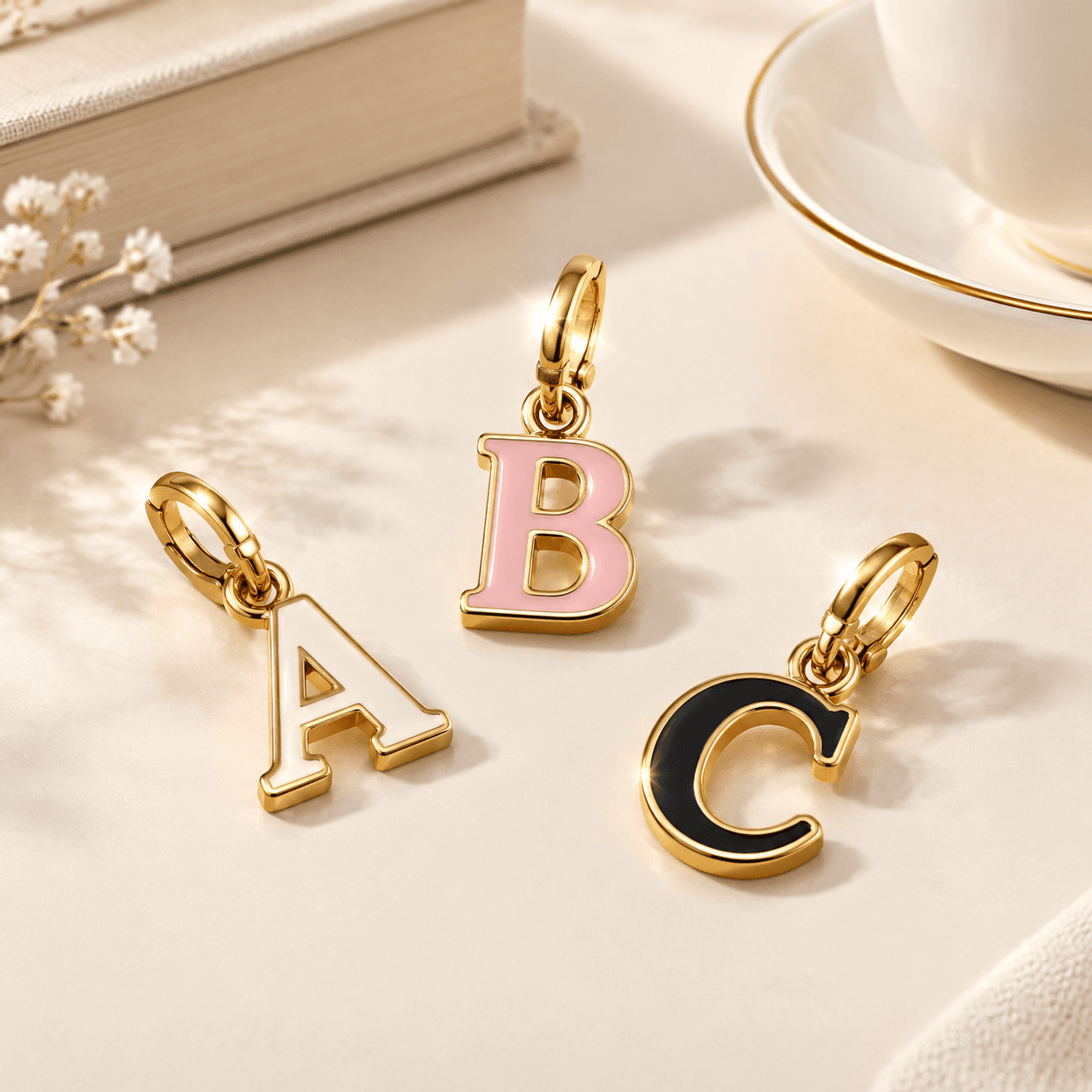
Choosing a supplier for stainless steel enamel letter charms wholesale requires more than reviewing attractive samples and comparing unit prices. Procurement teams must verify material traceability, inspect enamel adhesion, validate surface finishes, review laboratory documentation, and establish measurable acceptance criteria before authorizing bulk production. A small inconsistency in letter proportions, color filling, or attachment hardware can affect an entire retail assortment.
For North American boutique brands, charm bar retailers, gift companies, and private-label buyers, the objective is to secure repeatable quality across purchase orders while maintaining commercially viable lead times and minimum order quantities. This sourcing checklist provides a practical framework for supplier qualification, durability assessment, documentation review, and incoming quality control. Use it during initial vendor screening, sample approval, factory audits, and final shipment release.
Stainless Steel Enamel Letter Charms Wholesale: The Procurement Quality Checklist
Before requesting a quotation, establish a written specification for every letter design. The specification should define the 316L stainless steel base, dimensions, enamel colors, surface finish, attachment structure, marking requirements, and acceptable cosmetic limits. A supplier should be able to translate these requirements into a controlled production process rather than relying on informal visual judgment.
1. Verify the Supplier's Manufacturing Capability
- ☐ Confirm that the supplier manufactures 316L stainless steel charms as the base product rather than relying solely on outsourced finished goods.
- ☐ Review available production capabilities, including CNC machining, laser cutting, laser marking, welding, polishing, and enamel color filling where applicable.
- ☐ Ask who controls material purchasing, production scheduling, surface finishing, inspection, and final release.
- ☐ Establish whether the supplier can maintain approved specifications across repeat orders and different letter designs.
- ☐ Request evidence of a documented quality management process, including inspection records, nonconformance handling, and corrective actions.
- ☐ Verify production capacity against the forecast, required delivery window, and planned assortment size.
A qualified stainless steel charms manufacturer should explain how each critical characteristic is controlled, identify the responsible production stage, and provide objective evidence when requested. Factory photographs and sales presentations may support an initial assessment, but they do not replace process records or product testing.
2. Confirm Base Material Identity and Traceability
- ☐ Specify 316L stainless steel in the purchase specification, approved sample record, and purchase order.
- ☐ Request material certificates or supplier declarations that identify the grade and, where applicable, the relevant heat or batch reference.
- ☐ Confirm that incoming material records can be linked to production lots and finished-product batches.
- ☐ Ask whether composition verification is performed through a suitable analytical method when independent confirmation is required.
- ☐ Document the process for controlling material substitutions and prohibit unapproved changes in writing.
Material traceability matters because a polished appearance cannot establish grade identity. For higher-risk programs, procurement teams should consider independent verification using a suitable laboratory method. Portable X-ray fluorescence can help screen elemental composition, but it has limitations for certain elements and should not automatically be treated as definitive proof of every specification requirement. Agree on the appropriate verification method with a qualified laboratory.
3. Inspect Letter Geometry and Dimensional Consistency
- ☐ Define nominal height, width, thickness, hole diameter, and attachment-loop dimensions for each letter.
- ☐ Establish dimensional tolerances based on functional requirements and the approved sample.
- ☐ Inspect letter proportions, edge definition, symmetry, and readability at the intended retail viewing distance.
- ☐ Check that holes and loops are positioned correctly and allow the intended attachment mechanism to pass through securely.
- ☐ Verify that polishing does not round off essential details or create visibly inconsistent letter contours.
- ☐ Compare measurements across multiple samples rather than approving a single unusually good specimen.
Alphabet products often contain similar-looking letters with different structural requirements. Narrow openings, small internal spaces, and fine edges can be particularly sensitive to polishing and finishing. The inspection plan should therefore identify critical dimensions for each design rather than applying one generic visual standard to the entire assortment.
Why Quality and Durability Matter in Wholesale Programs
Consistent quality protects retail margins, reduces inspection labor, limits customer complaints, and supports repeat purchasing. For charm bar retailers, customers may select multiple initials in one transaction, making color consistency and visual uniformity especially important. For private-label buyers, inconsistent batches can also undermine packaging presentation and brand standards.
4. Evaluate Enamel Filling and Color Consistency
- ☐ Approve a physical reference sample for every enamel color and letter combination where the appearance differs materially.
- ☐ Record the color reference, finish, fill depth, and acceptable visual variation in the product specification.
- ☐ Inspect for visible gaps, pinholes, bubbles, contamination, uneven filling, overflow, and irregular boundaries.
- ☐ Check that enamel sits consistently within the intended design recesses and does not obscure the letter outline.
- ☐ Compare samples under standardized lighting to reduce disagreements caused by viewing conditions.
- ☐ Confirm that cleaning, polishing, and finishing procedures do not damage the filled areas.
Color approval should distinguish acceptable production variation from defects that change the product's appearance. A supplier can use an agreed physical master and documented visual criteria to reduce subjective decisions. Where precise color matching is commercially important, consider instrumental color measurement and define the measurement conditions before testing begins.
5. Test Enamel Adhesion and Surface Wear Resistance
Enamel durability must be evaluated through a defined test plan rather than an unsupported claim that the finish will last indefinitely. Select methods appropriate to the actual construction, intended use, and expected exposure. A test designed for a flat industrial coating may not translate directly to a small charm with recessed color filling and curved edges.
- ☐ Request documented adhesion testing appropriate to the enamel system and product geometry.
- ☐ Evaluate resistance to abrasion using an agreed method, load, cycle count, and inspection endpoint.
- ☐ Inspect for chipping, flaking, cracking, discoloration, and separation after the specified tests.
- ☐ Establish a controlled cleaning or chemical exposure test if the product's intended use warrants it.
- ☐ Test finished production samples, not only unrepresentative laboratory coupons.
- ☐ Record test conditions, sample identification, results, photographs, and pass-or-fail decisions.
For repeatability, specify the testing laboratory, applicable method or internal procedure, sample quantity, acceptance criteria, and retest policy. If a supplier uses a proprietary test, request the complete procedure and evidence that its severity is appropriate for the intended product. Passing a test demonstrates performance under those conditions; it does not establish universal resistance to every form of wear.
6. Verify Surface Finish and PVD Performance
Where the approved design includes PVD or a gold plated, silver finish, or rose gold plating appearance, finish specifications must be controlled separately from the base-material specification. Different finishes can have different visual characteristics and durability requirements.
- ☐ Define the approved color, gloss level, and acceptable variation for each finish.
- ☐ Inspect for uneven coloration, visible scratches, discoloration, surface pits, and exposed areas.
- ☐ Request coating-process documentation and any applicable adhesion or wear test results.
- ☐ Confirm whether the specified 240-hour salt spray test applies to the particular finished construction and what acceptance criteria govern the result.
- ☐ Review test evidence for the actual production finish instead of assuming one result covers every finish option.
- ☐ Record the approved appearance and finish requirements for future purchase orders.
Salt spray exposure can provide useful comparative information about corrosion behavior under a defined laboratory environment, but it does not directly predict an exact number of years in everyday use. A 240-hour result should be interpreted alongside the test method, sample preparation, coating system, exposure conditions, and observed defects. Procurement teams should avoid converting a laboratory duration into an unsupported consumer longevity guarantee.
7. Confirm Hardware Integrity and Functional Reliability
- ☐ Verify that each bail, jump ring, or attachment loop is fully formed and correctly positioned.
- ☐ Check that connectors pass through genuine holes or loops and are closed securely where applicable.
- ☐ Define an appropriate pull or functional test when the attachment is exposed to handling loads.
- ☐ Inspect for sharp edges, burrs, incomplete finishing, loose components, and visible structural defects.
- ☐ Confirm that hardware dimensions remain consistent across the approved product range.
- ☐ Require corrective action when a defect could cause detachment during ordinary intended use.
Functional inspection should reflect the actual application. A small decorative charm used in a retail jewelry program has different loading conditions from an accessory designed for frequent handling. Agree on realistic test loads and acceptance criteria rather than adopting an arbitrary universal force threshold.
Supplier Documentation, Certifications, and North American Compliance
Supplier qualification is incomplete without documentation that connects the product specification, test evidence, and production lot. North American buyers should review applicable US federal and state requirements and Canadian requirements according to the product's classification, intended use, distribution channels, and target consumers.
8. Review Third-Party Testing and Compliance Records
- ☐ Obtain current SGS documentation and verify the issuing organization, report number, date, sample identity, and stated scope.
- ☐ Review applicable RoHS and REACH documentation where required by the destination market, contractual requirements, or distribution program.
- ☐ Request Nickel Release EN1811 test evidence where relevant to the product's intended contact and applicable market requirements.
- ☐ Review the reported Salt Spray 240H result, including method, test conditions, acceptance criteria, and sample finish.
- ☐ Check whether the documentation covers the actual 316L stainless steel construction, enamel colors, surface finishes, and production configuration being purchased.
- ☐ Establish when retesting is required following changes in material source, process, finish, or product design.
Lancy Jewelry provides manufacturing support backed by SGS-certified testing and documentation covering RoHS, REACH, Nickel Release EN1811, and Salt Spray 240H. Buyers should still confirm the precise scope and applicability of individual records for each purchasing program. Certification or test documentation is not a blanket approval for every product, jurisdiction, or intended use.
9. Address US FDA and Canadian Regulatory Considerations
For US distribution, do not assume that ordinary decorative jewelry requires an FDA product approval simply because it is sold as a consumer accessory. FDA responsibilities depend on the product and its intended use; special requirements may apply if a product falls within a regulated category. Procurement teams should confirm product classification and applicable requirements rather than requesting an irrelevant approval certificate.
Separately, evaluate applicable consumer product safety obligations, restricted-substance requirements, labeling rules, and state-level requirements. If a product is marketed for children or otherwise falls within a specially regulated category, additional obligations may apply. For Canadian distribution, assess relevant federal and provincial requirements, including applicable consumer product and chemical restrictions. Obtain qualified regulatory advice whenever classification or applicability is uncertain.
- ☐ Prepare a destination-market compliance matrix before approving production.
- ☐ Identify the party responsible for testing, declarations, labeling, and record retention.
- ☐ Confirm that claims on packaging and product listings are supported by evidence.
- ☐ Maintain the final specifications, test reports, supplier declarations, and purchase-order records in one controlled file.
Advanced Quality Control: From Sample Development to Bulk Production
10. Establish a Controlled Sample Approval Process
Sample development should be treated as a formal engineering and purchasing milestone. A sample becomes an effective control only when the buyer and supplier agree on exactly what has been approved and how that approval will be used during production.
- ☐ Request representative samples covering critical letters, enamel colors, and surface finishes.
- ☐ Measure dimensions, inspect cosmetic quality, and evaluate the attachment mechanism.
- ☐ Record material identification, artwork revision, color references, and finish specifications.
- ☐ Mark the accepted reference sample with a revision identifier and approval date.
- ☐ Retain an approved sample under controlled conditions for future comparison.
- ☐ Require written approval before any change to material, artwork, process, or finish.
A sample should not be accepted solely because it looks attractive. The approval decision should document measurable requirements, test outcomes, outstanding deviations, and any limitations that production must observe.
11. Define Inspection Levels and Acceptance Criteria
For bulk charm orders, use a written inspection plan that identifies the sampling approach, defect classifications, and disposition rules. An agreed statistical sampling plan, such as one based on an appropriate ISO 2859-1 procedure, can help structure lot acceptance when suitable for the program. Specify the inspection level, lot definition, sample size, and acceptance numbers instead of citing a standard without defining how it will be applied.
- ☐ Classify safety-related and functional defects separately from major and minor cosmetic defects.
- ☐ Define acceptable limits for dimensions, color variation, surface defects, enamel filling, and attachment integrity.
- ☐ Conduct in-process checks at critical stages and final inspection before shipment release.
- ☐ Request lot-specific inspection records and traceability information.
- ☐ Establish reinspection, sorting, rework, replacement, and rejection procedures for nonconforming lots.
- ☐ Retain inspection evidence and document approval before shipment.
Sampling reduces inspection effort but does not guarantee that every unit is defect-free. For critical characteristics, consider additional controls, tighter sampling, or full inspection where commercially justified. The acceptance plan should reflect defect severity, order value, customer expectations, and the consequences of failure.
12. Agree on Warranty Terms and Corrective Actions
Longevity commitments should be tied to defined conditions and evidence. Avoid accepting vague promises that products will never fade, chip, or corrode. Instead, establish a commercially clear warranty that identifies the covered defects, claim period, proof requirements, exclusions, and remedy.
- ☐ Define the warranty period and the event that starts the coverage period.
- ☐ Identify covered manufacturing defects, including documented enamel separation, finish defects, or attachment failures under agreed conditions.
- ☐ Specify how samples, photographs, batch codes, and purchase records support a claim.
- ☐ Agree on response times, root-cause analysis, corrective action, and replacement or credit procedures.
- ☐ Require review of recurring defects and documented preventive measures.
Warranty terms should be commercially realistic and consistent with validated test results. Environmental exposure, abrasion, cleaning practices, and handling can affect product performance, so care instructions and limitations should be clearly defined where relevant.
13. Evaluate Commercial Readiness and Total Procurement Cost
Unit price alone is an incomplete measure of supplier value. Procurement teams should compare the full cost of producing, inspecting, packaging, transporting, and maintaining an assortment. A lower quotation can become more expensive if it produces inconsistent letters, repeated sample revisions, or high defect rates.
- ☐ Compare MOQ requirements by design, color, finish, and total order quantity.
- ☐ Confirm sample fees, development timelines, tooling charges where applicable, and production lead times.
- ☐ Review packaging specifications, labeling requirements, and private-label presentation options.
- ☐ Request a clear quotation covering unit prices, inspection, packaging, shipping assumptions, and other applicable charges.
- ☐ Confirm capacity for repeat orders and seasonal demand increases.
- ☐ Establish a communication and escalation process for schedule changes or quality incidents.
Buyers evaluating an ODM charm supplier should also review design-development support, while OEM programs should define the buyer-provided specifications and manufacturing responsibilities. In both models, the final purchase agreement should identify the approved product, documentation requirements, inspection rules, and commercial remedies.
Frequently Asked Questions
What documents should a wholesale enamel letter charm supplier provide?
Request a detailed product specification, 316L stainless steel material evidence, applicable test reports, finish and enamel references, sample approval records, batch traceability information, inspection results, and a written warranty. For North American distribution, also maintain a destination-specific compliance matrix and supporting declarations where applicable. Verify that documents match the actual product configuration and current production process.
Does SGS certification guarantee that every production batch will pass inspection?
No. SGS documentation supports evaluation within its stated scope, but a certificate or test report does not automatically guarantee every unit or future batch. Buyers should verify report applicability, establish lot-level inspection requirements, and review changes to materials, processes, and finishes. Final acceptance should follow the agreed purchase specification and inspection plan.
How can procurement teams evaluate enamel durability before placing bulk orders?
Approve representative production-intent samples, define adhesion and abrasion tests appropriate to the construction, and record the test conditions and acceptance criteria. Inspect for chipping, flaking, cracking, color changes, and other relevant defects after testing. Confirm results on the actual finished product and establish a documented process for handling failures before authorizing bulk production.
What should buyers verify when sourcing custom letter charms for US and Canadian markets?
Verify material identity, finish performance, attachment integrity, traceability, labeling responsibilities, and applicable consumer product and chemical requirements. Assess FDA applicability based on the product's classification and intended use instead of assuming that ordinary decorative jewelry requires FDA approval. Confirm any additional requirements for the specific distribution channel, consumer group, and destination.
Partner With Lancy Jewelry for Reliable Wholesale Production
Successful sourcing combines clear specifications, verifiable testing, controlled production, and practical commercial planning. Lancy Jewelry supports B2B buyers with 316L stainless steel charms, OEM and ODM development, logo engraving, PVD finishing, enamel color filling, crystal setting, sample development, and private-label packaging. Our manufacturing capabilities include CNC processing, laser cutting, laser marking, welding, and polishing, with low MOQ support available for qualifying projects.
Whether you are developing an alphabet assortment for a boutique retail program or planning repeat bulk orders for a charm bar, begin with a written brief covering dimensions, enamel colors, finish requirements, target quantity, packaging, and destination markets. Our team can help translate those requirements into a defined sample and production specification.
Explore the Lancy Jewelry product catalog to review available product directions, learn about our OEM manufacturing services, or submit your requirements through Request a Quote. Include your target MOQ, desired delivery date, test requirements, and artwork or reference specifications so the sourcing team can assess the project efficiently.
Choose a supplier on the strength of documented capability, measurable quality, and transparent accountability. A disciplined qualification process gives your business a stronger foundation for consistent product presentation, controlled purchasing costs, and dependable long-term supply.