Buying floating charm keychains in bulk requires more than confirming a competitive unit price and an attractive sample. Procurement teams must establish material traceability, verify chemical compliance, assess coating durability, review product safety documentation, and confirm that production controls can maintain consistent results across repeat orders. A missing test report or an unverified product change can create delays, rejected shipments, customer complaints, and avoidable costs.
For North American buyers sourcing private-label gift accessories, the most effective approach is to treat supplier qualification as a documented approval process rather than a one-time inspection. This advanced checklist explains how to evaluate RoHS and REACH evidence, interpret SGS testing, assess nickel release, understand US and Canadian regulatory considerations, and establish acceptance criteria before authorizing bulk production.
Stainless Steel Floating Charm Keychains in Bulk: The Compliance Checklist
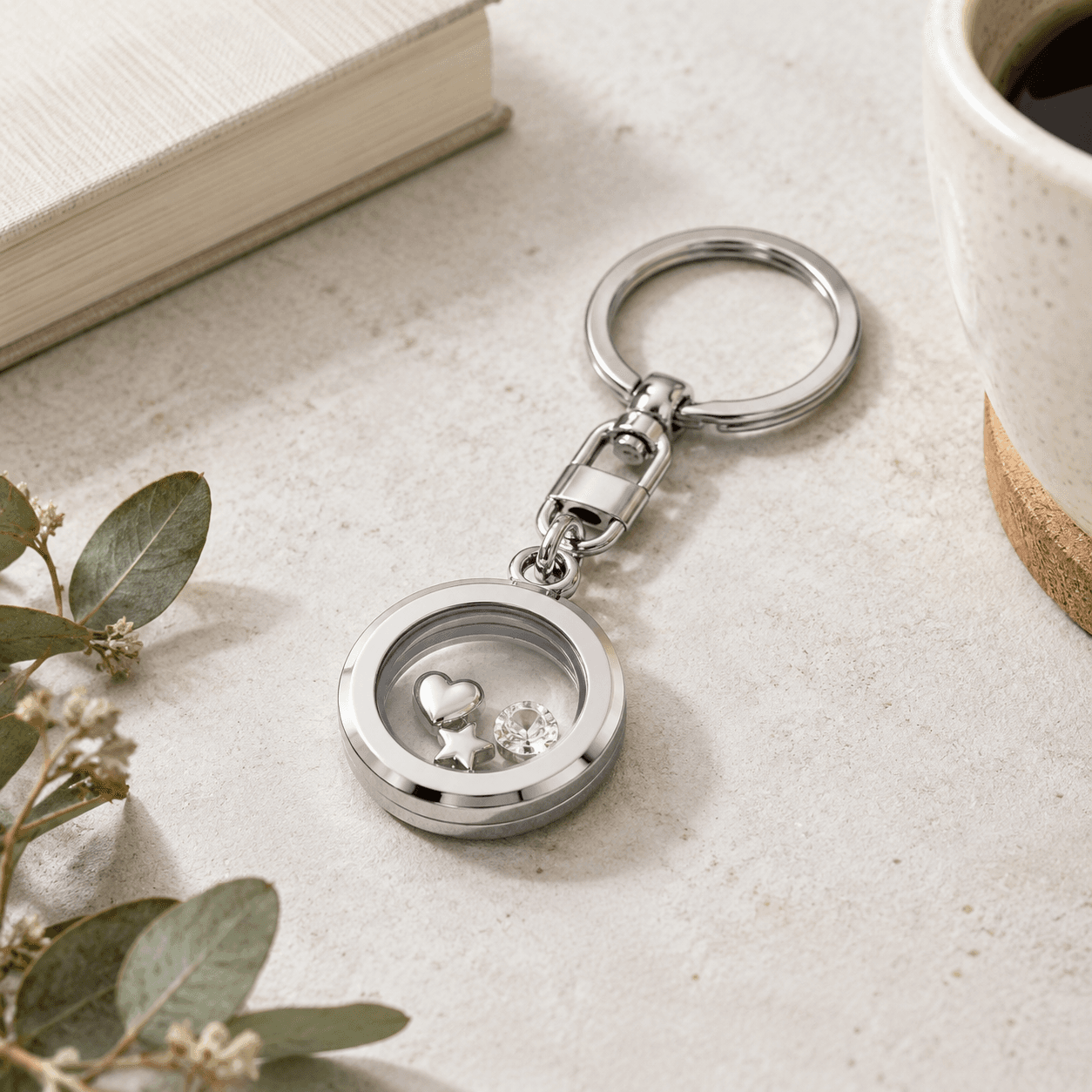
A floating charm keychain program may include a transparent viewing component, decorative elements, a key ring, connectors, and surface finishes. Each component creates a potential compliance or quality-control checkpoint. Begin by defining the exact product configuration, intended use, destination market, and applicable customer requirements. Do not approve a supplier based solely on a generic certificate or a report for a different product.
1. Verify the Supplier and Manufacturing Scope
Use this checklist before requesting final quotations or placing a production order.
- [ ] Confirm the legal supplier identity, manufacturing address, and the actual party responsible for production.
- [ ] Identify which processes are performed in-house, including CNC machining, laser cutting, laser marking, welding, polishing, assembly, and PVD application where applicable.
- [ ] Confirm that the decorative charm base and relevant metal components are specified as 316L stainless steel where required by the approved design.
- [ ] Request a component-level bill of materials identifying each material, finish, coating, adhesive if applicable, and supplied accessory.
- [ ] Establish whether any process is subcontracted and determine how subcontractor changes are approved.
- [ ] Review documented quality-control procedures for incoming materials, in-process checks, final inspection, and nonconforming product management.
- [ ] Confirm that the supplier can maintain the approved specifications across repeat bulk charm orders.
- [ ] Record the responsible contacts for quality assurance, regulatory documentation, production planning, and corrective actions.
A qualified stainless steel charms manufacturer should be able to connect the product specification to its production controls and supporting evidence. A sales statement about compliance is not a substitute for traceable documentation.
2. Confirm the 316L Stainless Steel Material Specification
Material verification is the foundation of the approval process. The designation 316L stainless steel identifies a particular stainless steel grade, but a product description alone does not establish that every supplied component meets the stated specification.
- [ ] Obtain a material specification identifying the required grade for the charm body and applicable metal hardware.
- [ ] Request available mill documentation, supplier declarations, or other traceable material records appropriate to the component and risk level.
- [ ] Define how material identity is verified at incoming inspection, including appropriate analytical testing when necessary.
- [ ] Check that the approved bill of materials covers the key ring, jump rings, connecting loops, and other metal parts rather than only the decorative face.
- [ ] Establish a change-control requirement for any material source, grade, manufacturing process, or component substitution.
- [ ] Ensure sample components and mass-production components follow the same approved material specification.
For high-volume orders, document the relationship between purchase-order requirements, incoming inspection records, production batches, and finished-goods lots. Where laboratory identification methods are used, confirm that the selected method can distinguish the required grade and is suitable for the material being evaluated. Do not treat a surface screening result as conclusive proof of every aspect of chemical composition.
3. Validate RoHS Documentation
RoHS is a restricted-substance framework associated primarily with electrical and electronic equipment. It should not automatically be treated as a universal legal requirement for every standalone decorative keychain. Its relevance depends on the product classification, intended use, customer specifications, and any applicable market rules.
- [ ] Ask why RoHS applies to the specific product or customer program.
- [ ] Obtain the applicable declaration, test report, or customer-required compliance record.
- [ ] Verify the product description, tested materials, report number, issue date, and laboratory identity.
- [ ] Confirm that the report covers the relevant homogeneous materials and restricted substances, rather than relying on a generic statement for an unrelated product.
- [ ] Check whether finishes, coatings, soldered connections if present, or other supplied components create additional testing needs.
- [ ] Record any exemptions, exclusions, or assumptions and obtain technical or legal review where the classification is uncertain.
For North American sourcing, do not assume that a RoHS report independently demonstrates compliance with all US state chemical laws, Canadian requirements, or consumer-product safety obligations. Maintain separate records for each applicable requirement.
4. Examine REACH Evidence and Chemical Restrictions
REACH is an EU chemicals framework, making it particularly relevant to buyers distributing products into European markets. North American procurement teams may also use REACH documentation as part of internal supplier qualification, but it does not replace US or Canadian legal assessments.
- [ ] Identify the product and component scope covered by the REACH declaration or laboratory report.
- [ ] Review the applicable restricted-substance requirements and the current Candidate List of substances of very high concern when relevant.
- [ ] Determine whether the product is an article and whether any applicable substance communication, restriction, or notification obligations may arise.
- [ ] Request supporting chemical test data where the risk assessment, customer specification, or legal requirement calls for it.
- [ ] Check whether the evidence addresses relevant coatings, decorative components, and supplied hardware.
- [ ] Confirm the report date and assess whether regulatory updates or material changes require renewed review.
- [ ] Maintain a record of the regulatory version and compliance criteria used at approval.
A REACH statement should identify its scope and limitations. Avoid accepting an unqualified claim that a product is REACH compliant without understanding which obligations, substances, components, and dates it addresses.
5. Authenticate SGS Reports and Laboratory Evidence
SGS is an independent testing, inspection, and certification organization. Buyers should distinguish between a test report, an inspection record, a certificate, and a supplier declaration because each serves a different purpose. The presence of an SGS name or logo does not establish that the submitted document covers the product being purchased.
- [ ] Request the complete report rather than a cropped certificate image or a marketing summary.
- [ ] Verify the report number and document authenticity through the issuing laboratory's available verification process.
- [ ] Match the applicant, manufacturer, sample description, model identifier, and material details to the actual supplier and product.
- [ ] Review the test methods, measured results, acceptance limits, conclusions, and any exclusions.
- [ ] Check whether the laboratory tested a finished product, a raw material, a coating sample, or only selected components.
- [ ] Confirm that the sample was representative of the intended production configuration.
- [ ] Determine whether the laboratory's accreditation and scope are appropriate for the specific test method when accreditation is required or specified.
- [ ] Record the report in the supplier approval file and define the conditions that would trigger retesting.
Lancy Jewelry supports supplier evaluation with SGS-related documentation covering RoHS, REACH, nickel release under EN 1811, and salt spray testing for 240 hours. Buyers should confirm the precise report scope, tested configuration, current validity, and relevance to the proposed order during the RFQ and approval process.
6. Evaluate Nickel Release, Not Just Nickel Content
Nickel content and nickel release are different measurements. A component may contain nickel while releasing it at a rate that depends on the material, surface condition, coating, wear, corrosion, and exposure conditions. For products intended for prolonged skin contact, nickel release may be an important safety consideration.
- [ ] Identify every component that may contact skin during reasonably foreseeable use, including the charm, connecting rings, and keychain elements if the product is marketed for wearable use.
- [ ] Determine whether the intended product category and destination market trigger specific nickel-release requirements.
- [ ] Request relevant nickel-release test evidence, including EN 1811 where appropriate to the product and applicable requirements.
- [ ] Check whether the tested sample included the actual surface finish and any coating used in production.
- [ ] Confirm the test method, conditioning or preparation procedure, results, units, and applicable acceptance criteria.
- [ ] Assess whether abrasion, corrosion, or coating wear could affect nickel release over the product's expected service life.
- [ ] Establish retesting criteria for changes to material sources, finishes, processing, or exposed contact surfaces.
EN 1811 is associated with determining nickel release from relevant articles intended for direct and prolonged skin contact. It is not a universal test requirement for every keychain. Product classification and foreseeable use must guide the assessment. If the item is marketed both as a keychain and as a wearable accessory, evaluate the wearable claims separately rather than assuming the keychain classification resolves the issue.
7. Assess PVD Plating and Corrosion Resistance
Surface performance influences both compliance risk and customer satisfaction. Gold plated and rose gold plating finishes, silver finish options, and decorative surface treatments must be evaluated against the approved specification. A finish description alone does not establish coating thickness, adhesion, color consistency, or long-term corrosion performance.
- [ ] Define the required finish, target color, surface preparation, and acceptable appearance range in the approved specification.
- [ ] Request relevant PVD process controls and finish inspection records for the proposed product.
- [ ] Review applicable salt spray results, including the reported 240-hour test where offered, and confirm the tested sample and evaluation criteria.
- [ ] Specify the acceptance limits for discoloration, corrosion, peeling, blistering, scratches, and other visible defects.
- [ ] Check whether the test conditions are appropriate for the product and whether the report documents the actual finish and base specification.
- [ ] Establish visual comparison standards using approved samples and documented lighting or inspection conditions.
- [ ] Confirm that any chemical testing relevant to the finished surface covers the production finish rather than an unfinished sample.
A 240-hour salt spray result is evidence of performance under a defined laboratory test, not a guarantee of a fixed service life or universal resistance to every real-world environment. Require the supplier to explain the test method and acceptance criteria. Combine laboratory evidence with incoming inspection, finish checks, and periodic production audits.
Why Compliance Verification Matters for North American Buyers
Reduce Regulatory and Commercial Exposure
For buyers selling into the United States and Canada, product compliance must be assessed against the applicable product category, intended use, distribution channel, and destination jurisdiction. A generic European compliance file may provide useful technical evidence, but it cannot replace a North American regulatory review.
In the United States, assess applicable requirements administered by the Consumer Product Safety Commission, including relevant consumer-product safety rules and children's product requirements when the intended audience, design, marketing, or use makes them applicable. The Federal Hazardous Substances Act and other federal or state requirements may also be relevant depending on product characteristics. Do not assume every adult-oriented keychain requires children's product testing, or that every keychain is automatically exempt from product safety obligations.
The Food and Drug Administration generally regulates products within its statutory scope, such as food, drugs, cosmetics, and medical devices. Ordinary decorative keychains are not typically FDA-regulated products simply because they are consumer goods. FDA requirements should be evaluated only if the product's intended use, claims, or associated components bring it within the agency's jurisdiction. Avoid requesting an FDA certificate for a conventional decorative keychain without a clear legal basis.
In Canada, assess applicable requirements under the Canada Consumer Product Safety Act and relevant regulations. If a product is intended for children or could fall under a specialized category, obtain a category-specific assessment. Provincial and other jurisdictional obligations may also affect chemical disclosures and sales requirements.
Protect Retail Readiness and Repeat-Order Consistency
- [ ] Maintain one controlled specification for each approved SKU and finish variation.
- [ ] Ensure the production sample, packaging sample, product description, and inspection criteria refer to the same configuration.
- [ ] Obtain traceable records that allow a production lot to be linked to its incoming materials and relevant testing.
- [ ] Establish written procedures for customer complaints, safety concerns, corrective action, and potential recalls.
- [ ] Verify that packaging and product claims do not overstate the scope of laboratory evidence.
- [ ] Retain records according to applicable legal obligations and the company's documented retention policy.
These controls help procurement teams prevent last-minute shipment holds and reduce the risk of approving a sample that does not represent the delivered goods.
Advanced Supplier Evaluation: From Sample Approval to Bulk Production
Step 1: Build a Compliance Matrix
Create a matrix for each target market, product configuration, and intended use. Separate mandatory legal requirements from customer specifications and voluntary quality criteria. Record the responsible reviewer, evidence required, test method, acceptance threshold, review date, and outstanding actions. This prevents a supplier from presenting one document as proof of compliance across unrelated requirements.
Step 2: Conduct Sample Development and Technical Review
Request a representative pre-production sample before approving a large order. Confirm dimensions, weight where relevant, attachment geometry, finish, decoration, and component configuration. For a floating charm keychain, inspect the viewing assembly and attachment hardware for secure construction, correct clearances, and mechanically plausible connections.
- [ ] Compare the sample with the approved drawing and bill of materials.
- [ ] Verify that every connector passes through a genuine hole or loop and remains securely closed where required.
- [ ] Inspect edges, burrs, sharp points, moving parts, and accessible small components.
- [ ] Confirm that any transparent or decorative nonmetallic components are separately specified and evaluated where applicable.
- [ ] Review chemical, coating, and nickel-release evidence for the actual production configuration as required.
- [ ] Record approval with dated photographs, revision identifiers, and signed-off acceptance criteria.
Sample approval must not replace final compliance review. If production uses a different finish, supplier, component specification, or process, determine whether renewed testing and approval are necessary.
Step 3: Define Inspection and Acceptance Criteria
Translate supplier promises into measurable purchasing requirements. An inspection plan should define the sample size, inspection level, defect classifications, acceptance numbers, measurement methods, and actions for failed lots. Where statistical sampling is used, select an appropriate plan and documented acceptance quality limit rather than treating an AQL value as a guarantee that a batch contains no defects.
- [ ] Establish critical, major, and minor defect definitions relevant to the product's safety and function.
- [ ] Set tolerances for dimensions, finish appearance, assembly, and attachment strength where applicable.
- [ ] Define the inspection and escalation process for safety-critical or regulatory nonconformities.
- [ ] Require corrective-action documentation, root-cause analysis, and verification of corrective measures.
- [ ] State whether third-party pre-shipment inspection is required and identify the inspection scope in the purchase order.
Step 4: Audit Change Control and Traceability
Supplier compliance is an ongoing obligation. A previously accepted report may no longer represent the product after a manufacturing change. Require prior written notification and approval for changes to the base specification, material source, coating formulation, plating process, decorative component, assembly method, or subcontractor.
- [ ] Assign revision numbers to drawings, specifications, bills of materials, and packaging artwork.
- [ ] Require batch or lot identification on production and inspection records.
- [ ] Maintain a register of test reports, declarations, sample approvals, and renewal dates where relevant.
- [ ] Define when a change requires document review, risk reassessment, retesting, or a new pre-production sample.
- [ ] Review supplier performance periodically using defect rates, on-time delivery, corrective-action closure, and document completeness.
Step 5: Align Commercial Terms With Compliance Controls
Low MOQ support can help buyers test demand, but small initial orders still require clear specifications and proportionate verification. For repeat programs, define which approvals remain valid across replenishment orders and which changes trigger a new review.
- [ ] Include the approved material, finish, components, packaging, and required documents in the purchase order.
- [ ] Set deadlines for pre-production approval, testing, inspection, and document submission.
- [ ] Agree on procedures for nonconforming goods, rework, replacement, and shipment release.
- [ ] Confirm that private-label packaging claims and market-specific labeling requirements are reviewed before printing.
- [ ] Specify that unapproved substitutions are prohibited and that required corrective actions must be completed before release.
For buyers developing a long-term program, review Lancy Jewelry's OEM manufacturing services to discuss custom specifications, logo engraving, finish options, and private-label requirements. For broader product planning, browse the product catalog to identify suitable charm configurations.
RFQ Documentation Checklist for Procurement Teams
Use the following list when preparing an RFQ for wholesale stainless steel charms or floating charm keychain programs. Submitting these requirements together makes quotations easier to compare and helps suppliers identify compliance gaps before sampling.
- [ ] Product drawing, dimensions, intended use, and approved visual reference.
- [ ] Component-level bill of materials with the specified 316L stainless steel base components.
- [ ] Required finishes, including PVD, gold plated, rose gold plating, or silver finish where selected.
- [ ] Decoration requirements, logo engraving, and applicable packaging specifications.
- [ ] Target market and intended consumer age group, including any children's product classification.
- [ ] Applicable RoHS and REACH documentation requirements and the reason each applies.
- [ ] Nickel-release requirements and EN 1811 evidence where applicable.
- [ ] SGS reports or other laboratory evidence required for the approved product configuration.
- [ ] Salt spray testing requirements, method, duration, and pass/fail criteria.
- [ ] Required sample quantity, sample-development timeline, MOQ, and target bulk quantity.
- [ ] Pre-production approval, inspection plan, traceability expectations, and change-control process.
- [ ] Packaging, labeling, country-of-origin marking, and market-specific documentation responsibilities.
When comparing suppliers, evaluate the completeness and relevance of evidence alongside price, lead time, communication, and production capacity. The lowest quotation is not the lowest total cost if it leaves compliance responsibilities unresolved.
Frequently Asked Questions
1. Are RoHS and REACH reports mandatory for every floating charm keychain?
No. Applicability depends on the product classification, destination market, intended use, and customer requirements. REACH is particularly relevant to products supplied into the EU, while RoHS primarily addresses electrical and electronic equipment. North American buyers should assess the applicable US and Canadian requirements independently and request supporting documentation that matches the actual product.
2. Does an SGS report guarantee that a supplier's bulk production is compliant?
No. A report provides evidence for the tested sample, materials, methods, and stated scope. Procurement teams must verify authenticity, confirm that the report covers the approved configuration, and maintain change control and production traceability. Material, finish, or process changes may require additional assessment or testing.
3. Is EN 1811 nickel-release testing necessary for a keychain?
Not automatically. The need depends on intended use, foreseeable skin contact, product classification, and applicable legal or customer requirements. If the product is also marketed for prolonged skin contact, evaluate the relevant requirements for that use and confirm that the tested finish and components match production.
4. What should buyers verify before placing a bulk order with Lancy Jewelry?
Confirm the approved 316L stainless steel specification, component-level bill of materials, finish requirements, relevant SGS documentation, sample approval, inspection criteria, traceability, and change-control process. Include the required documents and acceptance criteria in the RFQ and purchase order. Buyers can submit project requirements through the Lancy Jewelry contact page or use the request-a-quote route to discuss quantities, specifications, and documentation needs.
Partner With Lancy Jewelry for Compliance-Ready Sourcing
Reliable bulk sourcing begins with a supplier that understands the relationship between product development, material control, testing, and production consistency. Lancy Jewelry is a B2B OEM/ODM 316L stainless steel charms manufacturer supporting boutique jewelry brands, charm bar retailers, gift companies, distributors, and private-label buyers.
Our modern manufacturing facility uses CNC machining, laser cutting, laser marking, welding, and polishing to support custom product development. Available services include logo engraving, PVD plating, enamel color filling, crystal setting, sample support, and private-label packaging. We also support low MOQ programs and coordinated series planning for buyers building a consistent product assortment.
Our SGS-related documentation covers RoHS, REACH, nickel release under EN 1811, and salt spray testing for 240 hours. The applicable reports and requirements should be reviewed against each proposed product and target market before production approval. No single certificate replaces a complete product-specific compliance assessment.
Prepare your drawings, quantities, target finishes, destination markets, and documentation requirements before submitting an RFQ. Our team can help evaluate the specification, identify evidence needed for review, and plan sample development before bulk production.
Ready to evaluate your next program? Contact Lancy Jewelry to discuss your sourcing requirements and establish a clear path from sample approval to controlled bulk production.