In the world of boutique charm programs, material choice drives durability, finish, and brand credibility. This technical deep dive focuses on 316L stainless steel charms and how they compare to 304 stainless steel charms from a materials science perspective. The goal is to equip jewelry designers, sourcing managers, and private-label buyers with actionable knowledge about alloy chemistry, corrosion resistance, plating compatibility, and manufacturing implications—especially for OEM/ODM projects where consistent quality and supplier transparency are critical.
316L vs 304 Stainless Steel Charms
Chemical composition differences
316L stainless steel is an austenitic alloy primarily comprising iron with chromium (Cr) around 16–18% and nickel (Ni) around 10–14%, augmented by a small but essential amount of molybdenum (Mo) around 2–3%. The presence of molybdenum significantly enhances resistance to chlorides and pitting, which is particularly relevant for gift items that may be exposed to sweat, humidity, or salt air during shipping and wear. The 316L designation also denotes a low carbon content (the L stands for low carbon), which improves weldability and reduces carbide precipitation during heat treatment, aiding better corrosion resistance at welded joints. This combination—Cr/Ni/mo with low carbon—helps maintain a stable passive film that protects the underlying metal during repeated handling and plating processes.
By contrast, 304 stainless steel is the more common austenitic grade, with Cr typically around 18–20% and Ni around 8–10.5%. It lacks the molybdenum content that anchors 316L in chloride-rich environments. While 304 offers excellent formability, good corrosion resistance, and lower cost, its performance can degrade more quickly in salt spray, seawater exposure, or environments with chemical stressors that challenge passivation layers. For charm programs—where products may encounter skin oils, sweat, or outdoor gifting—304 can be more prone to pitting and surface degradation over time relative to 316L.
In practical terms for charm designers, the Mo-bearing chemistry of 316L translates into better long-term resilience against chloride-induced corrosion and less risk of surface roughening at the microstructure level. This is especially important when you plan to apply specialty finishes such as PVD plating or enamel, where a stable substrate supports uniform plating and color retention. The low carbon content of 316L further reduces sensitization risk during welding or laser processing, which aligns with high-precision manufacturing workflows used in OEM/ODM programs.
Corrosion resistance and passive film stability
316L’s molybdenum improves resistance to chlorine ion attack and hot salt environments. This reduces the likelihood of localized corrosion and improves the stability of the chromium oxide passive layer that forms on stainless steel surfaces. For charm finishes—PVD plating, enamel, and crystal inlay—the integrity of the base metal’s passivation layer is a prerequisite for achieving consistent surface appearance through production runs and private-label packaging programs.
304, while robust for many consumer goods, does not enjoy the same chloride resistance. In giftware and jewelry contexts, that difference translates to marginally higher maintenance demands, potential color changes after repeated wear, and greater sensitivity to cleaning regimes used in consumer workshops. For design teams iterating color stories (e.g., enamel fills or multi-layer crystals), the predictability of 316L helps ensure that enamels and crystals bond uniformly over the charm surface and that plating remains even across lots.
Weldability, formability, and machining considerations
316L generally offers superior weldability and machinability compared with 304, particularly in specialty processes such as laser marking, micro-welding for jump rings, and intricate engraving. For OEM/ODM charm development, this means fewer reworks, tighter tolerances, and higher fixture reliability when tools contact the charm surface during polishing, engraving, or logo customization. The low-carbon profile of 316L also reduces risk of carbide precipitation around heat-affected zones, minimizing post-processing issues that can affect the final finish after PVD or enamel application.
PVD plating, enamel, and crystal inlay compatibility
PVD plating adheres well to 316L substrates. The stable base minimizes diffusion and changes in color over time, delivering consistent gold, rose gold, or silver finishes that boutique brands rely on for repeat order cycles. Enamel fills respond predictably to 316L’s surface chemistry, with uniform color penetration and stable adhesion across multiple enamel colors. Crystal inlay and setting processes benefit from the substrate’s mechanical strength and corrosion resistance, which reduce the risk of micro-damage during setting and subsequent wear.
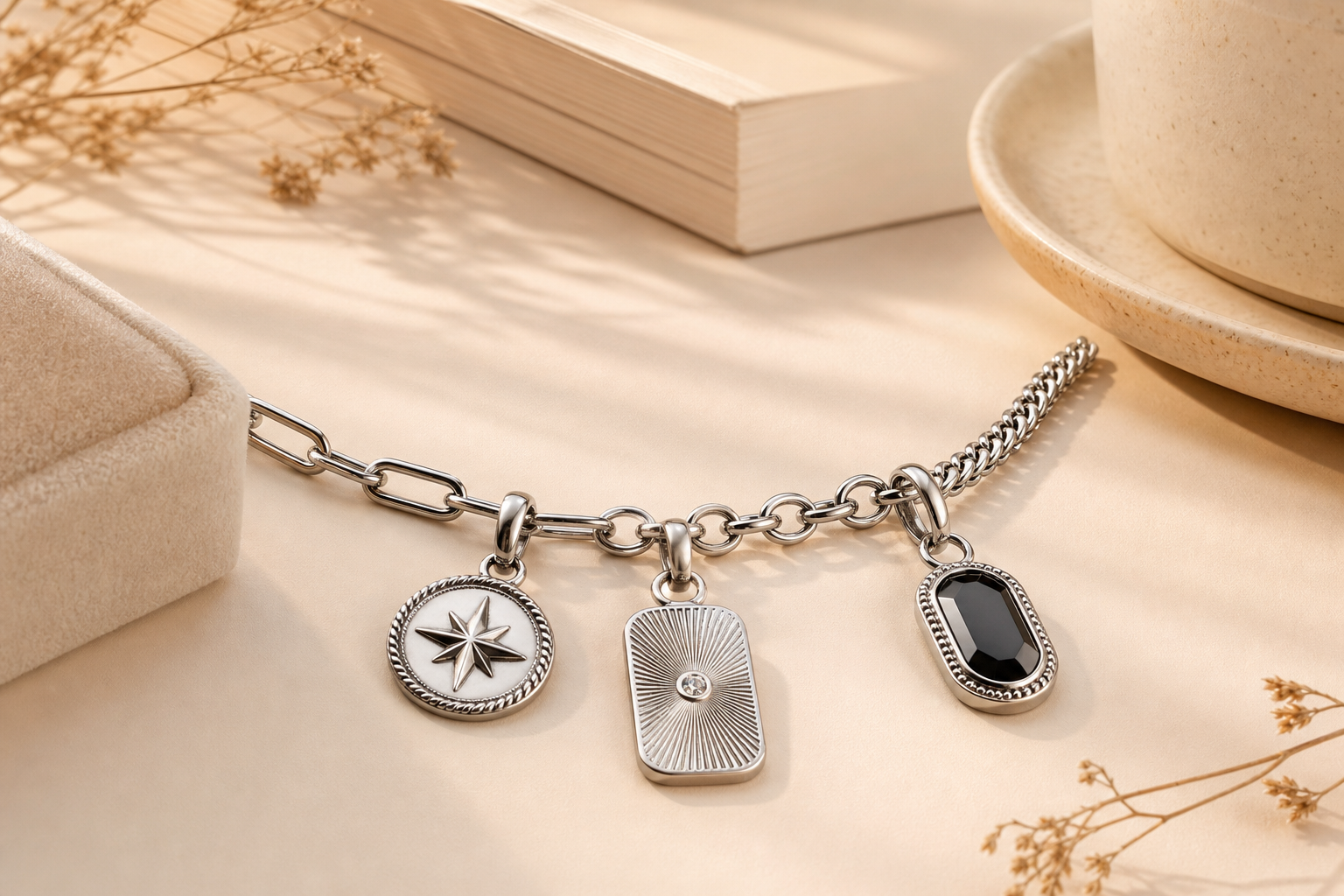
When evaluating material options for a private-label program, consider that 316L-based charms from Lancy Jewelry can be offered with PVD plating, enamel fills, and crystal inlays in a way that maintains consistency across sample development and bulk charm orders. This is particularly important for private-label buyers seeking low MOQ charm production without sacrificing finish uniformity.
Manufacturing and QA implications for OEM/ODM projects
From a factory-direct perspective, the alloy choice informs several downstream processes: tolerances in laser marking, compatibility with logo engraving, surface preparation for plating, and passivation quality after finishing. 316L’s composition supports tight tolerances and repeatable plating outcomes across lots, which helps maintain color consistency in enamel fills and uniform crystal setting. SGS-certified processes (RoHS, REACH, Nickel Release EN1811, Salt Spray 240H) further validate the material behavior under standard global compliance checks—an important factor for crossing US, EU, UK, and other markets with high regulatory expectations.
For designers and sourcing managers evaluating options, 316L is a proven substrate in 316L stainless steel charms manufacturing that aligns with consistent plating quality, low MOQ options, and reliable sample development timelines—key factors when negotiating private-label agreements or bulk charm orders with a manufacturer/supplier partner like Lancy.
Benefits: Why the material choice matters
Key benefits for designers and brands
- Enhanced corrosion resistance in chloride environments thanks to molybdenum, supporting longer wear life for charm programs.
- Lower carbon content improves weldability and reduces heat-affected zone issues during laser engraving, CNC, and other finishing processes.
- More predictable plating outcomes (PVD, rose gold, gold, silver finishes) across large production runs, aiding color consistency in private-label packaging.
- Stronger substrate for enamel fills and crystal inlays, promoting uniform color and secure setting in OEM/ODM projects.
- Better suitability for regulated markets with SGS certifications and strict nickel-release testing, reducing compliance risk for global distribution.
From a business perspective, partnering with a 316L stainless steel charms manufacturer that offers OEM/ODM capabilities, low MOQ charm production, and sample development support helps brands scale private-label operations while maintaining quality and cost control. Lancy Jewelry emphasizes a factory-direct model, enabling consistent plating quality and private-label packaging options across collections, which aligns with wholesale stainless steel charms and private-label buyer strategies.
Detailed analysis and practical guidance for designers
Step-by-step guide to selecting 316L for charm programs
Step 1: Define use-case and environment
Assess where the charm will live—from gift programs to charm bar displays and consumer wear. Environments with humidity or salt exposure, such as coastal markets or seasonal gift sets, benefit from the corrosion-resistant properties of 316L. For enamel or crystal-inlaid charms, 316L’s stable substrate reduces finish variability over multiple production cycles.
Step 2: Plan finishes and processing
Choose finishes (PVD plated, silver finish, rose gold plating) with awareness of substrate compatibility. 316L supports a broad range of PVD processes, delivering consistent color and adhesion. Plan enamel color filling and crystal inlay sequences to leverage the substrate’s uniform microstructure for tighter tolerances and fewer post-processing defects.
Step 3: Align with manufacturing capabilities
Coordinate with a partner offering CNC, laser cutting, laser marking, welding, and polishing—core competencies for high-precision 316L charm production. A dedicated OEM/ODM partner can align logo engraving, sample development cycles, and private-label packaging to product roadmaps and calendar milestones.
Step 4: Verify compliance and quality assurance
Ensure SGS-certified RoHS/REACH compliance and Nickel Release EN1811 testing, plus Salt Spray 240H for surface durability. These certifications provide confidence for global buyers and reduce risk in cross-border shipments and private-label programs.
Step 5: Plan for scale and value-added services
Discuss low MOQ charm production, scalable sample development timelines, and the availability of bulk charm orders. Consider a partner that can support custom logo charms, private-label packaging, and efficient supply for ongoing catalogs and seasonal drops.
Practical design considerations for 316L charms
- Logo engraving: ensure agency-ready file formats and material compatibility with laser engraving on 316L surfaces.
- Finish durability: plan PVD color sequences with an eye toward potential wear patterns and re-plating cycles.
- Attachment and usability: design bail and jump rings with realistic threading and closure to ensure mechanical plausibility during product photos and real-world use.
- Quality control: institute sample-to-bulk pass criteria that align with RoHS and EN1811 tests to maintain brand standards across collections.
For brands seeking reliable supply and design support, Lancy Jewelry provides a comprehensive path—from raw workmanship to finished product—via private-label options, OEM/ODM capabilities, and robust QA processes. All production aligns with global market expectations, enabling designers to pursue cross-market opportunities with ease.
FAQ
Q1: What is the main alloy difference between 316L and 304 stainless steel charms?
A: The key difference is the presence of molybdenum in 316L (about 2–3%), which enhances corrosion resistance in chloride environments, whereas 304 lacks molybdenum. 316L also has a lower carbon content to improve weldability and reduce carbide precipitation, making it a more robust substrate for plating, enamel, and crystal inlay in charm applications.
Q2: Is 316L safer for long-term wear and multi-use gift programs?
A: Yes. The combination of corrosion resistance and passivation stability in 316L supports durable finishes and stable surface integrity over time. SGS-certified processes further verify compliance for nickel release, RoHS, and other global standards, making 316L a dependable choice for private-label and OEM programs that require consistent quality across lots.
Q3: Can 316L hold enamel, crystals, and apply PVD finishes consistently?
A: Absolutely. 316L’s surface chemistry and mechanical properties provide a reliable platform for enamel filling, crystal inlays, and PVD plating. The result is uniform color, adhesion, and wear performance that designers expect for boutique catalogs and high-volume private-label lines.
Q4: How does the choice between 316L and 304 affect pricing and lead times for OEM/ODM projects?
A: While 316L tends to have a higher raw material cost than 304, the broader process compatibility, lower defect rates in finishing, and stronger long-term performance can reduce total cost of ownership in private-label programs. Working with a partner that supports sample development, low MOQ production, and scalable bulk orders helps optimize both pricing and lead times for OEM/ODM projects.
Call to action: Partner with Lancy Jewelry
Ready to translate material science into market-ready charm lines? Lancy Jewelry serves as a dedicated 316L stainless steel charms manufacturer with robust OEM/ODM capabilities, low MOQ support, and a track record of consistent plating quality and private-label packaging. Explore our OEM service to tailor a program around your brand identity, and use our Request a Quote workflow to start sample development or place bulk charm orders. For design collaboration and technical inquiries, contact our team to discuss your next collection and cross-market expansion.
Related resources