Seasonal charm programs create a concentrated procurement challenge: buyers must approve product quality, validate supplier documentation, and secure repeatable production before a fixed holiday selling window. A visually attractive sample is not sufficient evidence of production readiness. For wholesale stainless steel enamel Christmas charms, procurement teams need a documented evaluation process that connects material verification, enamel adhesion, coating durability, mechanical integrity, regulatory screening, and batch consistency.
This checklist is designed for sourcing managers, quality engineers, and private-label buyers serving the US and Canadian markets. Use it to assess suppliers, establish acceptance criteria, and prevent avoidable defects from reaching retail inventory. The objective is straightforward: approve only suppliers that can demonstrate that their 316L stainless steel charms meet agreed specifications and can reproduce those specifications throughout the bulk order.
Stainless Steel Enamel Christmas Charms Wholesale: Supplier Quality Checklist
Before comparing quotations, create a written product specification and require each prospective supplier to respond against the same criteria. This makes supplier evaluation more objective and reduces the risk of selecting a quotation that excludes essential testing, packaging controls, or quality responsibilities.
1. Verify the Manufacturer's Identity and Production Capability
- Confirm the supplier's legal business identity, production address, and responsibility for manufacturing, finishing, inspection, and packing.
- Request a documented process flow covering CNC machining where applicable, laser cutting, laser marking, welding, polishing, enamel filling, plating when specified, final inspection, and packaging.
- Establish which operations are performed in-house and which are outsourced. Require subcontractor disclosure for any process affecting product conformity.
- Review production capacity, seasonal scheduling, quality staffing, equipment maintenance, and contingency plans for holiday demand peaks.
- Ask for recent, relevant quality records with confidential customer information removed, including inspection reports, nonconformity records, and corrective-action examples.
A credible stainless steel charms manufacturer should explain not only how a charm is made, but also how process changes are controlled. If a supplier cannot identify who approves material substitutions, enamel color changes, or finishing adjustments, its quality system may be inadequate for repeat wholesale purchasing.
2. Confirm the Base Material and Traceability
- Specify 316L stainless steel as the only permitted base material for the charm body.
- Require a material declaration identifying the grade and, where available, a heat or lot reference linked to the supplied material documentation.
- Review the material test report or independent verification evidence appropriate to the risk and purchase volume.
- Confirm that the approved material specification applies to production goods, not merely to the preproduction sample.
- Require written authorization before any material source, grade, or manufacturing-process change.
Material traceability is essential when a complaint arises months after delivery. Procurement teams should be able to connect a finished-goods lot to its material records, production date, inspection results, and shipment documentation. A general statement that a product is stainless steel does not replace grade-specific evidence.
3. Approve Enamel Appearance and Application Quality
- Approve a signed or otherwise controlled reference sample showing the final motif, color placement, finish, and dimensions.
- Define acceptable color variation using agreed visual standards and, where practical, instrument-based color measurements.
- Inspect enamel coverage, edge definition, surface leveling, pinholes, bubbles, contamination, cracks, and visible gaps.
- Verify that enamel boundaries remain within the approved design and that adjacent decorative areas are cleanly separated.
- Establish rejection criteria for chips, peeling, exposed substrate in designated filled areas, and inconsistent color across a matched series.
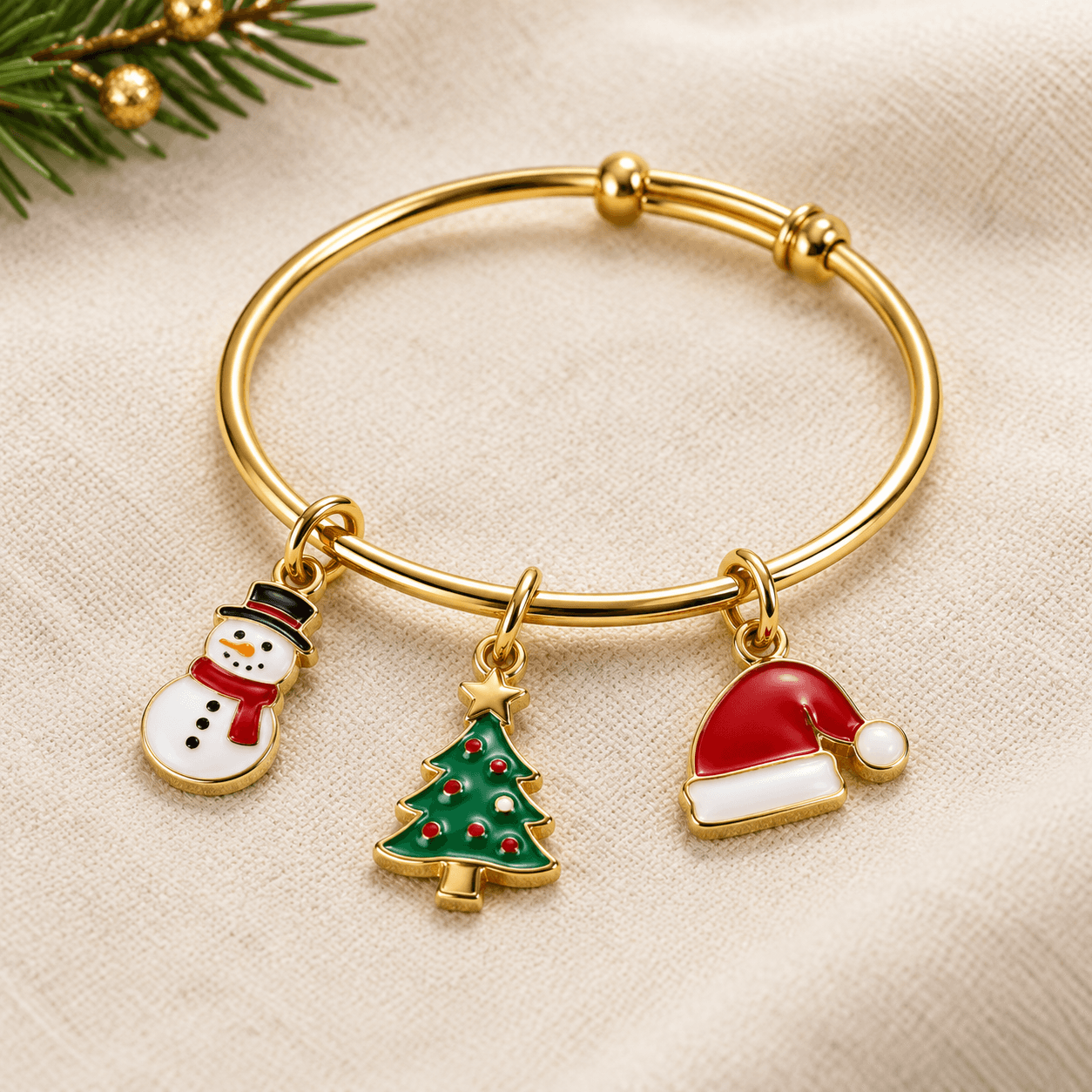
Christmas motifs often rely on small, contrasting color zones. Minor variation may therefore be highly visible when multiple charms are displayed together. The acceptance standard should distinguish permissible cosmetic variation from defects that affect design clarity, coating integrity, or customer perception.
4. Verify Decorative Finish and Hardware Integrity
- Identify the specified finish for every SKU, including silver finish, gold plated appearance, rose gold plating, or other approved PVD finish where applicable.
- Record approved color references, surface sheen, polishing level, and any protected areas that must remain free of finish buildup.
- Inspect edges, drilled holes, loops, and attachment points for burrs, deformation, sharp projections, or incomplete finishing.
- Confirm that each bail or jump ring passes through a real hole or loop and is properly closed where required.
- Require functional checks appropriate to the design, including attachment security and resistance to foreseeable handling loads.
Surface quality and mechanical integrity must be evaluated together. A flawless front face does not compensate for a weak attachment point or a connector that can open during ordinary use. Where PVD is specified, the supplier should document the applicable process controls and define how coating conformity will be assessed.
Why a Structured Quality Checklist Matters
Reduce Seasonal Returns and Protect Retail Presentation
Holiday inventory has a narrow selling window. Defects discovered after distribution can trigger rework, replacement shipments, customer complaints, and lost selling opportunities. A standardized approval process identifies risks before production quantities are committed and gives procurement teams objective grounds for accepting or rejecting a shipment.
Build an Evidence-Based Compliance File
Supplier declarations, material records, laboratory reports, approved samples, inspection results, and corrective-action records should form one controlled file for each product family. This supports faster internal reviews, more consistent supplier audits, and more defensible purchasing decisions. It also prevents a common documentation failure: using a report for a different finish, design, or production batch without verifying that the evidence remains relevant.
Use Certifications and Test Reports Correctly
Lancy Jewelry reports SGS-certified testing coverage for RoHS, REACH, nickel release under EN 1811, and salt spray testing up to 240 hours. Buyers should request the applicable reports and verify their scope, issue date, tested sample identification, methods, results, and any limitations before treating them as evidence for a particular order.
These records address different questions. RoHS and REACH relate to chemical restrictions and obligations within their respective scopes. EN 1811 provides a test method for nickel release from relevant articles. Salt spray testing evaluates corrosion behavior under defined laboratory conditions. None of these results alone proves that every finished charm is compliant with every law or suitable for every use.
For procurement teams, the critical distinction is between a supplier's general certification claim and a report that demonstrably applies to the actual product and finish being purchased. Verify the issuing organization, report number, test sample, and scope. Where necessary, request independent testing of production-representative samples.
Detailed Supplier Evaluation and Durability Guide
5. Set a Risk-Based Testing Plan Before Approval
Do not rely on an undefined promise of quality testing. Create a test matrix linking each product risk to a method, acceptance criterion, sampling stage, responsible party, and required record.
Material and Chemical Verification
- Determine whether material identity requires documentary review, instrumental verification, or both.
- Assess applicable chemical requirements for the intended market and product classification.
- Review nickel release evidence where relevant, paying attention to the tested configuration and the applicability of EN 1811.
- Confirm that any RoHS or REACH report addresses the applicable requirements and product components within its stated scope.
For North American programs, procurement teams should distinguish US federal requirements from state-level requirements and Canadian federal or provincial obligations. Requirements depend on product composition, intended use, distribution location, and applicable law. Do not assume that one European test report automatically satisfies every North American obligation.
Enamel Adhesion and Surface Wear
- Establish a repeatable enamel adhesion assessment suited to the part geometry and decorative process.
- Define inspection conditions for detecting chips, cracks, lifting, and edge separation after testing.
- Agree on an abrasion or handling simulation that reflects the intended use and packaging conditions.
- Record test equipment, method, sample count, conditioning, acceptance criteria, and results.
Not every enamel geometry can be assessed with the same method. A flat test panel may help evaluate a coating process, but it does not necessarily represent the stress concentration, edge geometry, or local thickness of a finished charm. Use production-representative parts whenever the objective is to qualify the finished article.
Corrosion and Finish Durability
- Review the salt spray method, exposure duration, sample preparation, and pass/fail criteria rather than relying on hours alone.
- Specify how visible corrosion, discoloration, pitting, or finish deterioration will be evaluated.
- Where relevant, assess finish wear at attachment points and other high-contact areas.
- Define whether retesting is required after a change in material source, surface preparation, plating chemistry, or production equipment.
A reported 240-hour salt spray result is meaningful only in relation to the test method, specimen condition, and acceptance criteria. It should not be converted into an unsupported promise of a particular service life. Real-world performance also depends on sweat, moisture, storage, abrasion, cleaning practices, and frequency of use.
6. Define Sample Approval and Production Controls
- Request preproduction samples manufactured with the intended material, enamel process, finish, and attachment design.
- Record sample dimensions, weight where relevant, color references, finish specification, artwork revision, and inspection status.
- Mark the approved sample or maintain an identifiable controlled reference with a revision number and approval date.
- Require written approval for changes to design, material source, finish, production method, or packaging.
- Establish first-article inspection before the order proceeds to full-scale production.
Sample development should validate manufacturing feasibility as well as appearance. The sample stage is the appropriate time to identify enamel filling challenges, insufficient edge clearance, weak loops, finish inconsistency, and packaging-related abrasion. Resolving these issues before bulk production is usually less disruptive than negotiating corrective action after shipment.
7. Establish Incoming Inspection and Defect Classification
- Create a SKU-level specification with measurable critical dimensions and clearly illustrated visual defects.
- Separate critical, major, and minor defects according to safety, functionality, compliance, and commercial impact.
- Define the sampling plan and acceptance quality limit, where applicable, before the inspection takes place.
- Require inspection records showing lot identification, sample size, defect counts, test results, and disposition.
- Specify how rejected lots will be contained, sorted, reworked, replaced, or credited, including who authorizes each action.
For example, a sharp edge or insecure attachment may warrant critical treatment because of foreseeable user harm. An enamel chip in a prominent design area may be a major cosmetic defect, while a slight variation that remains within the approved reference could be acceptable. The precise classification must be agreed in advance and aligned with applicable safety obligations.
Sampling plans should reflect order size, supplier history, product risk, and the cost of failure. An inspection sample is not proof that every unit is defect-free; it is a defined decision tool. High-risk findings or repeated failures should trigger containment and expanded inspection rather than automatic shipment approval.
8. Audit Corrective Action and Long-Term Consistency
- Ask the supplier to document root cause, containment, corrective action, and verification of effectiveness for recurring defects.
- Review trends in enamel defects, dimensional variation, finish inconsistency, and delivery-related damage.
- Confirm that inspection instruments are suitable for their use and that calibration or verification records are maintained where applicable.
- Schedule periodic supplier reviews based on risk, order frequency, product changes, and past performance.
- Maintain traceability between purchase orders, production lots, inspection files, and shipped cartons.
A supplier audit should test whether documented controls are actually followed. Compare the written procedure with production records, observe how nonconforming parts are segregated, and verify that corrective actions have prevented recurrence. A polished audit presentation is not a substitute for objective production evidence.
9. Review Commercial Terms and Delivery Risk
- Confirm MOQ, sample charges, tooling or setup charges where applicable, unit pricing, and quantity breaks in writing.
- Establish milestone dates for artwork approval, sample confirmation, production release, inspection, and shipment.
- Define packaging specifications that prevent scratches, color transfer, tangling, and transit damage.
- Agree on ownership and approval of artwork, logo engraving files, packaging layouts, and product revisions.
- Include a clear process for shipment holds, late delivery notifications, nonconforming goods, and authorized remedies.
Wholesale price should be assessed against total procurement risk, not in isolation. Repeated sample revisions, missing compliance evidence, unstable production, and preventable rework can erase a small unit-price advantage. For seasonal orders, suppliers should demonstrate realistic capacity and identify the last responsible date for each approval milestone.
10. Check US and Canadian Market Requirements
North American buyers should document the intended sales channel, product claims, target customer age group, and distribution geography before finalizing specifications. Depending on the product and its marketing, relevant obligations may include general consumer-product safety rules, chemical restrictions, labeling requirements, and specific state or provincial provisions.
Do not assume that every decorative charm is subject to the same rules. A jewelry accessory intended for adult use may be assessed differently from a product marketed primarily to children. If a product is designed, marketed, or intended primarily for children, assess the applicability of US Consumer Product Safety Commission requirements, including relevant lead-content, surface-coating, small-parts, and certification rules where applicable. Canadian requirements must be assessed separately under the relevant federal and provincial framework.
FDA requirements should also be considered accurately. The FDA is not a universal approval authority for ordinary jewelry charms, and FDA registration or approval should not be presented as a standard prerequisite for these products. If a product's intended use or claims bring it within FDA-regulated territory, obtain qualified regulatory advice to determine the applicable obligations. Otherwise, focus on the consumer-product, chemical, labeling, and market-specific rules that actually apply.
For every market, retain substantiation for claims about material composition, nickel release, finish durability, and intended use. Avoid unsupported terms such as hypoallergenic, guaranteed tarnish-proof, or permanently colorfast unless the claim is properly defined and supported by relevant evidence.
Frequently Asked Questions
What documents should a wholesale enamel charm supplier provide?
Request the product specification, 316L stainless steel material evidence, applicable chemical test reports, enamel and finish inspection criteria, approved sample record, batch inspection report, and traceability documentation. Verify that each document matches the actual product, finish, and manufacturing configuration.
Does a 240-hour salt spray result guarantee long-term durability?
No. Salt spray testing provides comparative evidence under defined laboratory conditions. Its meaning depends on the method, sample preparation, and acceptance criteria. It does not directly predict years of real-world use or guarantee that a charm will never discolor, corrode, or wear.
How can procurement teams control enamel color consistency across bulk orders?
Approve a controlled production sample, record color references, define acceptable variation, and inspect production-representative samples under consistent lighting. For critical colors, establish instrumental measurement where practical and require approval before any change in enamel formulation or process.
What should buyers check before approving an OEM order?
Verify the base material, finish specification, artwork revision, attachment integrity, testing scope, MOQ, sample approval, inspection plan, packaging requirements, and delivery milestones. The purchase agreement should also define change control and corrective-action responsibilities.
Partner With Lancy Jewelry for Wholesale Stainless Steel Enamel Charms
Lancy Jewelry supports boutique brands, charm bar retailers, gift companies, distributors, and private-label buyers seeking a structured OEM/ODM sourcing process. Our manufacturing capabilities include CNC machining, laser cutting, laser marking, welding, polishing, enamel color filling, PVD finishing, logo engraving, and private-label packaging, with 316L stainless steel as the sole charm base material.
We support sample development and low MOQ discussions for buyers building coordinated seasonal assortments. Our SGS-certified testing coverage includes RoHS, REACH, nickel release under EN 1811, and salt spray testing up to 240 hours; the applicability of each report should be confirmed for the specific product and finish under review.
For a productive RFQ, provide your target quantities, design files or reference drawings, required dimensions, enamel color specifications, finish requirements, packaging needs, destination markets, and target delivery date. Identify any mandatory testing or inspection criteria at the quotation stage so that the proposed scope can be reviewed before sample approval.
Explore our product catalog to review available product directions, learn about our OEM manufacturing service, or submit your requirements through Request a Quote. A clear specification and agreed acceptance plan give both teams a stronger foundation for consistent quality, predictable bulk production, and reliable seasonal delivery.