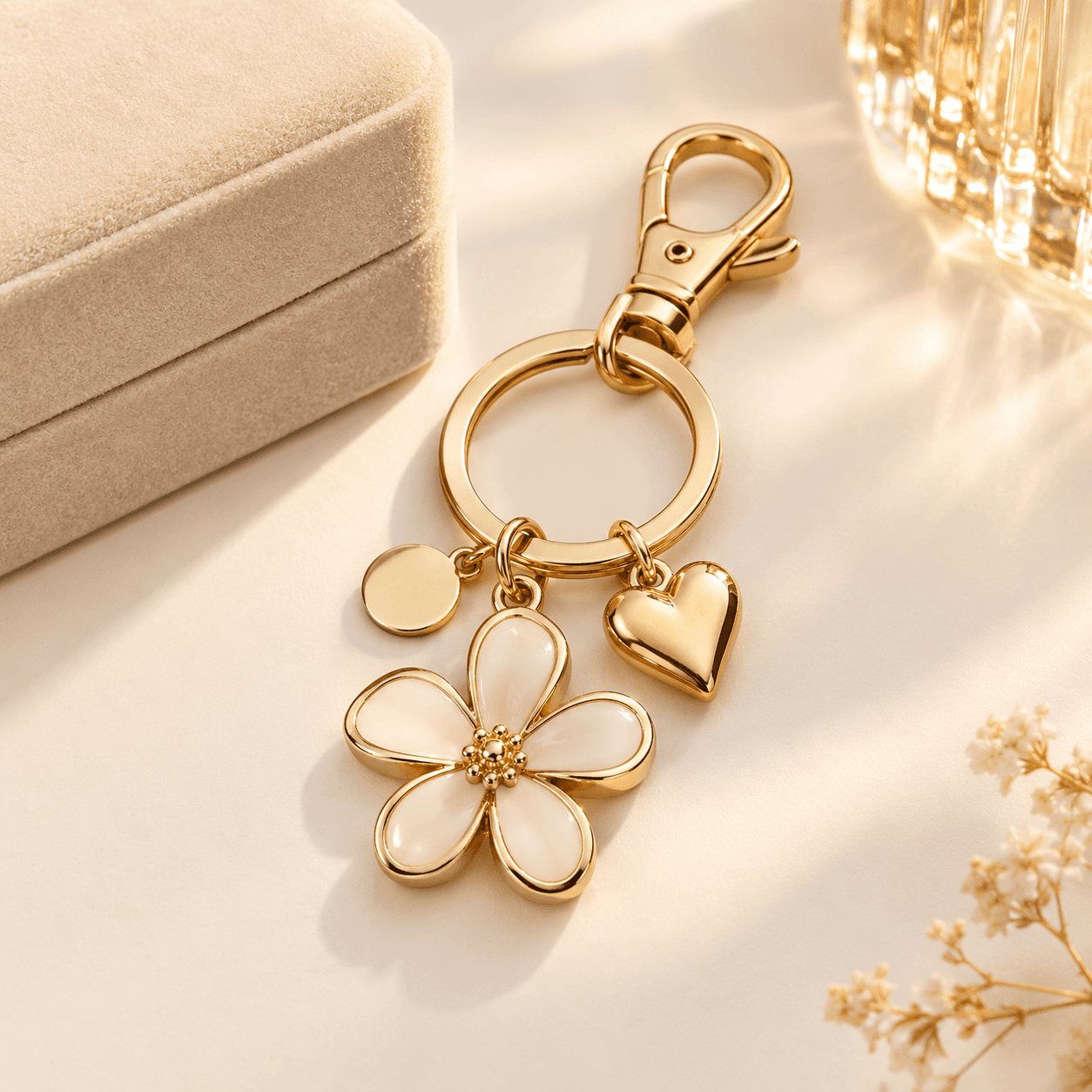
For jewelry designers sourcing a gold-tone stamped angel charm, the finish is not simply a color choice. It influences the visual definition of the design, the consistency of a coordinated collection, the perceived quality of the finished accessory, and the production controls required for repeat orders. Choosing the right finishing process before approving a sample can reduce unnecessary revisions and establish a more reliable foundation for commercial production.
This buyer guide examines how PVD coating, electroplating, mechanical polishing, and related surface treatments contribute to a gold-tone 316L stainless steel angel charm. It explains the trade-offs that matter to boutique jewelry brands, charm bar retailers, gift companies, and private-label buyers, with a focus on practical OEM/ODM decisions, measurable quality requirements, and repeatable manufacturing.
Gold-Tone Finish ODM Stamped 316L Stainless Steel Angel Charm
Start with the Base Material and Design Structure
A stamped angel charm combines a defined outline with surface details that communicate the intended design. Depending on the approved drawing, these details may include feather contours, facial or body outlines, recessed areas, decorative cutouts, and a clearly formed attachment hole or loop. The charm should retain a recognizable angel silhouette at its intended retail size without relying on excessive thickness or overly complicated surface details.
For Lancy Jewelry, 316L stainless steel is the required base material. CNC preparation, laser cutting, laser marking, welding where required, and polishing can support different stages of development. The manufacturing plan should establish the outline, thickness, relief, hole dimensions, edge treatment, and finish before the first production sample is approved.
The gold-tone appearance can then be developed around the actual geometry of the stamped charm. Recessed lines, narrow edges, raised contours, and attachment points do not necessarily respond identically to polishing or coating. A technically sound specification accounts for these variations rather than evaluating color from a single flat area.
Define What Gold-Tone Means for the Collection
Gold-tone is a visual target, not a complete manufacturing specification. Buyers should define the desired warmth, brightness, reflectivity, and surface uniformity. A soft satin appearance creates a different visual effect from a bright mirror finish, even when the coating color is similar.
For an angel charm collection, designers should also decide whether the wings, body, border, and recessed details will share one finish or use a controlled combination of surface effects. These choices influence the process sequence, sample approval criteria, production complexity, and unit economics.
Before requesting an RFQ, prepare a reference drawing or approved visual brief. Specify the intended dimensions, base material, target color, surface texture, engraving requirements, attachment geometry, packaging requirements, and expected order quantities. This gives the manufacturer a defined technical and commercial basis for quotation.
Benefits of Choosing the Right Finishing Strategy
1. More Consistent Visual Quality
A documented finishing specification reduces subjective decisions during production. Instead of asking operators to make every batch look approximately the same, buyers can establish an approved sample, reference color, gloss range, surface condition, and inspection method. These controls are especially important when an angel charm is one component of a larger collection.
2. Better Definition of Fine Details
Polishing and coating must be planned around the stamped geometry. Excessive polishing can soften fine contours, while an unsuitable coating specification may make narrow recessed lines appear less distinct. A coordinated process preserves the intended contrast between raised surfaces and engraved details.
3. More Predictable Repeat Orders
Wholesale stainless steel charms require repeatability across sampling, initial production, and replenishment. Retaining approved drawings, finish references, process specifications, and inspection records makes it easier to evaluate later batches against the original acceptance criteria.
4. Clearer Compliance Documentation
Buyers serving multiple markets should verify applicable chemical, nickel-release, and product-safety requirements for their intended products and sales channels. Lancy Jewelry reports SGS certification or testing documentation covering RoHS, REACH, Nickel Release EN1811, and Salt Spray 240H. Buyers should request the relevant reports, confirm their scope and validity, and determine whether the tested configuration corresponds to the proposed product and finish. These references support supplier evaluation but do not automatically establish compliance with every requirement in every destination market.
Detailed Analysis: PVD, Electroplating, Polishing, and Surface Treatment
Side-by-Side Comparison of Finishing Processes
| Evaluation factor | PVD coating | Electroplating | Mechanical polishing |
|---|---|---|---|
| Primary function | Deposits a controlled coating to create a specified surface appearance and functional finish. | Uses an electrochemical process to deposit a finishing layer. | Refines surface texture, removes selected surface imperfections, and controls reflectivity. |
| Role in a gold-tone charm | Can provide a gold-tone finish when the coating system is specified for that color. | Can provide a gold-tone finish when the selected plating system and process are appropriate. | Establishes the underlying surface character rather than independently creating a durable gold-tone coating. |
| Visual considerations | Color and appearance depend on the coating system, preparation, geometry, and process control. | Color and uniformity depend on the plating chemistry, preparation, geometry, and process control. | Determines whether the surface is bright, satin, or another specified texture. |
| Critical controls | Surface cleanliness, pretreatment, coating parameters, coverage, and adhesion verification. | Surface activation, bath control, current distribution, coverage, and adhesion verification. | Tooling, abrasive sequence, pressure, edge control, and removal of surface defects. |
| Principal limitation | Complex geometry and inadequate pretreatment can still produce inconsistent appearance or adhesion. | Complex contours can receive uneven deposition if the process is not properly controlled. | Cannot by itself establish the color, wear performance, or corrosion performance of a gold-tone coating. |
| Buyer priority | Define target color, coating system, coverage, and performance tests. | Define the plating specification, color target, coverage, and performance tests. | Define gloss, texture, edge quality, and the preservation of fine details. |
The correct selection depends on the required appearance, performance specification, design geometry, order volume, and validated manufacturing capability. No finishing method should be selected solely because its name suggests premium quality. Request evidence that the proposed process meets the actual acceptance criteria for the charm.
PVD Coating: A Process to Evaluate for Gold-Tone Finishes
PVD, or physical vapor deposition, applies a thin coating under controlled vacuum conditions. Depending on the coating system, it can support gold-tone finishes and other specified surface appearances. Its suitability must be assessed for the exact 316L stainless steel substrate, surface preparation, geometry, and target performance.
For stamped angel charms, coating performance begins before deposition. Residual polishing compounds, fingerprints, contamination, and inconsistent surface preparation can compromise coating adhesion or visual uniformity. A controlled cleaning and pretreatment sequence is therefore essential.
Designers should pay particular attention to the edges of the wings, recessed facial details, small openings, and the attachment hole. These areas can reveal process variation more clearly than a broad, flat surface. Ask the manufacturer how coverage is assessed on the actual part and whether the proposed coating process has been validated for comparable geometry.
PVD should not be treated as a guarantee of unlimited wear resistance. Performance depends on the coating composition, deposition conditions, substrate preparation, coating thickness where specified, and subsequent use. Establish a documented test plan instead of relying on general durability claims.
Electroplating: Evaluate the Complete Plating Specification
Electroplating deposits a finishing layer through an electrochemical process. It can be considered when the required gold-tone appearance, production specification, and validated performance meet the buyer's needs. The relevant comparison is between defined process specifications, not between generic labels.
On a stamped charm, current distribution and part geometry can affect deposition. Edges, recesses, and openings may respond differently from exposed faces. Cleaning, activation, process control, and post-treatment must be managed to reduce color variation, adhesion issues, and premature finish deterioration.
When reviewing an electroplated sample, inspect the front, back, sidewalls, recesses, and attachment area under consistent lighting. Ask for details of the finishing system and applicable test results. If the intended product requires a particular coating stack, verify that the quoted specification identifies it clearly.
Polishing: Control the Surface Before Applying Color
Polishing is a foundational operation that determines the surface quality beneath the final finish. A highly reflective gold-tone surface generally requires a more refined substrate than a deliberately satin surface. However, polishing must be controlled carefully on stamped details because excessive material removal can soften edges, flatten relief, or reduce the clarity of small engraved features.
For an angel design, establish which areas should be bright and which should retain defined contours. Where the design includes recessed lines or textured wings, the polishing method should preserve those features. The sample should be examined after polishing and again after the final coating, because a defect that is difficult to see on an unfinished surface may become more apparent after finishing.
Surface Treatment: Specify the Entire Process Sequence
Surface treatment is a sequence rather than a single operation. Depending on the approved design and finish, it may include deburring, edge refinement, cleaning, polishing, activation, coating or plating, and final inspection. The order of these operations matters because each stage affects the next.
For example, polishing after coating may damage the finished surface unless the process is specifically designed and validated for that sequence. Similarly, engraving or laser marking must be positioned within the manufacturing plan so the intended contrast, legibility, and finish remain acceptable. Buyers should require the supplier to identify the production sequence and confirm how any post-finish marking or additional detailing will be controlled.
Finishing Decision Matrix for Jewelry Designers
| Buyer requirement | What to prioritize | What to verify in the sample |
|---|---|---|
| Bright gold-tone appearance | Surface refinement, approved color reference, and coating consistency. | Gloss, color uniformity, visible scratches, and edge coverage. |
| Soft satin appearance | Controlled surface texture and a finish specification that preserves it. | Texture uniformity, unwanted bright spots, and consistency across faces. |
| Fine wing and body details | Stamping definition, careful polishing, and coating suitability. | Contour clarity, recessed line definition, and preservation of the silhouette. |
| Coordinated multi-design collection | Shared finish standards and retained color references. | Side-by-side comparison under the same lighting conditions. |
| Repeat bulk production | Documented process controls, inspection criteria, and traceable approvals. | Batch consistency, attachment dimensions, and finish performance records. |
How to Develop a Custom ODM Angel Charm
Step 1: Create a Production-Ready Design Brief
Provide a vector outline or dimensioned drawing whenever possible. Include the charm's overall height and width, thickness, target weight if relevant, attachment-hole dimensions, and the location of engraved or recessed details. Specify whether the angel is symmetrical, whether its wings include open spaces, and how the charm should hang when connected to a chain or jump ring.
For designs without an existing technical drawing, provide clear reference views and a list of essential design features. The manufacturer can then assess feasibility, tooling requirements, and the most suitable development route.
Step 2: Establish the Finish Specification
Identify the base as 316L stainless steel and define the target finish as gold-tone PVD coating or an approved electroplating specification. Add a color reference, preferred gloss or texture, required surface coverage, and any details that must remain visually distinct. If multiple finishes are planned for one collection, document each variant separately.
Do not rely on a color name alone. Terms such as warm gold, pale gold, or bright gold can be interpreted differently across factories. An approved physical sample or controlled color reference is more useful when supported by written acceptance criteria and consistent inspection conditions.
Step 3: Review the Sample Before Approving Production
Sample development should verify more than whether the charm looks attractive. Review the actual dimensions, thickness, attachment geometry, edge condition, surface texture, coating coverage, color, and detail definition. Check the front and reverse sides and examine the product under both diffuse and direct lighting.
Where finish durability matters, request an appropriate test plan and documented results. Tests should match the intended performance requirements and the specific finished product. A sample approval should not be interpreted as proof that all future batches will automatically meet the same standard; production controls and incoming or final inspections remain necessary.
Step 4: Confirm Commercial and Quality Requirements
Before confirming an OEM or ODM order, align on MOQ, sample charges if applicable, tooling arrangements, unit pricing, lead-time assumptions, packaging, inspection criteria, and acceptable defect limits. Request clarification on how changes to dimensions, coating, artwork, or packaging will be handled after approval.
For private label charms, also confirm logo placement, marking method, packaging artwork, barcode or labeling requirements where applicable, and the approval process for packaging samples. A complete specification reduces uncertainty between design approval and shipment release.
Step 5: Lock the Approved Reference for Reorders
Retain the approved sample, dimensioned drawing, finish specification, artwork, and quality checklist as controlled references. Any material, process, or design change should be evaluated against these documents before implementation. For repeat orders, define how the new batch will be compared with the approved reference and what corrective action applies if a measurable criterion falls outside the agreed tolerance.
How to Evaluate an ODM Charm Supplier
Manufacturing Capability and Process Control
A qualified stainless steel charms manufacturer should be able to discuss the design and the production process in concrete terms. Ask how the supplier manages stamping or cutting, edge finishing, polishing, laser marking, coating, attachment geometry, and final inspection. A capable supplier should identify potential risks before sampling rather than treating every requested design as straightforward.
Lancy Jewelry provides OEM/ODM development for boutique brands and private-label buyers, with manufacturing capabilities that include CNC processing, laser cutting, laser marking, welding, and polishing. The proposed production route should still be confirmed for each individual design and finishing specification.
Documentation and Quality Evidence
Ask for relevant material documentation, finish specifications, and test reports before committing to large quantities. Where SGS documentation is supplied for RoHS, REACH, Nickel Release EN1811, or Salt Spray 240H, verify the tested sample, test method, date, and scope. Confirm whether the documented configuration includes the intended finish and any additional surface treatments.
Salt spray results should be interpreted according to the documented test conditions and acceptance criteria. A stated test duration alone does not establish the product's expected service life or guarantee performance in every environment.
MOQ, Pricing, and Collection Planning
For a boutique-ready series, evaluate total collection economics rather than focusing only on the unit price of one charm. Consider the number of designs, finish variants, tooling or setup requirements, packaging complexity, sample revisions, and anticipated replenishment volume. Combining related designs under a consistent specification may simplify collection management, although the actual MOQ and price depend on the confirmed production plan.
Low MOQ support can be valuable when testing a new collection, but it should be discussed together with setup costs, variant limits, and future reorder expectations. Ask the supplier to distinguish sample quantities, trial production quantities, and standard bulk order conditions in the quotation.
Quality-Control Checklist for Gold-Tone Stamped Charms
| Inspection area | Acceptance question | Recommended control |
|---|---|---|
| Base material | Is the specified base material documented as 316L stainless steel? | Review applicable material documentation and production records. |
| Dimensions | Does the charm meet the approved drawing and tolerances? | Measure overall size, thickness, and attachment dimensions. |
| Shape and detail | Are the angel silhouette and stamped features clearly defined? | Inspect edges, relief, cutouts, and engraved areas. |
| Surface preparation | Is the surface free from unacceptable scratches, burrs, and polishing defects? | Use a documented visual inspection standard. |
| Finish consistency | Does the gold-tone color and gloss match the approved reference? | Compare samples under consistent lighting and viewing conditions. |
| Coating integrity | Does the finish meet the agreed adhesion and durability criteria? | Use applicable, documented tests on the specified finished configuration. |
| Attachment function | Can the charm connect securely without obstructing movement? | Check hole or loop dimensions, connector clearance, and orientation. |
| Order documentation | Can the production batch be checked against the approved specification? | Retain drawings, sample approvals, inspection records, and change history. |
The inspection plan should distinguish cosmetic requirements from functional and performance requirements. A minor visual variation may be acceptable under one documented specification and unacceptable under another. Define the criteria before mass production, not after finished goods arrive.
FAQ: Gold-Tone 316L Stainless Steel Angel Charms
1. Is PVD always better than electroplating for a gold-tone angel charm?
No finishing method is universally superior for every application. The decision depends on the specified coating system, desired color, surface preparation, design geometry, performance requirements, and validated test results. Compare complete specifications and approved samples rather than relying on the process name alone.
2. Can Lancy customize the shape and surface details of an angel charm?
Lancy Jewelry supports OEM/ODM development, including design-related manufacturing processes such as CNC processing, laser cutting, laser marking, welding, and polishing where appropriate. Customization feasibility depends on the drawing, dimensions, tooling requirements, finish specification, and confirmed production plan. Submit your design brief for a technical review.
3. What information should buyers provide for an accurate ODM quotation?
Provide the design drawing or reference views, target dimensions, 316L stainless steel base material, requested gold-tone finish, attachment requirements, logo or engraving details, quantity by design and finish, packaging requirements, target markets, and preferred delivery schedule. Include sample expectations and any required testing or documentation. These details help the supplier evaluate MOQ, development work, and production pricing.
4. How can buyers maintain consistent finishes across repeat bulk orders?
Approve a representative sample, document the color and gloss requirements, retain the technical drawing and process specification, and establish inspection and testing criteria. Require controlled review of material, coating, design, or process changes. Compare each production batch with the retained reference and keep inspection records to support corrective action when necessary.
Partner With Lancy Jewelry for ODM Angel Charm Development
Successful custom charms begin with a precise brief, a technically appropriate finish, and an agreed quality standard. For a gold-tone stamped angel charm, the critical decisions are the definition of the 316L stainless steel base, the choice between PVD and an approved electroplating process, the preparation of the surface, the preservation of fine details, and the verification of the finished product.
Lancy Jewelry works with boutique jewelry brands, charm bar retailers, gift companies, distributors, and private-label buyers seeking practical OEM/ODM development and repeatable manufacturing. Our development approach focuses on translating a design brief into a manufacturable specification, evaluating finish options, supporting sample approval, and coordinating private-label requirements.
To begin, prepare your drawing or reference images, desired dimensions, gold-tone finish preference, estimated quantity, and packaging requirements. Include your destination markets and any applicable testing or documentation needs so the proposed specification can be evaluated appropriately.
Explore our OEM and ODM manufacturing services to review custom development options. Browse all products for additional catalog references, or use our Request a Quote page to submit your RFQ. For questions about design feasibility, finish specifications, or sample development, visit our contact page.
With a clearly defined finish target, documented approval criteria, and a disciplined sampling process, your angel charm can move from creative concept to a production-ready component with greater confidence and better control over collection consistency.