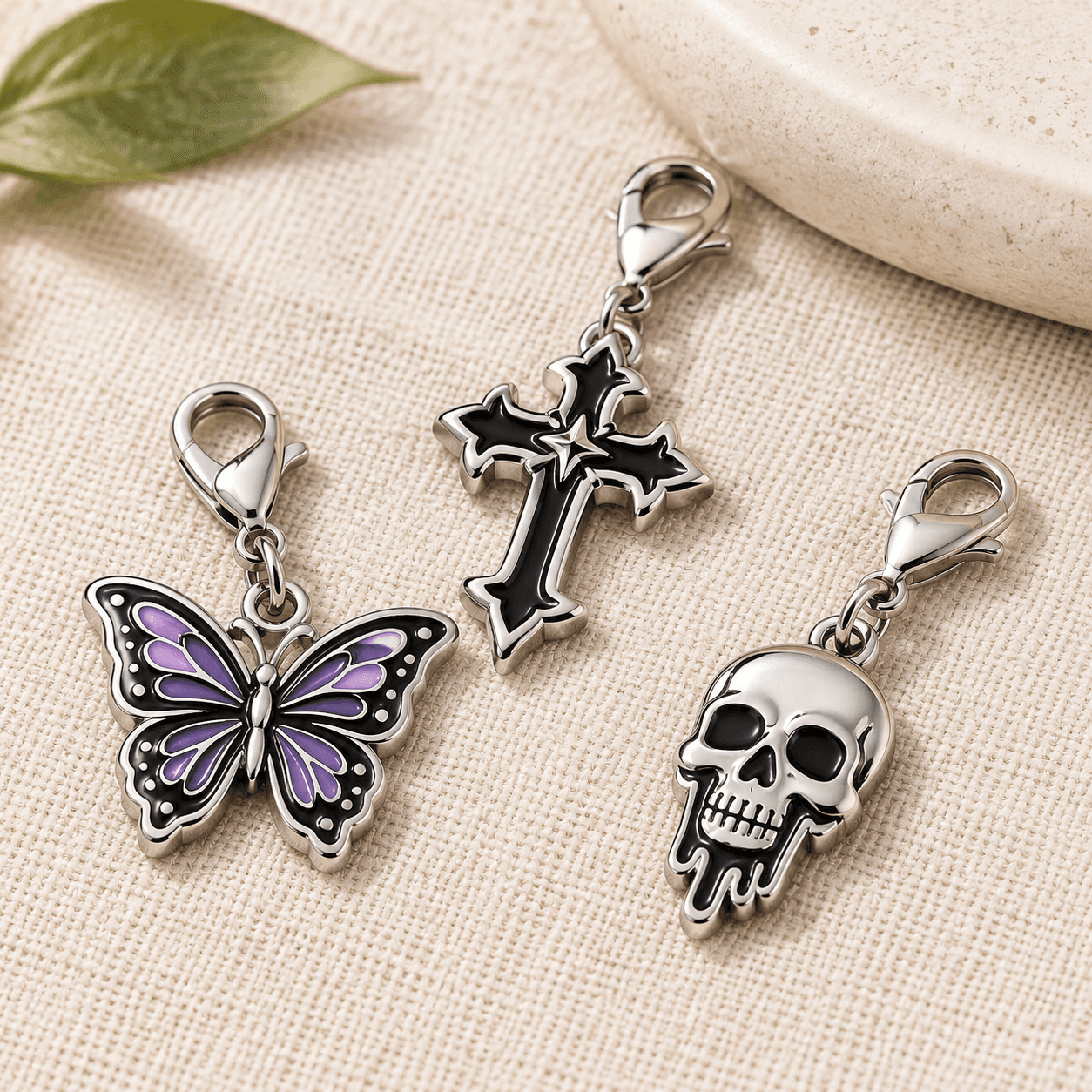
Finding the best price on bulk stainless steel enamel charms is not simply about choosing the supplier with the lowest unit quotation. For wholesale buyers, boutique jewelry brands, charm bar retailers, and private-label businesses in the US and Canada, purchasing decisions directly affect product margins, inventory efficiency, and customer satisfaction. A competitive price must also account for material consistency, enamel quality, plating performance, production reliability, packaging, and delivery costs. Understanding these factors helps buyers negotiate more effectively, compare supplier quotations accurately, and secure better long-term value without compromising product quality.
How to Get the Best Price on Bulk Stainless Steel Enamel Charms
Bulk purchasing can reduce manufacturing costs through more efficient material preparation, production scheduling, surface finishing, and quality inspection. However, the actual savings depend on product specifications and order structure. Buyers should evaluate the complete quotation rather than focusing exclusively on the advertised unit price.
Understand the Main Factors Behind Bulk Pricing
The price of a stainless steel enamel charm generally reflects several manufacturing and commercial variables. Understanding their influence makes it easier to identify opportunities for savings.
| Pricing factor | Cost influence | Buyer strategy |
|---|---|---|
| 316L stainless steel specifications | Material grade, dimensions, and product weight affect material consumption and processing. | Confirm material specifications and optimize dimensions without compromising the design. |
| Charm size and structure | Larger dimensions and complex outlines may require additional processing. | Standardize sizes across coordinated product collections where practical. |
| Enamel color filling | Multiple colors and intricate boundaries increase filling and inspection requirements. | Use a consistent color palette and simplify unnecessary decorative details. |
| Surface finishing | Polishing, silver finish, and PVD gold plated options influence production costs. | Select finishes according to the intended retail positioning. |
| Order quantity | Production setup and scheduling costs can be distributed across more units. | Consolidate suitable designs into planned production orders. |
| Packaging and customization | Logo engraving, individual packaging, and custom presentation add processing costs. | Match packaging specifications to actual retail requirements. |
| Shipping and inspection | Freight, documentation, inspection, and potential rework affect landed cost. | Compare complete delivered-cost quotations. |
Compare the Total Order Cost, Not Just the Unit Price
Two suppliers may quote different prices for apparently identical charms. The difference could reflect material specifications, enamel application, plating thickness, inspection procedures, packaging, or production tolerances. A lower quotation may exclude services that another supplier already includes.
For a meaningful comparison, request an itemized quotation covering the same technical requirements. Confirm whether sampling, logo engraving, packaging, inspection, and shipping are included or charged separately. This approach makes supplier comparisons more transparent and reduces unexpected expenses after an order is placed.
Why Strategic Bulk Purchasing Matters for Wholesale Buyers
For businesses selling through boutiques, gift programs, charm bars, and online retail channels, purchasing decisions influence both immediate profitability and future operating costs. A well-planned bulk order can improve margins while maintaining a consistent customer experience.
Key Benefits of Working With a Reliable Manufacturer
- More predictable margins: Clearly defined production specifications make purchasing costs easier to forecast and retail prices easier to plan.
- Consistent product quality: Controlled manufacturing processes help maintain uniform dimensions, surface finishes, enamel colors, and attachment details.
- Better inventory planning: Coordinated product series simplify replenishment and reduce unnecessary variation in stock.
- Lower quality-related expenses: Effective sampling and inspection can reduce returns, replacement shipments, and customer complaints.
- Stronger brand presentation: Custom logo engraving and private-label packaging help create a consistent retail experience.
Certifications and Testing Documentation
Compliance documentation is another important consideration when sourcing products for North American and international markets. Buyers should request relevant test reports and verify that the documentation applies to the specified product, material, finish, and intended use.
Lancy Jewelry has SGS certification and testing documentation covering RoHS, REACH, Nickel Release EN1811, and Salt Spray 240H. These references support supplier evaluation by providing information about restricted substances, nickel release performance, and corrosion resistance under specified testing conditions. Buyers should still confirm the applicable market requirements and product-specific documentation before placing commercial orders.
For US and Canadian sales, also consider the intended consumer age group and applicable consumer product requirements. Children's jewelry can involve additional restrictions and testing obligations. In the United States, the Consumer Product Safety Commission (CPSC) is particularly relevant to consumer product safety requirements. In Canada, applicable requirements under the Canada Consumer Product Safety Act should be reviewed. The FDA is not a routine product-approval authority for ordinary fashion jewelry charms; however, health-related or therapeutic marketing claims may introduce different regulatory considerations. Do not treat a general supplier certificate as automatic approval for every market or application.
Detailed Guide: How to Compare Bulk Enamel Charm Suppliers
Choosing a stainless steel charms manufacturer requires a structured evaluation of product specifications, commercial terms, manufacturing capabilities, and long-term service. The following steps provide a practical framework for purchasing managers and wholesale buyers.
Step 1: Define Your Product Specifications Before Requesting Prices
Before sending an RFQ, prepare a clear product specification sheet. Suppliers can only provide meaningful quotations when they understand exactly what needs to be manufactured.
Include the following information:
- Base material: 316L stainless steel.
- Charm dimensions, thickness, and approximate weight.
- Shape, outline, and decorative design details.
- Enamel colors, color placement, and filling requirements.
- Surface finish, including silver finish, PVD gold plating, or rose gold plating.
- Attachment requirements, including the bail or jump ring dimensions.
- Logo engraving and private-label packaging requirements.
- Estimated order quantity and expected delivery schedule.
Complete specifications reduce misunderstandings and help suppliers calculate production requirements more accurately. They also make it easier to compare quotations from multiple manufacturers on an equivalent basis.
Step 2: Compare Different Purchasing and Production Approaches
Not every purchasing model offers the same balance of cost, flexibility, and inventory risk. Wholesale buyers should consider how their order structure affects both initial investment and future replenishment.
| Purchasing approach | Advantages | Potential limitations | Best suited for |
|---|---|---|---|
| Small mixed-design order | Allows buyers to test several designs and assess customer preferences. | More design changes and individual setup requirements may increase average unit costs. | New boutiques and product testing programs. |
| Single-design bulk order | Supports repeatable production and more efficient quantity planning. | Concentrates inventory in one design and requires accurate demand forecasting. | Established sellers with proven bestsellers. |
| Coordinated collection order | Creates a consistent product range while allowing buyers to plan several related designs together. | Requires careful coordination of specifications and quantities. | Charm bar retailers and seasonal collections. |
| OEM customized order | Provides control over design, branding, and product details. | Development and sampling may add initial costs and lead time. | Private-label brands and differentiated retail programs. |
| ODM development order | Provides a structured route to developing coordinated product concepts with manufacturing support. | Design selection and approval require communication and sampling. | Buyers seeking new product series. |
The most economical approach depends on sales history, product complexity, available inventory capital, and expected replenishment frequency. A large order is not automatically the most profitable choice if it creates excessive unsold inventory.
Step 3: Evaluate MOQ and Quantity-Based Pricing
MOQ is an important factor in bulk sourcing because production preparation involves time and resources regardless of the final quantity. However, MOQ should be evaluated at the appropriate level: individual design, finish, color combination, or combined order.
Ask potential suppliers whether they support mixed-design orders, coordinated collections, or consolidated production schedules. Some manufacturers may offer greater flexibility when multiple designs share similar production requirements.
| MOQ consideration | Question to ask | Commercial benefit |
|---|---|---|
| Per-design MOQ | Is the minimum quantity calculated separately for each design? | Helps determine the realistic investment for a collection. |
| Color MOQ | Does each enamel color combination require a separate minimum? | Prevents unexpected costs when planning multiple variations. |
| Finish MOQ | Are different PVD finishes subject to separate minimum quantities? | Supports more accurate collection planning. |
| Combined MOQ | Can several designs be consolidated into one production order? | May improve production scheduling and order efficiency. |
Rather than negotiating only for the lowest minimum, ask for several quantity-based quotation levels. Comparing the price at different quantities reveals where additional purchasing investment creates meaningful unit-cost savings.
Step 4: Compare Enamel Quality and Surface Finishing
Enamel quality is especially important because the decorative surface is often the most visible feature of a charm. Inconsistent color filling, uneven boundaries, surface contamination, and visible defects can affect retail presentation and customer satisfaction.
Request physical samples and evaluate:
- Color consistency across different pieces.
- Clean boundaries between adjacent enamel sections.
- Uniform surface appearance and finishing.
- Accurate alignment between decorative details and the charm outline.
- Secure, properly formed attachment points.
- Consistency between the approved sample and production specifications.
For PVD gold plated or rose gold plating options, also establish clear finish specifications and request relevant testing documentation. Salt spray and nickel release reports can support evaluation, but different tests measure different performance characteristics. Buyers should not assume that one test guarantees every aspect of product durability.
Step 5: Calculate Total Cost of Ownership
Total cost of ownership provides a more realistic view of purchasing value than the quoted unit price alone. It includes the direct purchasing cost and other expenses associated with receiving, managing, and selling the products.
A practical calculation is:
Total landed and purchasing cost = Product order value + Sampling and setup costs + Packaging costs + Freight and insurance + Applicable import duties and taxes + Inspection and handling costs.
For example, consider two hypothetical quotations for the same bulk order of 1,000 enamel charms:
| Cost item | Supplier A | Supplier B |
|---|---|---|
| Unit price | $1.20 | $1.30 |
| Product order value | $1,200 | $1,300 |
| Sampling and setup | $100 | $50 |
| Packaging | $100 | $50 |
| Freight and handling | $200 | $150 |
| Total cost | $1,600 | $1,550 |
| Total cost per piece | $1.60 | $1.55 |
In this hypothetical comparison, Supplier A has the lower quoted unit price, but Supplier B delivers a lower total cost per piece. The difference is $50 across the order. This illustrates why wholesale buyers should compare all purchasing expenses before selecting a supplier. The figures are illustrative only and do not represent actual Lancy quotations.
Step 6: Assess Production Capacity and Supplier Reliability
A competitive quotation has limited value if the supplier cannot consistently meet the agreed specifications or delivery schedule. Production reliability is particularly important for US and Canadian retailers planning seasonal promotions, gift programs, and replenishment cycles.
Evaluate the manufacturer's capabilities in the following areas:
- Production equipment: CNC processing, laser cutting, laser marking, welding, and polishing capabilities.
- Enamel processing: Ability to manage detailed color filling and repeatable decorative specifications.
- Quality management: Defined inspection standards for dimensions, finishing, color, and attachment mechanisms.
- Sample development: Ability to produce and revise samples before bulk manufacturing.
- Production communication: Clear confirmation of specifications, order milestones, and delivery expectations.
- Packaging support: Options for logo engraving and private-label presentation.
Request a production schedule and agree on sample approval procedures before confirming a purchase order. For repeat orders, retain approved samples and technical specifications as reference standards.
Step 7: Improve Retail Margins Through Better Product Planning
Purchasing cost is only one part of profitability. Product selection, retail positioning, inventory turnover, and packaging also influence the financial performance of a charm collection.
Buyers can improve commercial results by organizing products into coordinated series, selecting a manageable number of enamel colors, and prioritizing designs with clear customer demand. For charm bar retailers, a balanced assortment can provide variety without requiring excessive inventory in every individual design.
Consider these practical measures:
- Start with a focused assortment and expand according to sales performance.
- Use coordinated dimensions and attachment specifications where appropriate.
- Prioritize designs that can support repeat purchasing.
- Review packaging expenses against the intended retail price.
- Plan replenishment before popular products reach critically low stock levels.
- Track actual defect rates, returns, and delivery performance when reviewing supplier value.
Why Consider Lancy Jewelry for Bulk Enamel Charm Production?
Lancy Jewelry is a B2B OEM/ODM 316L stainless steel charms manufacturer supporting boutique brands, charm bar retailers, distributors, and private-label buyers. Its manufacturing capabilities are designed to help purchasing teams develop commercially practical charm collections with consistent specifications and coordinated finishing options.
The production facility uses CNC equipment, laser cutting, laser marking, welding, and polishing processes. Available customization services include logo engraving, PVD plating, enamel color filling, crystal inlay, sample development, and private-label packaging.
For wholesale buyers, the focus is on balancing product quality, order flexibility, and production efficiency. Low MOQ support can help businesses evaluate new designs and develop coordinated collections without immediately committing to unnecessarily large inventories. Buyers can also discuss bulk production planning, finish selection, and packaging requirements during the quotation process.
Explore the Lancy product catalog to review available product categories, or visit the OEM manufacturing service page to learn more about customization and development support.
Frequently Asked Questions About Bulk Stainless Steel Enamel Charms
1. What determines the best price for bulk stainless steel enamel charms?
The best price depends on material specifications, dimensions, design complexity, enamel colors, surface finishing, order quantity, packaging, and shipping. Buyers should compare complete quotations and evaluate total landed cost rather than selecting a supplier based only on the lowest unit price.
2. How can wholesale buyers negotiate a lower MOQ?
Prepare a coordinated order plan and ask whether the supplier supports mixed designs, shared production scheduling, or combined quantities. Simplifying color variations and standardizing dimensions may also improve production efficiency. Confirm whether MOQ applies separately to each design, finish, or color combination.
3. What certifications should buyers request when sourcing charms for the US and Canada?
Request relevant product-specific testing documentation, including applicable RoHS, REACH, nickel release, and corrosion-resistance reports. Also review applicable CPSC requirements in the United States and Canada Consumer Product Safety Act requirements in Canada. Additional obligations may apply to children's products. The appropriate documentation depends on product specifications, intended use, and destination market.
4. Is it better to place one large bulk order or several smaller orders?
A large order may reduce average manufacturing costs, but it increases inventory investment and demand risk. Smaller orders offer greater flexibility and allow buyers to test product performance. The best strategy depends on sales history, storage capacity, cash flow, and supplier replenishment lead times. Compare the total cost and inventory risk of both approaches before committing.
Partner With Lancy Jewelry for Competitive Bulk Charm Production
Getting the best price on bulk enamel charms requires more than aggressive negotiation. It involves understanding manufacturing costs, preparing accurate specifications, evaluating MOQ flexibility, checking quality documentation, and measuring the total cost of ownership. A reliable manufacturing partner can help buyers achieve a stronger balance between competitive pricing, consistent quality, and efficient inventory planning.
Lancy Jewelry supports B2B customers with custom stainless steel charms, OEM development, ODM charm supplier services, enamel color filling, PVD finishing, sample development, and private-label packaging. Whether you are launching a new boutique collection, expanding a charm bar assortment, or planning recurring bulk charm orders, the right production plan can help protect your margins and support sustainable growth.
Share your designs, target quantities, preferred finishes, and packaging requirements with our team. We can review your specifications and prepare an RFQ based on your project needs.
Ready to discuss your next collection? Request a bulk quotation or contact Lancy Jewelry to discuss your sourcing requirements.