For a boutique jewelry brand, a custom pet bag charm is more than a decorative accessory. It is a personalized product that connects with customers emotionally while creating opportunities for repeat purchases, gift programs, and distinctive brand positioning. However, a successful product launch requires more than an attractive pet design. Buyers must evaluate material consistency, surface durability, attachment security, personalization quality, and manufacturing reliability before approving bulk production.
For North American brands, these considerations are particularly important. Customers increasingly value personalized accessories, recognizable details, and products designed for everyday use. A charm featuring a pet silhouette, engraved name, or carefully selected finish can become a strong addition to a boutique collection. This guide explains how purchasing teams can compare specifications, establish practical quality standards, and select a reliable manufacturing partner for custom stainless steel charms.
Stainless Steel Custom Pet Bag Charm: What B2B Buyers Should Evaluate
Understanding the Product Requirements
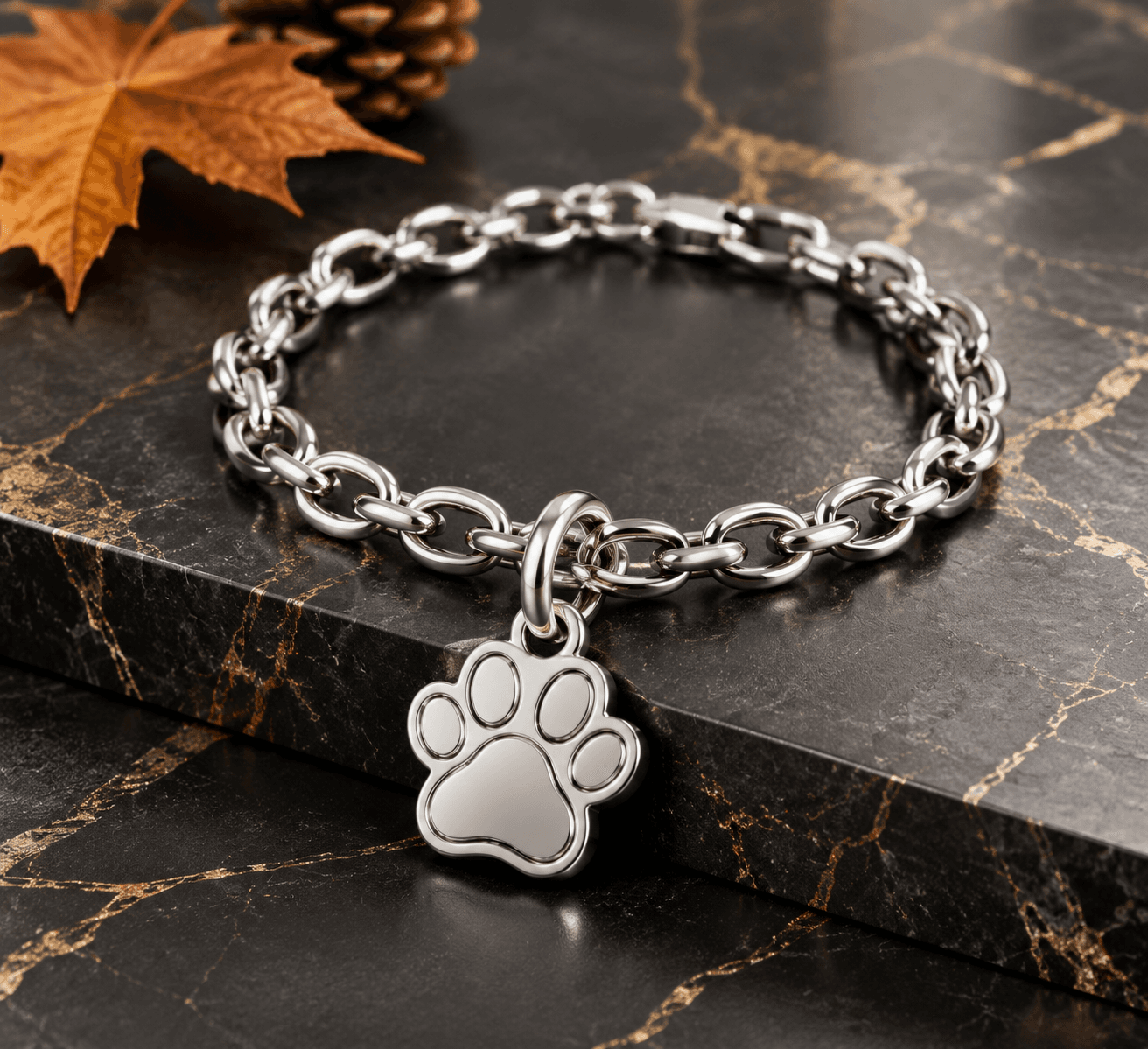
A custom pet bag charm is a decorative accessory designed around recognizable pet-related details. Common concepts include dog silhouettes, cat profiles, paw motifs, engraved pet names, and personalized decorative elements. The product may be developed as an individual charm or as part of a coordinated seasonal collection.
For professional sourcing, the first decision should be the manufacturing specification. Lancy Jewelry focuses on 316L stainless steel charms, providing a consistent material foundation for OEM and ODM development. Buyers can specify dimensions, surface finishes, engraving details, enamel colors, crystal inlay, and attachment configurations.
A complete RFQ should identify the intended application, target retail positioning, required quantity, preferred finish, packaging requirements, and expected delivery schedule. These details help the manufacturer assess feasibility and provide a realistic quotation.
Comparing Important Product Specifications
Not every attractive sample is ready for commercial production. Brand managers should evaluate the complete product rather than judging appearance alone.
| Evaluation area | Basic requirement | Preferred B2B specification |
|---|---|---|
| Base material | Clearly identified material | Documented 316L stainless steel |
| Surface finish | Consistent visual appearance | Controlled PVD, silver finish, or rose gold plating |
| Personalization | Recognizable pet motif | Precise laser marking and controlled enamel application |
| Attachment | Functional connection | Secure, closed, and appropriately sized hardware |
| Quality testing | Visual inspection | Documented material, finish, and mechanical checks |
| Packaging | Protected during transport | Private-label presentation suitable for retail |
This comparison provides a practical starting point for comparing quotations. A lower unit price should never compensate for unclear specifications or inconsistent inspection requirements.
Why 316L Stainless Steel Matters for Pet Bag Charms
Material Consistency and Everyday Durability
Material selection directly affects product performance, manufacturing repeatability, and brand reputation. Lancy Jewelry uses 316L stainless steel as the base material for its stainless steel charms. Buyers should request clear material specifications and supporting documentation instead of relying exclusively on a supplier's general product description.
316L stainless steel is valued for its corrosion resistance, structural strength, and suitability for detailed accessory manufacturing. These characteristics make it a practical choice for bag charms that may experience repeated handling, contact with bags, and routine environmental exposure.
However, material selection alone does not establish the durability of a finished product. Surface treatment, polishing quality, attachment construction, and production controls also influence the final result. A professional purchasing specification should therefore evaluate the complete manufacturing process.
Finish Options: A Side-by-Side Comparison
Surface appearance is a major part of product positioning. North American boutique brands may prefer understated finishes for everyday accessories, while gift-oriented collections can benefit from more distinctive decorative details.
| Finish option | Visual characteristics | Commercial application | Quality priority |
|---|---|---|---|
| Silver finish | Clean, neutral metallic appearance | Minimalist and everyday collections | Surface uniformity and polishing consistency |
| PVD gold plating | Warm gold-toned appearance | Premium gift and boutique collections | Color consistency and abrasion resistance |
| Rose gold plating | Soft, warm pink-gold appearance | Personalized and gift-focused programs | Shade consistency between production batches |
| Enamel | Defined decorative color areas | Pet silhouettes and colorful designs | Color accuracy and filling uniformity |
| Crystal inlay | Decorative reflective details | Statement and gift collections | Setting security and alignment |
These options can be evaluated individually or combined where the design allows. For example, a pet silhouette may feature a PVD gold-plated surface with carefully positioned enamel details. The final combination should be confirmed during sample development before bulk approval.
Certifications and Compliance Documentation
Professional buyers should request relevant third-party testing documentation and confirm that the reports apply to the intended product specifications. Lancy Jewelry has SGS certification and testing documentation covering RoHS, REACH, Nickel Release EN1811, and Salt Spray 240H.
These testing areas address different purchasing concerns:
- RoHS: Addresses restrictions on specified hazardous substances within its applicable scope.
- REACH: Addresses relevant chemical substance requirements under applicable European regulations.
- Nickel Release EN1811: Evaluates nickel release under the specified test method and applicable product requirements.
- Salt Spray 240H: Provides an assessment of corrosion resistance under specified salt spray test conditions.
Buyers should distinguish between a factory's available test reports, product-specific test results, and regulatory obligations in the destination market. A test report does not automatically establish compliance with every requirement for every product configuration.
Benefits of a Quality-Controlled Custom Pet Bag Charm Program
1. Stronger Brand Positioning Through Personalization
Pet-related designs offer a clear opportunity for emotional product storytelling. Customers may recognize their own pets in a silhouette or choose an engraved name to create a meaningful gift. For boutique brands, this creates a product concept that can be developed into multiple coordinated designs.
Brand managers should establish a consistent visual system. Define engraving placement, font style, pet silhouette proportions, finish selection, and packaging presentation before developing the complete series. Consistency across these details helps customers recognize the collection as part of one brand.
2. More Predictable Product Quality
Standardized specifications reduce uncertainty between samples and bulk production. A documented quality plan should define acceptable color variation, surface defects, dimensional tolerances, engraving legibility, and attachment performance.
For example, two samples of the same pet design should maintain consistent outline proportions and engraving positions. Likewise, repeated production runs should follow an approved finish reference rather than relying on visual interpretation alone.
3. Better Product Longevity and Customer Confidence
Durability influences customer satisfaction, return rates, and long-term brand perception. A well-manufactured charm should maintain its intended appearance under normal use when handled and maintained according to its product-care instructions.
Buyers should establish realistic performance expectations instead of accepting broad promises such as permanent color or unlimited wear resistance. Specify the applicable test method, inspection criteria, sample size, and acceptance threshold in the purchase agreement.
4. More Efficient Private-Label Collection Development
Working with an experienced stainless steel charms manufacturer can simplify the transition from concept to retail-ready product. Lancy Jewelry provides OEM and ODM development, logo engraving, PVD plating, enamel color filling, crystal setting, sample support, and private-label packaging.
These capabilities allow brand managers to coordinate product development and presentation through one manufacturing relationship. Low MOQ support can also help buyers evaluate new pet-themed concepts before committing to larger bulk charm orders.
Detailed B2B Quality Guide: How to Evaluate Your Supplier
Step 1: Confirm Material and Design Specifications
Start by requesting a written product specification. It should identify 316L stainless steel, finished dimensions, product weight where relevant, design drawings, surface finish, and attachment details.
For pet designs, pay particular attention to small features. Facial outlines, ears, paws, and engraved names must remain recognizable at the finished product size. An attractive digital drawing is not sufficient evidence that the manufacturing process can reproduce every detail accurately.
Ask the manufacturer to review minimum line widths, engraving depth, edge finishing, and any design elements that may become difficult to reproduce consistently. Resolving these issues before sampling reduces unnecessary revisions.
Step 2: Compare Manufacturing Capabilities
A supplier's production equipment and process control influence repeatability. Lancy Jewelry operates a modern manufacturing facility equipped with CNC processing, laser cutting, laser marking, welding, and polishing capabilities.
| Manufacturing process | Quality contribution | Buyer verification |
|---|---|---|
| CNC processing | Supports dimensional accuracy and controlled production | Review sample dimensions and tolerances |
| Laser cutting | Creates defined outlines and detailed profiles | Inspect edge quality and silhouette consistency |
| Laser marking | Supports logos, names, and fine decorative details | Check legibility and positioning |
| Welding | Supports specified structural connections | Inspect joint appearance and mechanical integrity |
| Polishing | Improves surface appearance and finish preparation | Check smoothness and surface uniformity |
Ask whether the supplier can maintain the same specifications across different production quantities. Production capability should be supported by actual sample evaluation and documented inspection procedures.
Step 3: Request and Approve a Pre-Production Sample
Sample development is one of the most important stages in custom manufacturing. Never approve bulk production based solely on a rendering or verbal description.
Request a physical sample that represents the intended production specification. Evaluate the following:
- Overall dimensions, weight, and product proportions.
- Pet silhouette accuracy and recognizable decorative details.
- Engraving clarity, depth, and positioning.
- Finish color, surface smoothness, and visual consistency.
- Enamel filling uniformity and crystal setting security where applicable.
- Jump ring closure, connection strength, and attachment movement.
- Packaging dimensions and presentation quality.
Record the approved sample specification and retain an approved reference for future production comparisons. Any later changes to the design, finish, or hardware should require documented approval.
Step 4: Establish Wear-Resistance Testing
Wear resistance should be evaluated using defined procedures rather than subjective descriptions. A practical testing plan can include several separate checks.
Surface abrasion evaluation: Examine the finish after a specified rubbing procedure. Record visible changes, exposure of the underlying surface, and any unexpected deterioration. The test method and number of cycles should be agreed upon before production.
Corrosion evaluation: Review applicable salt spray test results. Lancy Jewelry offers Salt Spray 240H testing documentation. Buyers should confirm the tested sample configuration, evaluation criteria, and report applicability.
Attachment evaluation: Check the jump ring, connecting loop, and other functional components for secure closure and structural integrity. A charm intended for repeated handling should not have a loosely fitted or visibly defective connection.
Finish consistency evaluation: Compare samples from different production batches under consistent lighting. Record color differences, surface marks, polishing defects, and decorative application irregularities.
Testing should reflect the product's actual use conditions. No single test can establish every aspect of product lifespan, and accelerated testing should not be presented as an exact prediction of years of consumer use.
Step 5: Create a Bulk Production Inspection Plan
Once the sample is approved, convert its specifications into a production inspection checklist. Separate critical functional defects from major cosmetic defects and minor appearance variations.
| Inspection stage | What to inspect | Suggested control |
|---|---|---|
| Incoming material | Material identification and documentation | Verify against purchasing specifications |
| In-process production | Dimensions, engraving, and structural details | Perform scheduled process checks |
| Surface finishing | Color, polishing, and coating appearance | Compare with approved finish references |
| Final inspection | Visual defects, attachment security, and functionality | Apply agreed acceptance criteria |
| Packaging inspection | Logo placement, protection, and labeling | Verify against approved packaging artwork |
For larger orders, buyers can agree on an appropriate sampling inspection plan and acceptance quality limits. Define these requirements in advance so that both the purchasing team and manufacturer understand the approval process.
Step 6: Evaluate the Commercial Offer Beyond Unit Price
A competitive quotation should explain the complete cost structure. Review tooling or development charges, sample fees, finish costs, packaging costs, MOQ, production lead time, and shipping arrangements.
Also examine the supplier's response process when a defect is discovered. A dependable manufacturing partner should have a defined method for documenting issues, identifying affected quantities, reviewing root causes, and agreeing on corrective action.
For private-label buyers, packaging and brand presentation deserve the same attention as the charm itself. Confirm logo artwork, print placement, packaging materials, labeling information, and packing protection before approving the final order.
North American Market Considerations for Pet Bag Charm Buyers
Product Positioning for US and Canadian Customers
North American customers provide opportunities for personalized gift accessories, pet-themed collections, and seasonal boutique programs. Practical product concepts include pet silhouette charms, engraved name charms, paw designs, and coordinated collections featuring different pet profiles.
For US and Canadian retail programs, consider offering several finish choices and personalization options while maintaining a consistent design language. A focused range of recognizable designs is often easier to merchandise than an excessively complicated collection.
Packaging should communicate the product's personalization features, care instructions, and relevant material information. If the product is intended for adult fashion use, its marketing and labeling should accurately reflect that intended purpose.
FDA and Consumer Product Compliance Considerations
FDA approval is not a general certification requirement for ordinary fashion bag charms. FDA requirements apply to products and claims within its regulatory jurisdiction, so buyers should not request or advertise FDA approval as a substitute for appropriate accessory testing.
Instead, US buyers should evaluate the applicable federal, state, and local requirements based on product design, intended users, distribution channel, and marketing claims. If an accessory is specifically designed or marketed for children, additional requirements may apply, including relevant Consumer Product Safety Commission rules and testing obligations. Canadian buyers should similarly assess applicable consumer product and chemical safety requirements.
Importers should also verify current documentation requirements with their compliance specialists. Material reports, nickel release documentation, product labeling, and accurate country-of-origin information may all be relevant to a sourcing decision.
Frequently Asked Questions
1. Why should B2B buyers choose 316L stainless steel for custom pet bag charms?
316L stainless steel offers corrosion resistance, structural strength, and consistent manufacturing potential. It provides a practical base material for personalized bag charms, particularly when combined with controlled surface finishing, appropriate polishing, and documented quality inspection. Buyers should still evaluate the complete finished product rather than relying on the material specification alone.
2. Which quality tests should buyers request for custom stainless steel charms?
Relevant checks include material verification, RoHS and REACH documentation where applicable, Nickel Release EN1811 testing where relevant, salt spray evaluation, finish abrasion assessment, dimensional inspection, and attachment security testing. Lancy Jewelry has SGS certification and testing documentation covering RoHS, REACH, Nickel Release EN1811, and Salt Spray 240H. Buyers should confirm the applicability of each report to their specific product.
3. Can Lancy Jewelry develop private-label pet bag charms with custom logos?
Yes. Lancy Jewelry supports OEM and ODM development, including custom pet designs, laser logo engraving, PVD plating, enamel color filling, crystal setting, sample development, and private-label packaging. Buyers can submit design references, dimensions, finish preferences, and packaging requirements for a manufacturing assessment and RFQ.
4. How can buyers establish realistic durability expectations?
Begin with an approved physical sample and define measurable testing procedures for corrosion resistance, surface wear, finish consistency, and attachment security. Agree on acceptance criteria and inspection frequency before bulk production. Any commercial durability guarantee should specify its coverage period, usage conditions, exclusions, and corrective-action process in writing.
Partner With Lancy Jewelry for Custom Pet Bag Charm Manufacturing
Successful private-label development requires a manufacturing partner that understands both product design and commercial quality expectations. From material specifications to sample approval and final inspection, every stage should support consistent production and a reliable customer experience.
Lancy Jewelry is a B2B OEM/ODM 316L stainless steel charms manufacturer serving boutique jewelry brands, gift companies, charm bar retailers, and private-label buyers. Our production capabilities include CNC processing, laser cutting, laser marking, welding, polishing, PVD plating, enamel color filling, and crystal setting.
We support low MOQ projects, custom logo development, sample production, and private-label packaging. Whether you are introducing a new pet-themed accessory or expanding an established gift collection, our team can help translate your product requirements into a practical manufacturing specification.
Explore our stainless steel product catalog to review available product directions. Learn more about our OEM and ODM manufacturing services and how we support custom development. When your specifications are ready, request a quote with your target quantity, preferred finish, design files, and packaging requirements.
Build your next custom pet bag charm collection on a foundation of documented specifications, controlled manufacturing, and measurable quality standards. Partner with Lancy Jewelry to develop boutique-ready stainless steel charms with confidence.