Rabbit bag charms look simple until a buyer encounters a failed jump ring, a discolored bail, or a PVD surface that shows wear during transit. For boutique jewelry brands, gift companies, and private-label buyers, the important question is whether a factory can consistently manufacture the same 316L stainless steel charm, finish, and attachment quality across every bulk order. This guide provides sourcing teams with a practical factory evaluation checklist for durability testing before selecting a stainless steel rabbit bag charm factory.
Stainless Steel Rabbit Bag Charm Factory: What Durability Really Means
A reliable stainless steel rabbit bag charm factory must control three important quality areas: base material, decorative finish, and connection points. A charm may pass visual inspection but experience problems during repeated handling if the bail is weak, PVD adhesion is inconsistent, or engraving affects structural integrity. For B2B buyers, durability is a commercial consideration that protects product positioning, reduces returns, and supports predictable reorders. The following checklist helps buyers evaluate a stainless steel charms manufacturer for private label charms, sample development, and bulk charm orders.

Define the Rabbit Charm Specification Before Testing
Begin with a written product specification. Define charm dimensions, thickness, bail or jump ring diameter, attachment orientation, surface finish, enamel color, crystal inlay, and logo placement. For bag charm applications, the connection must be physically secure and visible. The charm should hang from a real loop rather than an artificial attachment. Confirm whether the rabbit design is flat, dimensional, or double-sided. Specify target markets, including the US, Canada, UK, EU, and Australia. Buyers commonly prioritize secure connectors, smooth edges, consistent finishes, and reliable reorder quality. A detailed specification gives the factory a measurable standard for sample approval and production inspection.
Identify the Failure Modes Buyers Actually See
Customer complaints often involve edge sharpness, bail distortion, finish wear at high-contact points, enamel damage, crystal loss, and color differences between production lots. Build the test plan around these risks. Ask the factory to explain its CNC machining, laser cutting, welding, polishing, PVD processing, and final assembly controls. A professional manufacturer should document production procedures and retain samples from individual batches. Without documented process controls, an approved sample may not accurately represent subsequent bulk production.
Map the Charm to Real Bag Charm Applications
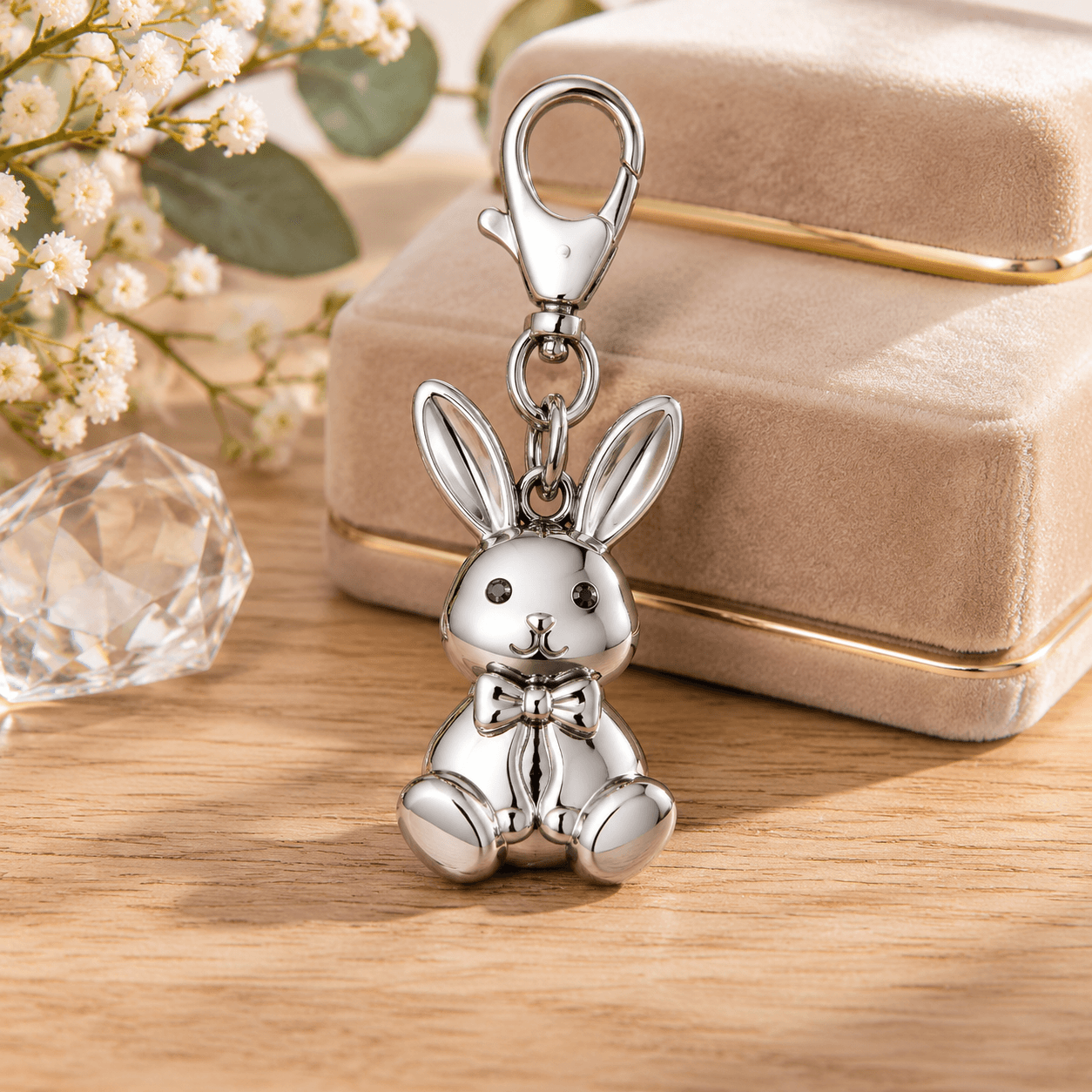
Bag charm applications create repeated movement and surface contact. The charm may swing, rub against hardware, and contact zippers, handles, and packaging. The bail or jump ring must support the charm without opening or deforming during normal use. On a rabbit design, raised ears, feet, and tail details may become snag points if polishing is incomplete. Test the complete assembled charm rather than examining only the decorative body. Attach it to a representative bag ring or chain link during handling checks and confirm that the connector remains securely closed.
Why Durability Testing Protects Brand Positioning
Private-label buyers build customer trust through consistent product quality. An attractive rabbit design may secure an initial order, but reliable durability encourages repeat purchases. When buyers have documented test results and approved samples, sourcing decisions become evidence-based. This is particularly valuable when retail buyers and internal quality teams require documentation before approving larger purchasing programs.
Certifications and Reports Reduce Sourcing Risk
Testing documentation provides useful evidence for material and finish evaluation. Lancy Jewelry provides SGS testing reports covering RoHS, REACH, Nickel Release EN1811, and Salt Spray 240H. These documents can support buyer due diligence concerning restricted substances and corrosion performance. Nickel release information is particularly relevant for jewelry intended for skin contact, while salt spray results help buyers evaluate finish performance under accelerated corrosion conditions. Request current reports relevant to the actual product specifications and finishes being purchased. Documentation for an unfinished 316L stainless steel sample should not automatically be treated as evidence for a finished PVD product.
Consistent PVD Quality and Attachment Performance Protect Repeat Orders
Customers recognize fading, surface deterioration, and damaged hardware even when they are unfamiliar with PVD technology. Consistent PVD processing supports the perceived value of private label charms and helps reduce quality complaints. Secure bails and jump rings are equally important. When a rabbit bag charm is attached to a tote, wristlet, or gift accessory, its connector becomes an essential functional component. Testing that connection is an important quality-control decision. For boutique programs, small differences in connector construction can influence the overall product experience.
International Buyers Expect Documentation and Efficient Development
US, Canadian, European, UK, and Australian buyers frequently work with defined launch schedules. They need efficient sample development, transparent MOQ arrangements, and dependable bulk charm orders. A factory with documented testing procedures can make sample approval more efficient because buyers can evaluate measurable results. Traceable reports, approved samples, and inspection photographs also support retailer questionnaires and internal quality records. These documents allow sourcing managers to make purchasing decisions with greater confidence.
Advanced Durability Testing Checklist for Stainless Steel Rabbit Bag Charms
Use this checklist during factory qualification and before each production release. Mark each item as pass, fail, or requiring clarification. Keep approved samples and testing documents with the purchase order. A rabbit bag charm has several important inspection areas, including its front design, reverse finish, edges, bail, jump ring, and decorative enamel or crystal details.
1. Material Verification
- ☐ Confirm that the base material is 316L stainless steel. Request material identification documents for the production batch.
- ☐ Verify charm weight and dimensions against the approved specification. Significant differences may indicate changes in material thickness or construction.
- ☐ Check that the bail, jump ring, and connectors also use 316L stainless steel construction.
- ☐ Confirm that the charm body and attachment components meet the approved material specification.
- ☐ Examine polishing quality under magnification for pits, burrs, sharp edges, and visible welding marks.
- ☐ Retain an approved production sample from each lot for future quality comparisons.
2. PVD Plating and Finish Wear
- ☐ Request PVD plating thickness information and adhesion test results for gold plated, rose gold plating, or silver finish options.
- ☐ Confirm finish color under controlled lighting and compare it with the approved master sample.
- ☐ Conduct an abrasion or rubbing assessment on high-contact areas, including the bail, outer edges, and raised rabbit details.
- ☐ Inspect for uneven coverage, masking defects, and color differences around holes and recessed areas.
- ☐ Review Salt Spray 240H results for the specific finished product.
- ☐ Confirm that the factory can maintain consistent PVD processing across repeat orders and production batches.
- ☐ Inspect the reverse side as carefully as the front because concealed surface deterioration may also generate customer complaints.
3. Attachment and Connector Strength
- ☐ Inspect the bail or jump ring for a fully closed loop and a smooth, secure joining point.
- ☐ Confirm that the connector passes through a real hole or loop without incorrect overlapping.
- ☐ Conduct a pull test or tensile assessment based on the intended bag charm application. Document the testing conditions and results.
- ☐ Verify that any opening mechanism returns to its closed position and maintains its shape during normal handling.
- ☐ Reject samples with floating hardware, visible gaps, sharp wire ends, or incorrectly positioned connectors.
- ☐ Check that the charm hangs in a balanced position and does not place unnecessary stress on its connector.
- ☐ Photograph the attachment from multiple angles for the product approval record.
4. Surface, Enamel, and Crystal Inlay Durability
- ☐ Evaluate enamel color filling for chipping, cracking, and visible color changes after repeated handling.
- ☐ Confirm that crystal inlay settings are secure and mechanically appropriate for the product design.
- ☐ Inspect laser engraving and logo marking for consistent depth, readability, and clean edges.
- ☐ Conduct perspiration or humidity exposure assessments when the charm is intended for skin contact or humid retail environments.
- ☐ Confirm that edge polishing removes sharp corners without changing the intended rabbit silhouette.
- ☐ Check decorative recesses for polishing residue and uneven finish coverage.
5. Corrosion and Nickel Release Compliance
- ☐ Request RoHS and REACH documentation relevant to the actual product specifications and finishes.
- ☐ Review Nickel Release EN1811 results for products intended for skin contact or prolonged handling.
- ☐ Examine Salt Spray 240H results and record any discoloration, pitting, or surface deterioration.
- ☐ Confirm that the factory maintains appropriate production controls to protect 316L stainless steel material integrity.
- ☐ Ensure that testing documents can be traced to the relevant charm SKU, finish, and production date.
- ☐ Consider packaging and shipping conditions because humid transit environments can affect finish performance.
6. North American Compliance and Retail Readiness
- ☐ Review applicable US and Canadian buyer requirements concerning lead, cadmium, nickel, and product labeling.
- ☐ Keep regulatory statements accurate. Jewelry should not be described as FDA-approved. Buyers should instead maintain appropriate material documentation and product safety information.
- ☐ Confirm that private-label packaging and product descriptions do not contain unsupported health or medical claims.
- ☐ Inspect the charm for sharp edges, small detachable components, and unsecured decorative details that may create handling risks.
- ☐ Prepare a quality documentation file containing the product specification, approved sample, testing reports, and inspection photographs.
- ☐ Confirm that the factory can support retailer questionnaires and provide relevant product information within the required schedule.
7. Private Label Quality Control
- ☐ Confirm that the factory can apply your logo through engraving or laser marking while maintaining product integrity.
- ☐ Approve packaging, backing card design, barcode placement, and label wording before bulk production.
- ☐ Establish an AQL inspection plan covering appearance, dimensions, plating color, attachment strength, and packaging accuracy.
- ☐ Require pre-production samples and mutually approved reference samples before manufacturing.
- ☐ Define acceptable reorder tolerances so subsequent bulk charm orders remain consistent with the approved product.
- ☐ Verify that packaging provides adequate protection for the surface finish during fulfillment and retail handling.
8. Sample Development to Bulk Order Validation
- ☐ Use sample development to evaluate the actual rabbit design, finish, and connector rather than relying on an unrelated sample.
- ☐ Request a testing coupon from the same PVD production batch when appropriate.
- ☐ Complete wear and attachment assessments on the approved sample before authorizing bulk charm orders.
- ☐ Confirm MOQ, production lead time, inspection procedures, and quality issue handling arrangements in writing.
- ☐ Request production photographs or videos showing connectors correctly threaded through actual loops.
- ☐ Compare final production inspection results with the approved sample and testing requirements.
- ☐ Document every mutually approved specification adjustment to support future reorders.
9. Factory Process Audit: What to Look For on Site or by Video
- ☐ Verify that CNC machining, laser cutting, laser marking, welding, and polishing workstations are organized and properly maintained.
- ☐ Ask how production batches are tracked from incoming 316L stainless steel material through final packaging.
- ☐ Review PVD production controls, including cleaning, loading, chamber parameters, and color verification.
- ☐ Confirm that quality inspectors use consistent lighting conditions and measurement equipment across production batches.
- ☐ Check how rejected products are identified and separated from approved production output.
- ☐ Request examples of corrective actions taken after previous finish or attachment quality issues.
- ☐ Confirm that private-label packaging is checked against approved artwork before cartons are sealed.
10. Pre-Shipment Inspection and Reorder Control
- ☐ Select finished cartons randomly and compare plating color with the approved reference sample.
- ☐ Measure charm dimensions, bail opening, and jump ring closure using a defined inspection sample size.
- ☐ Conduct connector pull tests on a representative sample and document the results.
- ☐ Confirm that every bag charm includes the correct backing card and product label.
- ☐ Review photographs of finished cartons and inner packaging before shipment approval.
- ☐ Archive inspection reports together with the product durability testing file.
- ☐ Schedule a quality review whenever material specifications, finishes, or packaging processes change.
FAQ: Durability Testing for Rabbit Bag Charms
What is the most important durability test for a 316L stainless steel rabbit bag charm?
The attachment test is a high priority for bag charm applications. A weak bail or jump ring may fail even when the charm body meets every visual requirement. Combine a pull test with salt spray assessment and PVD abrasion testing because the connector and finish are important areas of customer evaluation. For private-label programs, conduct testing on the exact assembled charm rather than an individual component.
Does Salt Spray 240H guarantee the charm will not tarnish?
No individual test guarantees lifetime performance. Salt Spray 240H provides evidence of evaluation under accelerated corrosion conditions. It should be considered alongside PVD adhesion data, Nickel Release EN1811, RoHS, REACH, and practical handling assessments. Request results relevant to the specific gold plated, rose gold plating, or silver finish included in your purchasing specification.
Can Lancy support low MOQ and private label charms?
Yes. Lancy Jewelry supports low MOQ discussions, OEM and ODM development, logo engraving, PVD plating, enamel color filling, crystal setting, and private-label packaging. These capabilities help boutique brands evaluate a rabbit bag charm design before moving into larger bulk charm orders. Share your target quantity, finish requirements, and packaging specifications to receive a suitable manufacturing quotation.
How should North American buyers document FDA considerations?
Keep regulatory information factual. Jewelry should not be described as FDA-approved. Buyers should focus on applicable restricted-substance documentation, nickel release, sharp-edge control, and accurate product labeling. Relevant SGS reports for RoHS, REACH, Nickel Release EN1811, and Salt Spray 240H can support retailer and brand reviews. Include internal inspection records and approved samples to complete the quality documentation file.
Partner With Lancy Jewelry for 316L Stainless Steel Charm Manufacturing
Lancy Jewelry is a stainless steel charms manufacturer specializing in 316L stainless steel charms for boutique jewelry brands, charm bar retailers, gift companies, and private-label buyers. Our OEM and ODM manufacturing capabilities include CNC machining, laser cutting, laser marking, welding, polishing, PVD gold plating, rose gold plating, silver finish, enamel color filling, crystal inlay, and custom logo engraving. We also support low MOQ discussions, sample development, and private-label packaging for commercial accessory programs. If you are developing a rabbit bag charm collection, begin with a detailed product specification, an approved sample, and a documented inspection plan. Explore our OEM Service, submit your product requirements through our Request a Quote page, or use Contact for sample development inquiries. Our team can help turn your product concept into a repeatable 316L stainless steel charm manufacturing program with defined quality standards. For catalog browsing, visit All Products.