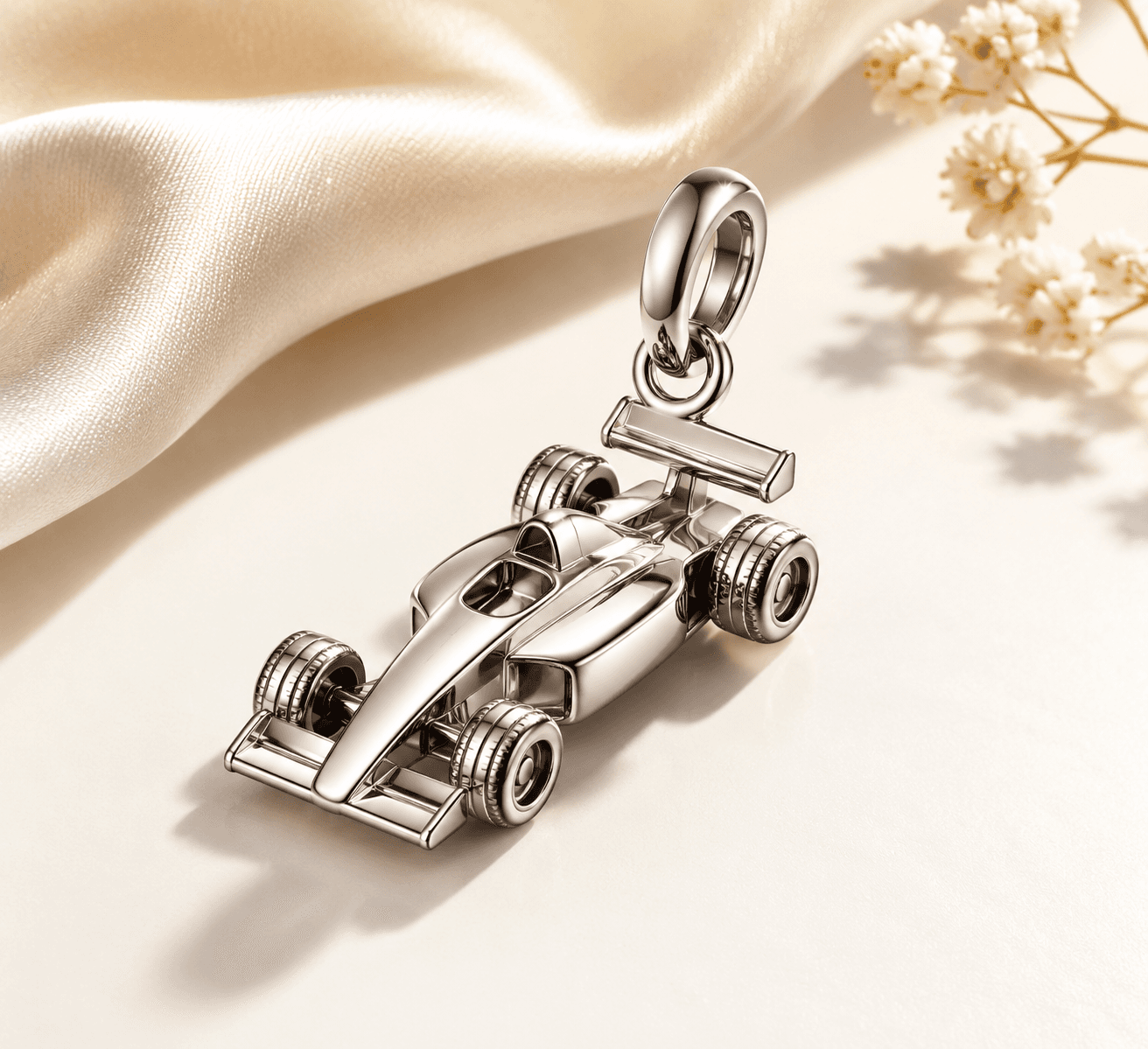
For wholesale buyers, race car charms are more than decorative accessories. They represent a product category that requires consistent manufacturing quality, reliable surface finishes, practical attachment hardware, and competitive purchasing costs. Whether you supply boutique jewelry brands, automotive-themed gift programs, charm bars, or private-label collections across the United States and Canada, choosing the right manufacturing partner can directly influence product returns, customer satisfaction, and profit margins.
Before placing a bulk order, buyers should evaluate more than the appearance of a sample. Material composition, corrosion resistance, nickel release performance, dimensional consistency, and supplier quality controls all deserve attention. This checklist explains how to assess stainless steel race car charms wholesale and how to build a dependable sourcing process for long-term commercial success.
Stainless Steel Race Car Charms Wholesale: The Essential Buyer Checklist
A successful sourcing decision starts with clearly defined specifications. Race car designs may include miniature vehicle silhouettes, racing flags, wheels, helmets, checkered patterns, or personalized number details. Regardless of the design, every charm should meet the same basic quality requirements.
1. Verify the 316L Stainless Steel Base Material
Material verification should be the first purchasing checkpoint. Lancy Jewelry focuses on 316L stainless steel charms, providing buyers with a consistent material specification for commercial collections.
- ☐ Request documentation identifying 316L stainless steel as the base material.
- ☐ Confirm that the material specification applies to every component included in the product.
- ☐ Ask whether the manufacturer maintains material inspection and batch traceability records.
- ☐ Check that the sample and production order follow the same approved material specification.
- ☐ Request relevant third-party test documentation where applicable.
Material consistency matters because different production batches can create variations in finishing performance, durability, and appearance. A documented specification helps wholesale buyers establish repeatable purchasing standards.
2. Inspect the Race Car Design and Manufacturing Details
Automotive-themed charms often contain small decorative features. These details should remain clearly defined without compromising the strength or usability of the finished product.
- ☐ Inspect the outer silhouette for smooth, consistent edges.
- ☐ Check the definition of wheels, windows, racing numbers, and decorative contours.
- ☐ Examine laser-cut details for clean and consistent execution.
- ☐ Confirm that engraving is readable and positioned correctly.
- ☐ Inspect enamel color filling for even coverage and clean boundaries.
- ☐ Check crystal inlay settings for secure placement and consistent positioning.
- ☐ Verify that the bail or jump ring passes through a real attachment hole or loop.
For wholesale collections, visual consistency is especially important. A series of ten different race car designs should maintain a coordinated appearance in dimensions, polishing quality, attachment proportions, and decorative treatment.
3. Evaluate Surface Finish and PVD Plating Quality
Surface appearance is an important factor in customer purchasing decisions. Buyers may request a polished stainless steel appearance, silver finish, gold plated options, or rose gold plating for different collection concepts.
For PVD plated stainless steel charms, inspect both the initial appearance and the manufacturer's finishing controls.
- ☐ Check whether the surface color is uniform across the entire charm.
- ☐ Inspect edges, recessed details, and attachment areas for uneven coverage.
- ☐ Look for visible scratches, pinholes, discoloration, or surface defects.
- ☐ Confirm that the approved sample establishes the color reference for production.
- ☐ Ask for documented adhesion and wear-resistance testing where relevant.
- ☐ Confirm that production batches follow the same finishing specifications.
Do not rely exclusively on photographs or showroom samples. Request physical samples and compare them under consistent lighting. For repeat orders, retain an approved reference sample and written finish specifications to reduce color variation.
4. Check Attachment Hardware and Mechanical Reliability
A decorative charm can have excellent visual quality but still create customer complaints if its attachment mechanism is poorly manufactured. The connection point deserves the same inspection attention as the decorative front.
- ☐ Confirm that the jump ring or bail is securely closed where applicable.
- ☐ Check that the attachment opening has appropriate dimensions.
- ☐ Inspect connection points for sharp edges and excessive movement.
- ☐ Test the assembled connection using an appropriate quality-control procedure.
- ☐ Verify that hardware dimensions remain consistent throughout the order.
- ☐ Ensure that the attachment mechanism does not obscure important design details.
Ask the supplier to document its assembly inspection criteria. Mechanical reliability is particularly important for products intended for repeated everyday handling.
Why Quality and Durability Matter for Wholesale Buyers
Quality control is not simply a manufacturing expense. It is a commercial safeguard. Defective products can increase return rates, create additional customer service work, delay retail launches, and reduce the profitability of an otherwise attractive collection.
5. Understand the Benefits of Documented Testing
Reliable testing documentation helps buyers evaluate whether a supplier has established measurable product-control procedures. Lancy Jewelry provides SGS-related testing documentation covering RoHS, REACH, Nickel Release EN1811, and Salt Spray 240H requirements.
These testing areas address different purchasing concerns:
- RoHS: Provides information about restricted substances within the scope of the applicable requirements.
- REACH: Supports evaluation of relevant chemical compliance obligations for products supplied to European markets.
- Nickel Release EN1811: Provides a recognized test method for assessing nickel release under applicable jewelry and skin-contact requirements.
- Salt Spray 240H: Provides corrosion-resistance testing information under specified laboratory conditions.
Buyers should request the actual reports, confirm the tested product configuration, and review the report dates and applicable test methods. A test result for one sample or finish should not automatically be treated as proof that every product variation has identical performance.
6. Evaluate Wear Resistance and Expected Product Longevity
For retail products, longevity is an important part of perceived value. Wholesale buyers should ask manufacturers how they evaluate the performance of the surface finish and assembled charm under foreseeable handling conditions.
Useful quality checks include:
- ☐ Surface abrasion assessment using an agreed testing method.
- ☐ Adhesion assessment for applicable PVD finishes.
- ☐ Corrosion testing under defined laboratory conditions.
- ☐ Nickel release assessment where relevant to the intended application.
- ☐ Inspection after mechanical handling or assembly testing.
- ☐ Comparison of samples before and after testing.
Salt spray testing is useful for evaluating corrosion behavior under controlled conditions, but a 240-hour result does not establish a guaranteed number of years of consumer use. Similarly, no finish should be marketed as completely scratch-proof or maintenance-free without appropriate evidence.
Instead of relying on broad durability promises, request written specifications, test results, and a clearly defined defect-handling policy. A dependable manufacturer should be able to explain its testing scope and the conditions under which a product warranty or quality remedy applies.
Detailed Wholesale Sourcing Guide: Price, MOQ, and Supplier Reliability
Once product quality has been evaluated, the next step is determining whether the supplier can support a commercially viable purchasing program. Bulk pricing should be assessed alongside manufacturing consistency, communication, production capacity, and repeat-order reliability.
7. Compare MOQ and Total Purchasing Costs
MOQ is an important consideration for boutique brands and smaller wholesale programs. Race car designs may require several variations, making it difficult to commit to large quantities of every individual SKU.
When discussing MOQ, buyers should clarify:
- ☐ Minimum order quantity per design.
- ☐ Whether different designs can be combined within a purchasing program.
- ☐ Whether different PVD colors have separate production minimums.
- ☐ Whether logo engraving or custom packaging changes the MOQ.
- ☐ Whether sample costs are credited toward confirmed bulk orders.
- ☐ Whether repeat orders have different quantity requirements.
Request a quotation that separates unit pricing, customization charges, sampling costs, packaging expenses, and shipping estimates. This makes it easier to calculate the actual landed cost and compare suppliers on a consistent basis.
For margin planning, consider the following formula:
Gross profit per unit = Selling price − Total landed cost per unit.
Total landed cost should include the product price, packaging, freight allocation, applicable duties, and other purchasing expenses. A lower factory quotation does not necessarily produce a better commercial result if inconsistent quality increases inspection, replacement, and return costs.
8. Assess OEM and ODM Manufacturing Capabilities
Custom development can help retailers create distinctive automotive-themed collections. However, customization requires more than accepting a design file. Buyers should evaluate the supplier's engineering and production capabilities before committing to development.
Ask whether the manufacturer can support:
- ☐ Custom race car silhouettes and decorative layouts.
- ☐ Logo engraving and personalized racing numbers.
- ☐ Laser cutting and laser marking.
- ☐ Enamel color filling and crystal setting.
- ☐ Different PVD plating specifications.
- ☐ Private-label packaging and coordinated product presentation.
- ☐ Sample development before bulk manufacturing.
A capable OEM charms manufacturer should provide clear feedback on design feasibility, production tolerances, finishing options, and expected development timelines. This is particularly useful when a buyer is planning a coordinated series rather than purchasing isolated designs.
9. Review the Manufacturer's Production Infrastructure
Factory capabilities influence production consistency and the ability to manage customized orders. Buyers should understand which processes are performed within the manufacturer's production system and how each stage is inspected.
Lancy Jewelry operates a modern manufacturing facility equipped with CNC processing, laser cutting, laser marking, welding, and polishing capabilities. These processes support the development of detailed 316L stainless steel charms and customized decorative components.
During supplier evaluation, ask for information about:
- ☐ Incoming material inspection.
- ☐ Production process monitoring.
- ☐ Surface finishing inspection.
- ☐ Dimensional and attachment checks.
- ☐ Final appearance inspection.
- ☐ Batch identification and production records.
- ☐ Procedures for identifying and correcting nonconforming products.
Manufacturing equipment is important, but documented quality procedures are equally valuable. A reliable supplier should be able to explain how it maintains consistent standards from the approved sample through final shipment.
10. Consider US and Canadian Market Requirements
North American wholesale buyers should establish product compliance requirements before approving a design. Regulatory responsibilities depend on the product's intended use, age group, marketing claims, and distribution destination.
For the United States, the Consumer Product Safety Commission (CPSC) oversees relevant consumer product safety requirements. Jewelry intended primarily for children may be subject to additional requirements, including applicable lead-content restrictions under the Consumer Product Safety Improvement Act (CPSIA). Buyers should establish whether children's product testing, certification, or other documentation is required for their specific program.
For Canada, applicable consumer product requirements should be reviewed under the Canada Consumer Product Safety Act (CCPSA) and relevant regulations. Importers should confirm the requirements for the intended product category and customer group before distribution.
What about FDA considerations? The FDA is not a general approval authority for ordinary decorative jewelry. Buyers should not request or advertise an FDA approval claim as a substitute for applicable jewelry safety documentation. If a product includes a component or intended use that falls within FDA jurisdiction, its specific requirements should be assessed separately.
For both markets, maintain accessible material declarations, applicable laboratory reports, supplier records, and product specifications. Compliance requirements should be confirmed with qualified regulatory professionals when necessary.
11. Establish a Pre-Production and Final Inspection Process
A structured inspection plan helps reduce purchasing risks and makes supplier performance easier to measure over time.
Before production:
- ☐ Approve a physical sample for each relevant design and finish.
- ☐ Confirm dimensions, weight, thickness, and attachment specifications.
- ☐ Approve engraving artwork and color references.
- ☐ Confirm packaging specifications and labeling requirements.
- ☐ Agree on acceptable defect classifications and inspection criteria.
During and after production:
- ☐ Review production samples when required.
- ☐ Check consistency across randomly selected units.
- ☐ Inspect surface finish, decorative details, and attachment hardware.
- ☐ Verify product quantities and SKU identification.
- ☐ Confirm packaging condition and shipment documentation.
- ☐ Record any defects and agree on corrective actions.
Buyers may also establish an agreed sampling inspection plan using an appropriate acceptance quality limit (AQL). The inspection level and acceptance criteria should reflect order value, product complexity, and the buyer's risk tolerance.
Frequently Asked Questions About Wholesale Race Car Charms
1. What should buyers prioritize when sourcing stainless steel race car charms wholesale?
Prioritize verified 316L stainless steel material, consistent manufacturing dimensions, secure attachment hardware, documented surface-finish testing, and supplier quality controls. Also evaluate MOQ, unit pricing, sample support, and the manufacturer's ability to manage repeat bulk orders.
2. What testing documents should a wholesale buyer request?
Depending on the destination market and intended application, request relevant RoHS, REACH, Nickel Release EN1811, and Salt Spray 240H documentation. Review the actual laboratory reports, tested product configuration, test methods, and report validity rather than relying on general marketing statements.
3. Can race car charms be customized for private-label collections?
Yes. OEM and ODM development can support custom silhouettes, logo engraving, racing number details, enamel color filling, crystal inlay, PVD finishes, and private-label packaging. Buyers should approve production samples and written specifications before confirming bulk manufacturing.
4. How can buyers reduce quality risks when placing large wholesale orders?
Begin with samples, approve measurable product specifications, request applicable testing documentation, establish inspection criteria, and conduct pre-shipment quality checks. Work with a manufacturer that maintains traceable production records and provides a clear process for handling quality issues.
Partner With Lancy Jewelry for Wholesale Stainless Steel Charms
Choosing a manufacturing partner should be a decision based on measurable quality, reliable communication, and long-term commercial value. For boutique jewelry brands, charm bar retailers, gift companies, and private-label buyers, a dependable supplier can make product development and inventory planning considerably easier.
Lancy Jewelry is a B2B 316L stainless steel charms manufacturer offering OEM and ODM development, low MOQ support, sample development, logo engraving, PVD plating, enamel color filling, crystal setting, and private-label packaging.
Our manufacturing capabilities and SGS-related testing documentation support buyers seeking consistent specifications and organized quality evaluation for North American and international markets.
Whether you are developing a race car-themed collection, expanding an existing charm assortment, or preparing a customized gift program, our team can help evaluate your design requirements and production specifications.
Explore the next steps:
- Browse All Products to review available stainless steel charm categories.
- Explore OEM Services to discuss custom designs and private-label development.
- Request a Quote for MOQ, bulk pricing, and manufacturing details.
- Contact Lancy Jewelry to discuss samples, testing documentation, and your sourcing requirements.
Send us your design references, estimated order quantity, preferred finish, and target delivery schedule. Lancy Jewelry can help you develop a practical sourcing plan built around consistent 316L stainless steel quality and dependable wholesale production.