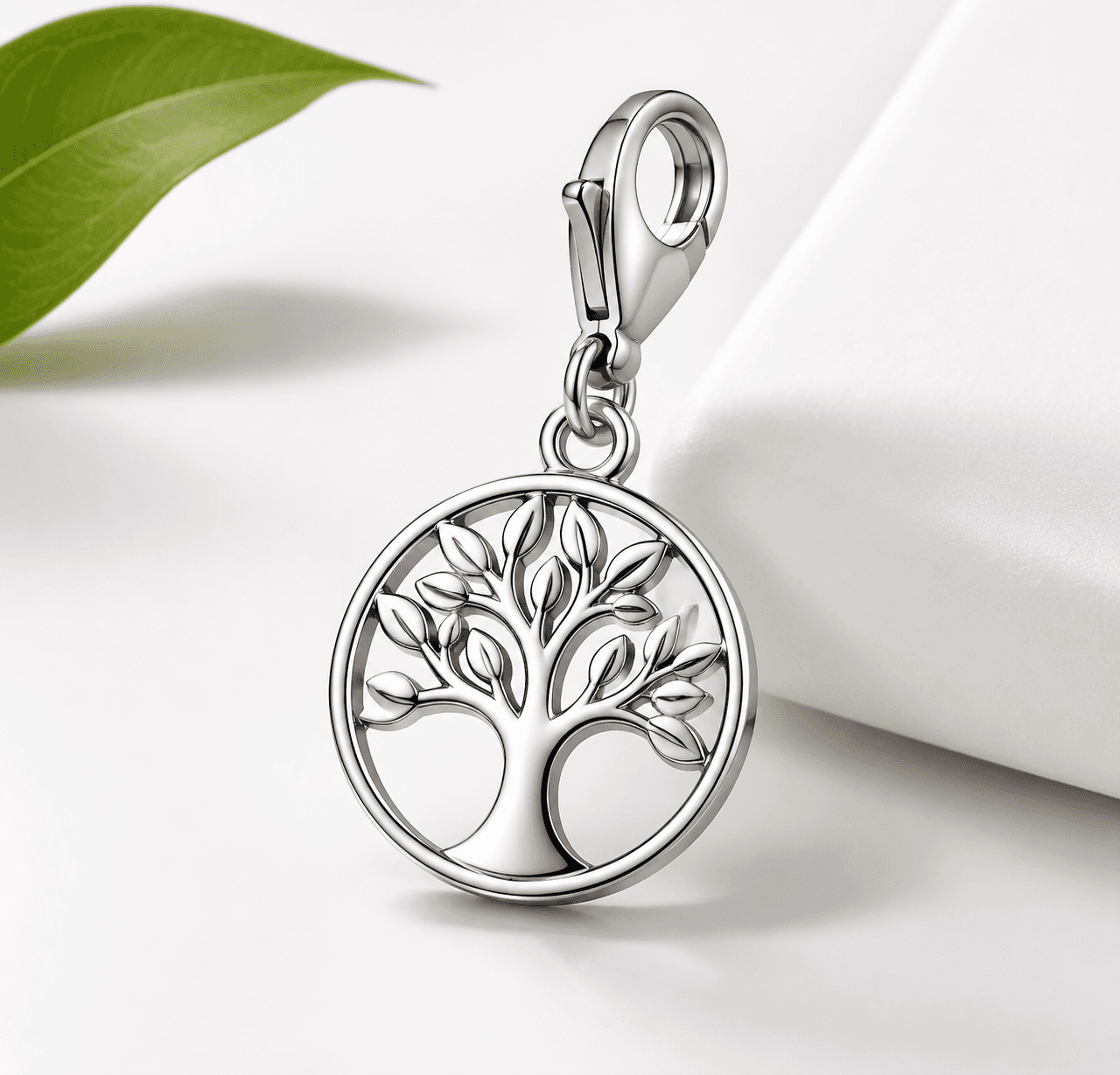
Custom car charms designed for rear-view mirror applications offer boutique retailers, gift companies, and private-label buyers an opportunity to develop distinctive accessory collections. However, a successful sourcing decision requires more than attractive designs and competitive quotations. Procurement teams must establish whether the manufacturer can demonstrate material traceability, chemical compliance, documented nickel-release testing, consistent surface finishing, and appropriate product-safety controls.
For North American buyers, the challenge is particularly important because a decorative automotive accessory may be subject to several different considerations: general consumer-product obligations, chemical restrictions, state-level requirements, and vehicle visibility or installation concerns. A supplier's statement that a product is safe is not a substitute for verifiable documentation.
This advanced checklist explains how to evaluate a stainless steel charms manufacturer, review relevant SGS testing documentation, assess 316L stainless steel charms, and establish a reliable OEM purchasing process. Use it during initial supplier qualification, sample approval, factory audits, and final bulk-order authorization.
Stainless Steel Custom Car Charms Rear View Mirror: Procurement Compliance Checklist
Before approving a supplier, define the intended application and establish a documented compliance specification. A rear-view mirror charm is generally a decorative accessory rather than a vehicle safety component, but its position inside the vehicle introduces practical considerations that should be included in the purchasing specification.
1. Confirm the Product Scope and Intended Use
- ☐ Define the product as a decorative 316L stainless steel car charm intended for rear-view mirror display.
- ☐ Specify the intended customer market, including the United States, Canada, or both.
- ☐ Document the intended installation method, attachment mechanism, and approximate finished dimensions.
- ☐ Identify whether the product will be sold individually, as a gift accessory, or within a coordinated decorative collection.
- ☐ Establish whether enamel, crystal inlay, PVD gold plated finishes, or other permitted surface treatments are required.
- ☐ Confirm that the complete assembly, including its connecting hardware, is covered by the supplier's product specification.
Procurement teams should distinguish product-material compliance from installation suitability. A product can satisfy relevant chemical testing requirements and still present a practical concern if its dimensions, weight, attachment design, or position obstruct the driver's view.
2. Verify the Base Material and Traceability
- ☐ Obtain written confirmation that the charm base material is 316L stainless steel.
- ☐ Request the material specification and available supporting test documentation.
- ☐ Confirm that the production specification identifies the material grade rather than using a general stainless steel description.
- ☐ Verify that the approved material specification is linked to the relevant product code and purchase order.
- ☐ Establish incoming inspection procedures for production materials.
- ☐ Require notification and written approval before any material or specification change.
Material identification is a critical control point. The term stainless steel alone does not establish the exact grade. Buyers should require the supplier to identify 316L stainless steel explicitly and maintain traceability between approved specifications, production batches, and inspection records.
3. Review the Chemical Compliance Documentation
- ☐ Request relevant RoHS test reports where applicable to the product and its intended market.
- ☐ Review applicable REACH requirements and restricted-substance declarations.
- ☐ Request nickel-release testing documentation using EN 1811 where relevant to the intended use and exposure classification.
- ☐ Confirm that reports identify the tested sample, test method, laboratory, and report date.
- ☐ Check whether the tested sample includes the same finish and decorative treatments as the proposed production item.
- ☐ Record the applicable compliance requirements in the supplier agreement.
Do not treat a collection of certificates as automatic proof that every product complies. The procurement team must evaluate the scope of each document and determine whether its test conditions represent the actual product being purchased.
Why Compliance Verification Matters for North American Buyers
Compliance documentation supports supplier qualification, reduces uncertainty during product launches, and creates an auditable basis for purchasing decisions. For businesses importing decorative car accessories into the United States and Canada, the objective is not simply to collect certificates. It is to establish a defensible relationship between product specifications, laboratory evidence, manufacturing controls, and the final item supplied to customers.
Key Benefit 1: RoHS Documentation Supports Chemical Risk Assessment
RoHS is a regulatory framework originating in the European Union that restricts specified hazardous substances in electrical and electronic equipment. An ordinary decorative rear-view mirror charm is not automatically within its product scope simply because a supplier provides a RoHS report.
Nevertheless, buyers may include relevant restricted-substance screening in their internal chemical-control requirements. If a product incorporates electrical or electronic functionality, its regulatory classification must be assessed separately. Procurement teams should identify the actual product scope before describing a report as evidence of RoHS compliance.
- ☐ Identify whether RoHS applies to the product category.
- ☐ Review the substances covered by the supplied report.
- ☐ Confirm the laboratory's testing scope and sample identification.
- ☐ Retain the report and associated supplier declaration in the product compliance file.
Key Benefit 2: REACH Documentation Supports Market Readiness
REACH is an EU chemical regulation, not a general North American certification. It remains relevant to businesses that distribute products in European markets or operate international sourcing programs with common chemical-control requirements.
For North American procurement teams, REACH documentation can provide useful additional information about restricted substances and substances of very high concern. However, it does not replace US or Canadian legal assessments. Buyers should request the applicable declaration, determine whether relevant restrictions apply, and review any obligations associated with articles containing substances of very high concern.
- ☐ Request an up-to-date REACH-related declaration.
- ☐ Check whether applicable restricted substances are addressed.
- ☐ Determine whether any SVHC communication obligations are relevant.
- ☐ Confirm that the declaration covers the actual product configuration.
Key Benefit 3: SGS Reports Provide Independent Test Evidence
Independent laboratory testing can strengthen supplier qualification by providing evidence beyond a manufacturer's internal statement. Lancy Jewelry provides SGS-tested documentation covering RoHS, REACH, Nickel Release EN1811, and Salt Spray 240H.
For procurement purposes, the important distinction is between a laboratory test report and a blanket product certification. A report demonstrates the results obtained for an identified sample under specified testing conditions. It does not automatically establish that every subsequent design, finish, or production batch has identical results.
- ☐ Obtain the complete report rather than relying exclusively on a certificate image.
- ☐ Check the laboratory identity and report reference.
- ☐ Verify sample descriptions, photographs, and product identification.
- ☐ Review test methods, measured results, and applicable acceptance criteria.
- ☐ Confirm whether the report covers the requested finish and decorative configuration.
- ☐ Establish a process for reviewing updated reports when specifications change.
Key Benefit 4: Nickel-Release Testing Addresses an Important Contact-Safety Question
Nickel release is an important consideration for jewelry and accessories that may contact skin. EN 1811 is a recognized European test method for determining nickel release from products intended for direct and prolonged skin contact, with specific application requirements and limitations.
A rear-view mirror charm is generally intended to hang inside a vehicle rather than remain in prolonged skin contact. Therefore, the applicable nickel-release classification should be assessed according to the actual product design, foreseeable use, and relevant market requirements. Buyers should not assume that every decorative automotive accessory falls into the same regulatory category as a wearable jewelry item.
- ☐ Request the EN 1811 report where applicable to the product specification.
- ☐ Verify the tested sample and surface treatment.
- ☐ Review the reported nickel-release result and relevant acceptance criteria.
- ☐ Determine whether additional exposure-related requirements apply.
- ☐ Retain the evidence as part of the product safety documentation.
Key Benefit 5: Salt Spray Testing Helps Evaluate Finish Durability
For decorative accessories, finish consistency influences both product presentation and customer satisfaction. Lancy Jewelry offers SGS-tested Salt Spray 240H documentation. This testing can provide useful information about corrosion resistance under specified accelerated conditions.
However, a 240-hour salt spray result should not be interpreted as a guaranteed equivalent number of years in normal use. Actual performance depends on the test protocol, product construction, surface preparation, finish thickness, environmental exposure, and maintenance conditions.
- ☐ Request the relevant Salt Spray 240H test report.
- ☐ Confirm the tested finish matches the production specification.
- ☐ Review the observed surface condition and evaluation criteria.
- ☐ Include finish inspection in sample approval and production quality control.
Detailed Supplier Evaluation and Factory Audit Checklist
Compliance documents are only one part of a complete supplier assessment. A qualified manufacturing partner must also demonstrate that approved specifications can be reproduced consistently, that production changes are controlled, and that nonconforming products can be identified before shipment.
Step 1: Evaluate Manufacturing Capability
Assess whether the supplier controls the processes needed to manufacture custom stainless steel charms rather than simply coordinating outsourced production. A factory's equipment and production workflow should correspond to the technical requirements of the requested design.
Lancy Jewelry operates a modern manufacturing facility equipped with CNC equipment, laser cutting, laser marking, welding, and polishing capabilities. These processes support custom product development, dimensional control, decorative detailing, and surface finishing.
- ☐ Review the factory's actual manufacturing capabilities.
- ☐ Confirm which processes are performed in-house.
- ☐ Request production samples demonstrating engraving and finishing quality.
- ☐ Evaluate the consistency of edges, openings, attachment points, and polishing.
- ☐ Verify that production capacity matches the forecast order quantity.
- ☐ Ask how production records and inspection results are maintained.
Step 2: Audit Design and Engineering Controls
Rear-view mirror charms require particular attention to the connection between the decorative element and its suspension mechanism. An attractive front design is insufficient if the attachment system is unreliable or mechanically impractical.
- ☐ Request dimensioned drawings showing the complete product.
- ☐ Verify that attachment holes and loops are correctly positioned.
- ☐ Check that jump rings or connecting components pass through actual holes or loops.
- ☐ Confirm that closed connections remain secure under the specified inspection procedure.
- ☐ Review edge finishing and identify any sharp or irregular areas.
- ☐ Assess the finished dimensions and weight for the intended application.
- ☐ Confirm that the proposed hanging arrangement does not create unnecessary visual obstruction.
Require a documented design review before tooling or production approval. Any engineering adjustment that changes the product's dimensions, attachment method, or finish should trigger a revised approval record.
Step 3: Evaluate Surface Finishing and Decorative Treatments
Surface treatment can influence appearance, durability, and chemical test results. Buyers should evaluate each requested finish independently instead of assuming that one tested sample represents every finish variation.
- ☐ Specify the required PVD gold plating, silver finish, or rose gold plating.
- ☐ Define acceptable color consistency and visual appearance.
- ☐ Specify enamel color references and filling quality where applicable.
- ☐ Review crystal inlay positioning and retention.
- ☐ Request finish-specific inspection records.
- ☐ Confirm whether additional testing is necessary after a finish or process change.
For coordinated boutique collections, establish a master reference sample and written finish tolerances. This makes visual approval more objective and reduces disagreements between procurement, manufacturing, and receiving teams.
Step 4: Conduct a Documentation Audit
Organize supplier documentation into a controlled compliance file. A procurement department should be able to trace a finished product back to its approved specifications and relevant test evidence without relying on informal email explanations.
| Document | Verification objective | Priority |
|---|---|---|
| Material specification | Confirms 316L stainless steel identification | Required |
| RoHS report | Reviews applicable restricted-substance testing | Scope dependent |
| REACH declaration | Addresses relevant chemical obligations | Market dependent |
| SGS test reports | Provides independent laboratory evidence | High |
| EN 1811 report | Documents relevant nickel-release testing | Application dependent |
| Salt Spray 240H report | Supports finish durability evaluation | Recommended |
| Approved drawings | Controls dimensions and attachment design | Required |
| Inspection records | Documents production acceptance results | Required |
| Packaging specification | Controls retail presentation and labeling | Required |
Step 5: Establish Production Quality Controls
Factory audits should examine how quality requirements are implemented during production, not just how samples look at the beginning of a project.
- ☐ Review incoming material inspection records.
- ☐ Confirm that approved drawings are available at production stations.
- ☐ Examine in-process dimensional and visual inspection procedures.
- ☐ Review finish inspection and defect classification criteria.
- ☐ Verify that rejected products are identified and segregated.
- ☐ Request final inspection records for each production batch.
- ☐ Establish corrective-action procedures for repeated defects.
- ☐ Require written approval for production deviations.
For bulk charm orders, define acceptance criteria before issuing the purchase order. Specify acceptable cosmetic variations, critical functional defects, sampling methods, and corrective-action responsibilities. Where appropriate, establish an agreed statistical sampling plan rather than leaving acceptance decisions entirely to subjective visual judgment.
Step 6: Address US and Canadian Product-Safety Considerations
North American buyers should evaluate the product according to its intended use and the jurisdictions in which it will be distributed. Chemical test reports are valuable, but they do not replace product-specific legal review.
United States: Consider applicable Consumer Product Safety Commission requirements, relevant consumer-product rules, and state-specific chemical disclosure obligations. California Proposition 65 may require additional evaluation if exposure to a listed chemical is foreseeable. Whether a warning is required depends on the substance, exposure, and applicable legal thresholds, not simply the presence of a laboratory report.
Canada: Assess applicable obligations under the Canada Consumer Product Safety Act and associated regulations. Review chemical composition, product labeling, import responsibilities, and any relevant bilingual packaging requirements for the intended distribution channels.
Vehicle visibility: Because the product hangs near the driver's viewing area, evaluate dimensions, suspension length, placement, and foreseeable movement. Applicable vehicle visibility requirements and provincial or state traffic rules must be reviewed independently. Buyers should avoid marketing or installation instructions that encourage placement in a position that obstructs the driver's view or interferes with vehicle controls, sensors, or airbag deployment areas.
FDA considerations: The FDA is generally not the primary regulatory authority for an ordinary decorative rear-view mirror charm. FDA requirements are relevant to specific regulated product categories, not automatically to general automotive decorative accessories. Buyers should not request an FDA certificate as a substitute for applicable consumer-product, chemical, or vehicle-safety assessments. If a product's claims or intended use introduce a separately regulated function, obtain a product-specific regulatory assessment.
Step 7: Approve Samples Before Authorizing Bulk Production
Sample development is a critical stage in OEM procurement. Never authorize a full production run solely on the basis of a rendering, quotation, or previous unrelated sample.
- ☐ Approve the final product drawing and dimensions.
- ☐ Inspect the 316L stainless steel specification.
- ☐ Evaluate the actual finish under consistent lighting.
- ☐ Inspect engraving, enamel filling, and crystal inlay where applicable.
- ☐ Test the attachment mechanism using an agreed inspection procedure.
- ☐ Review the sample's weight, balance, and intended hanging arrangement.
- ☐ Confirm the packaging and labeling specification.
- ☐ Retain a signed or otherwise documented golden sample.
- ☐ Obtain written approval before mass production begins.
The approved sample should become the reference for subsequent manufacturing and inspection. If the design changes after approval, document the revision and determine whether new samples or laboratory testing are required.
Common Supplier Qualification Mistakes to Avoid
Even experienced procurement teams can overlook important gaps when purchasing decorative accessories. The following mistakes should be treated as warning indicators during supplier evaluation.
- Accepting generic certificates: A document without identifiable sample information or a relevant testing scope cannot establish product-specific compliance.
- Confusing market requirements: REACH and RoHS are not universal North American product approvals. Determine which regulations actually apply.
- Ignoring finish differences: Different PVD colors or decorative treatments may require separate evaluation.
- Approving appearance without function: A visually attractive charm still requires inspection of attachment integrity, dimensions, and edges.
- Skipping production traceability: A compliant development sample does not automatically prove that every subsequent production batch follows the same specification.
- Ignoring automotive placement: A decorative accessory must be assessed for its position and potential impact on driver visibility.
- Failing to control changes: Unapproved changes to materials, finishes, or construction can invalidate previous assumptions and test evidence.
A disciplined supplier qualification program should connect every requirement to an accountable person, a verifiable document, and a defined approval stage.
Frequently Asked Questions
1. Are 316L stainless steel car charms suitable for rear-view mirror applications?
316L stainless steel provides a suitable manufacturing base for many decorative charm applications because it supports durable construction and refined surface finishing. However, suitability depends on the complete product design, dimensions, attachment mechanism, finish, and intended use. Buyers should evaluate mechanical integrity, chemical documentation, and vehicle visibility considerations before approving a product.
2. Which compliance documents should buyers request from a stainless steel charms manufacturer?
Start with the 316L stainless steel material specification, relevant SGS laboratory reports, applicable RoHS and REACH documentation, and EN 1811 nickel-release evidence where relevant. Lancy Jewelry provides SGS-tested documentation covering RoHS, REACH, Nickel Release EN1811, and Salt Spray 240H. Buyers should verify each report's sample identification, scope, test method, and relevance to the proposed product.
3. Does a RoHS or REACH report automatically prove that a car charm is compliant in the United States and Canada?
No. RoHS and REACH have their own regulatory scopes and do not automatically establish compliance with US or Canadian consumer-product requirements. North American buyers should separately assess applicable CPSC requirements, the Canada Consumer Product Safety Act, relevant state or provincial obligations, and vehicle placement considerations. Product-specific legal review may be necessary.
4. What should procurement teams check before placing a bulk OEM order?
Approve the material specification, final drawings, attachment design, surface finish, applicable compliance reports, and packaging requirements. Inspect and retain an approved production sample, establish written quality acceptance criteria, and confirm production traceability. A documented approval process reduces specification disputes and helps maintain consistency throughout bulk production.
Partner With Lancy Jewelry for Compliant OEM Car Charm Development
Selecting the right manufacturing partner requires more than comparing quotations. Boutique jewelry brands, charm bar retailers, gift companies, and private-label buyers need a supplier capable of connecting engineering, production, documentation, and quality control within one structured sourcing process.
Lancy Jewelry is a B2B OEM/ODM 316L stainless steel charms manufacturer supporting custom development for international buyers. Our manufacturing capabilities include CNC processing, laser cutting, laser marking, welding, polishing, PVD plating, enamel color filling, crystal setting, logo engraving, and private-label packaging.
Our SGS-tested documentation covers RoHS, REACH, Nickel Release EN1811, and Salt Spray 240H, providing procurement teams with supporting evidence for supplier evaluation and product documentation. Test applicability and sample coverage should always be confirmed against the specific product configuration.
We support low MOQ projects, coordinated boutique-ready series planning, sample development, and bulk production requirements. Whether you are developing a distinctive rear-view mirror charm collection or expanding an established gift accessory program, our team can help translate your product specification into a controlled manufacturing project.
Start your sourcing process with these actions:
- ☐ Prepare your product concept, reference drawings, and target dimensions.
- ☐ Specify the required 316L stainless steel construction and finish.
- ☐ Identify your target market and relevant compliance requirements.
- ☐ Define your expected MOQ, quantity forecast, and packaging needs.
- ☐ Request sample development and supporting documentation.
Explore our 316L stainless steel product catalog to review available product directions, learn about our OEM and ODM manufacturing services, or contact Lancy Jewelry to discuss your project requirements. For a detailed purchasing inquiry, submit your specifications through our Request a Quote page.
Make compliance a sourcing requirement from the beginning, not a corrective action after production. Partner with Lancy Jewelry to develop custom stainless steel charms with documented specifications, controlled manufacturing processes, and a practical path from sample approval to bulk production.