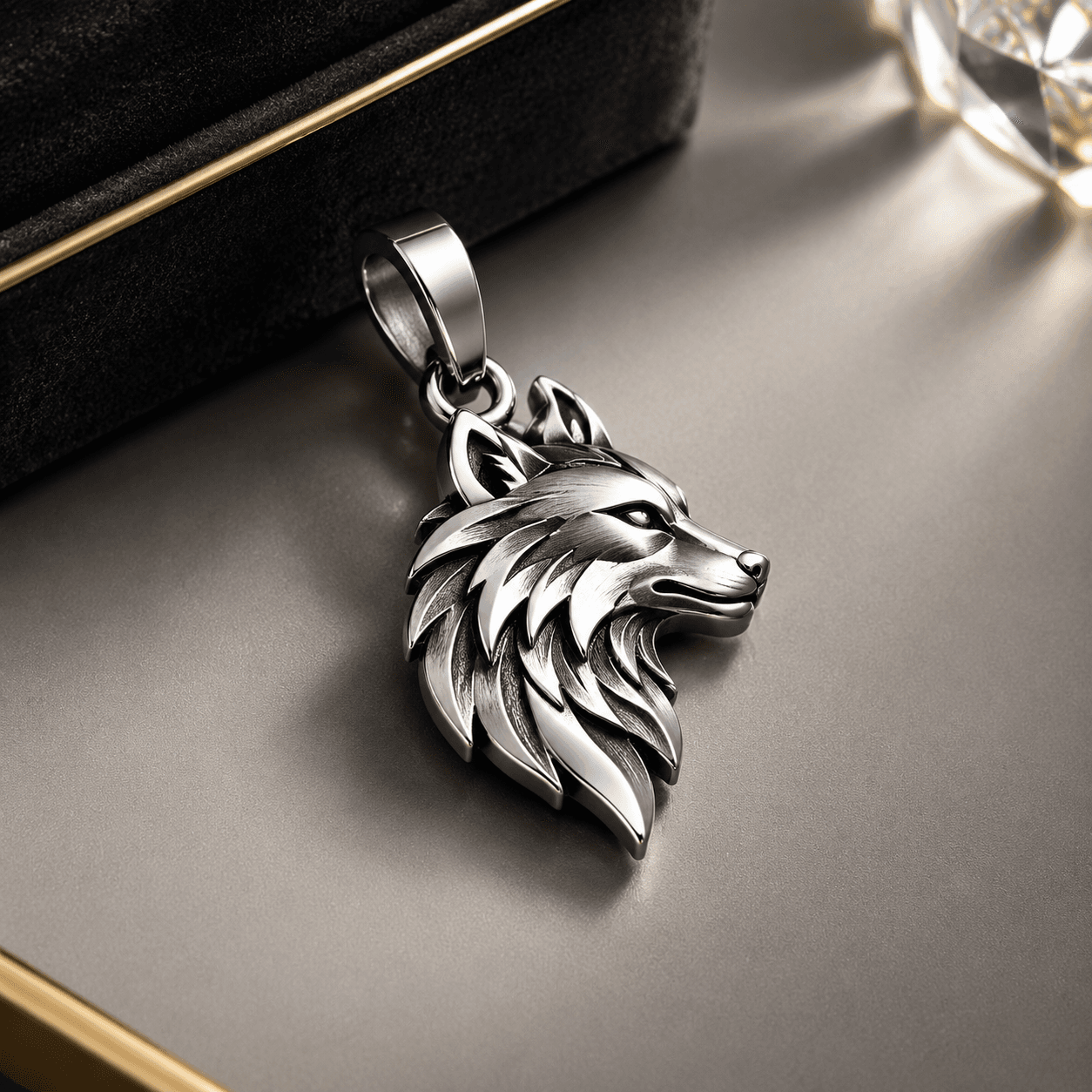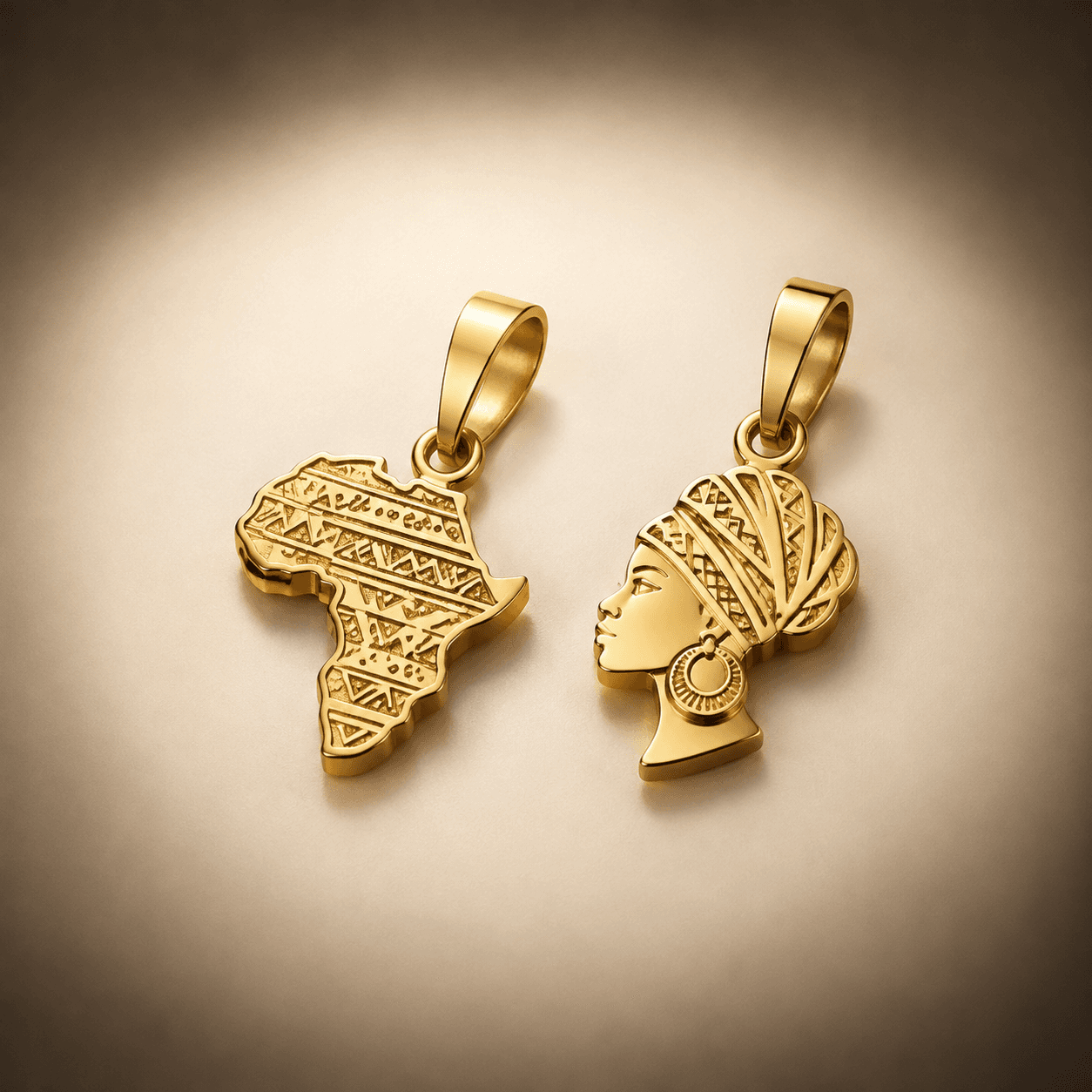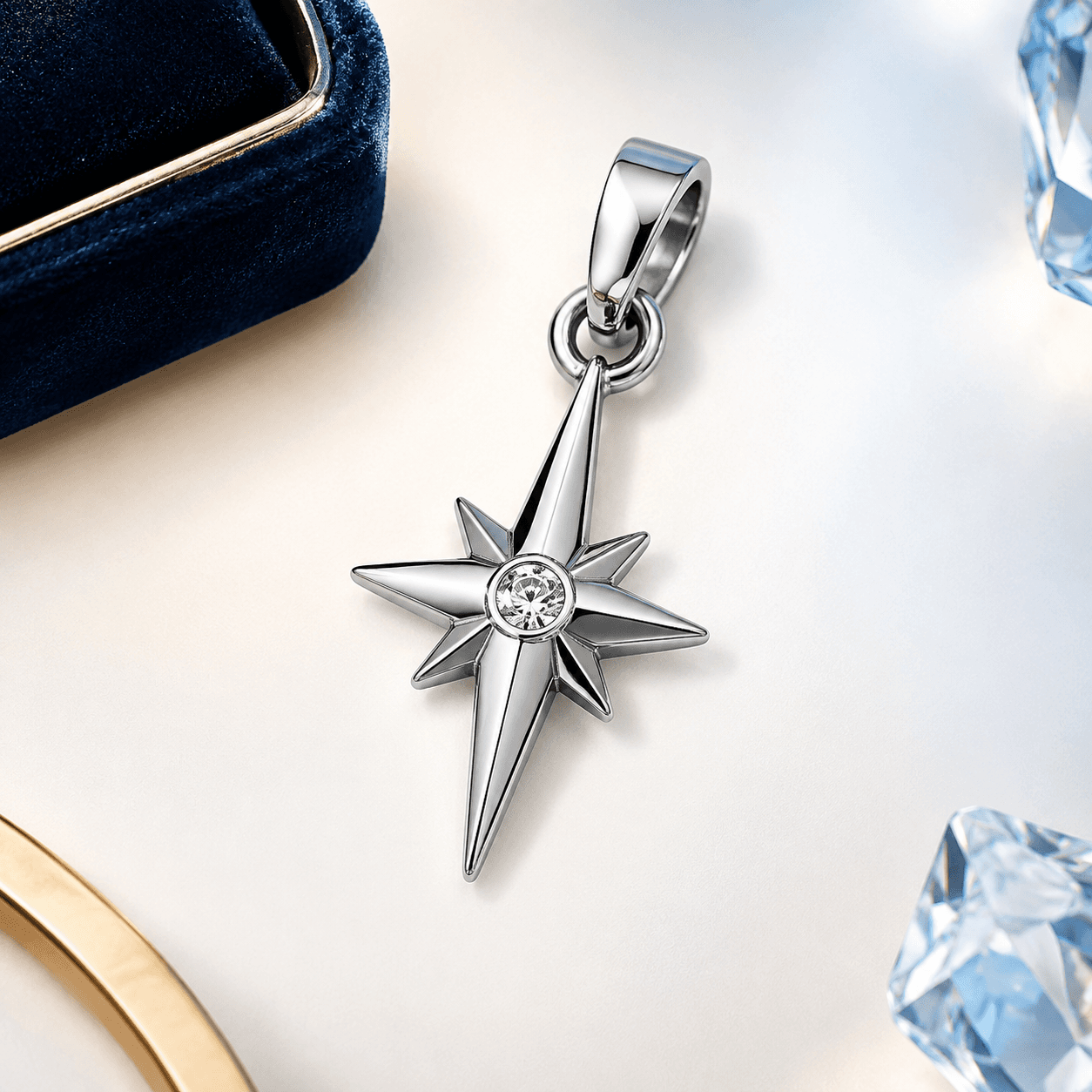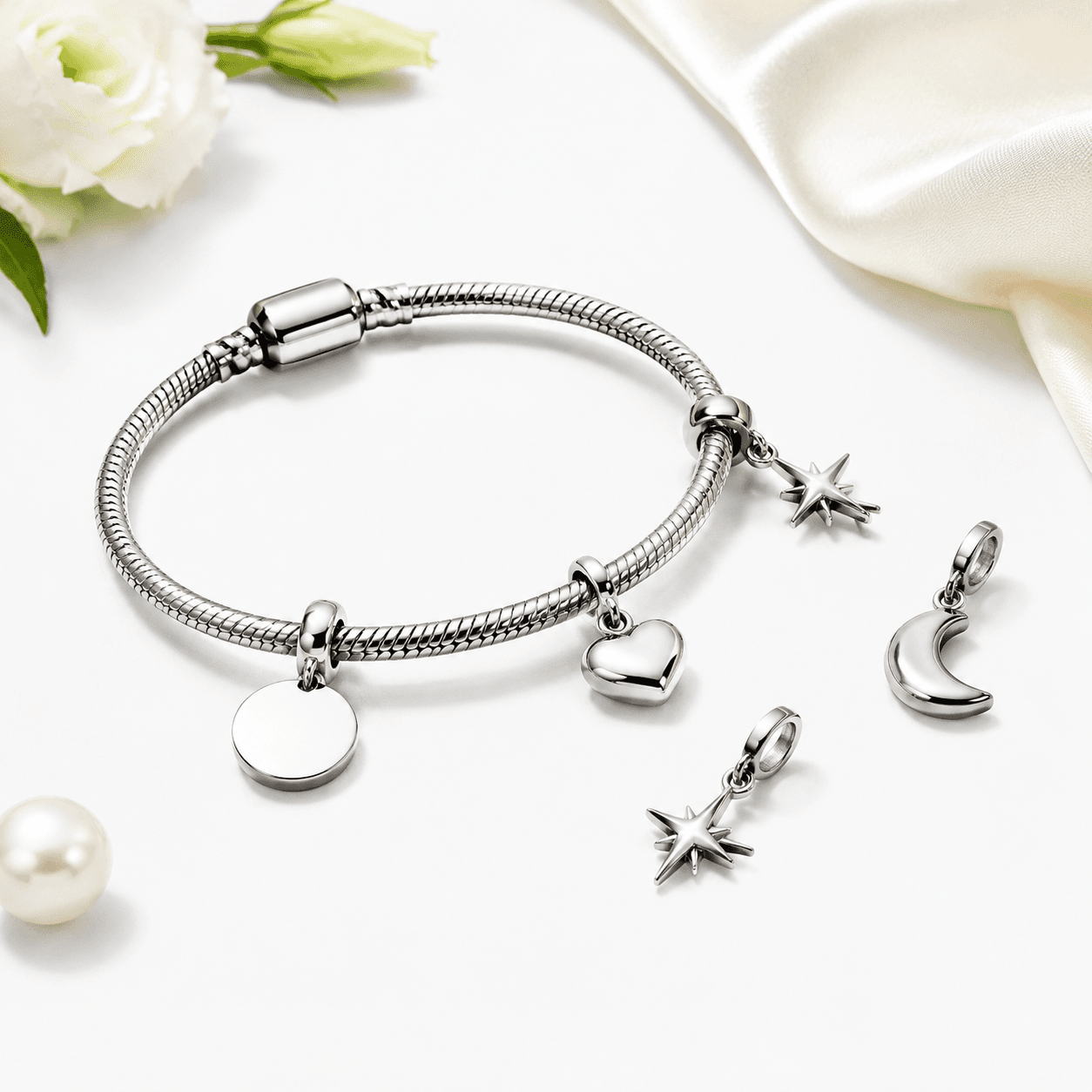
Minimalist charm design leaves little room for manufacturing inconsistencies. On a clean geometric silhouette, a visible polishing mark, uneven gold tone, rough edge, or poorly defined engraving can change the entire appearance of the finished product. For jewelry designers and sourcing managers, choosing the right surface finish is therefore a core product development decision, not a final decorative step.
This guide compares PVD coating, electroplating, mechanical polishing, and complementary surface treatments for 316L stainless steel charms. It explains how each process affects appearance, how to define finish specifications, and how to evaluate samples before committing to wholesale stainless steel charms or a private-label launch. The objective is straightforward: translate a design concept into a repeatable production specification that supports consistent quality across an entire collection.
Minimalist Stainless Steel Charm Design Features and Finishing Options
Minimalist designs typically rely on restrained geometry, balanced proportions, smooth surfaces, and carefully controlled details. Circles, bars, hearts, initials, stars, and abstract geometric forms are effective because their simplicity makes the surface treatment especially noticeable.
Why surface finishing matters in minimalist design
Finishing influences reflectivity, perceived color, edge definition, engraving visibility, and the tactile impression of a charm. A mirror finish creates strong highlights, while a satin finish produces a softer, more controlled reflection. Gold plated finishes introduce warmth, and a silver finish preserves a neutral metallic appearance. Rose gold plating offers another color direction for coordinated collections.
Before selecting a finish, designers should establish three priorities: the intended visual effect, the expected use environment, and the acceptable variation between production batches. These priorities provide a practical basis for comparing finishing processes.
Finishing methods at a glance
| Method | Visual result | Primary purpose | Key buyer consideration |
|---|---|---|---|
| Mechanical polishing | Bright, smooth, or mirror-like surface | Refines the surface and controls reflectivity | Inspect edges, recesses, and consistency |
| PVD coating | Controlled decorative color, including gold tones | Deposits a functional decorative coating | Confirm process specifications and adhesion testing |
| Electroplating | Decorative metallic color or finish | Applies a coating through an electrochemical process | Request details of the coating system and quality controls |
| Brushed or satin treatment | Soft, directional, or diffused reflection | Creates a less reflective surface texture | Check texture direction and uniformity |
| Enamel color filling | Defined areas of solid color | Adds controlled color accents to a metal design | Specify color references, fill boundaries, and coverage |
These processes serve different purposes and should not be treated as interchangeable. Polishing prepares and refines a surface, coating processes establish decorative layers, and enamel adds color within designated design areas. A successful specification defines how these elements work together.
Benefits of Selecting the Right Finish
Consistent appearance across a collection
When several charm designs share a finish, buyers need a coordinated visual result rather than a collection of unrelated color interpretations. This is particularly important for minimalist series, where small differences in warmth, brightness, and reflection can become obvious when products are displayed side by side.
Establish a master sample for every approved finish. Use it as the visual reference for subsequent sampling and production approval. Record the intended color, surface texture, reflective quality, and any acceptable variation. For gold plated and rose gold plating options, compare samples under consistent lighting to reduce misleading differences caused by the viewing environment.
Reliable performance in everyday use
Surface durability depends on more than the name of a finish. Base material quality, surface preparation, coating chemistry, process control, component geometry, and wear conditions all influence performance. Sweat, cosmetics, friction, cleaning practices, and repeated contact can affect decorative surfaces over time.
316L stainless steel provides a consistent base for developing minimalist charms. However, the base material alone does not guarantee that every coating will perform identically. Buyers should evaluate the complete finished component, including its coating and surface preparation, under suitable test conditions.
More predictable customization and quality control
A documented finish specification reduces ambiguity between designers, sourcing teams, and manufacturers. It also makes revisions easier to manage when a collection expands from a few sample designs to a larger commercial assortment.
Lancy Jewelry supports OEM and ODM development for 316L stainless steel charms, including laser marking, logo engraving, polishing, PVD plating, enamel color filling, crystal setting, and private-label packaging. The development process can be organized around approved drawings, finish references, samples, and production inspection criteria.
Material and compliance verification
Material verification and finished-product testing should form part of supplier evaluation. Lancy reports SGS certification and testing coverage for RoHS, REACH, Nickel Release EN1811, and Salt Spray 240H. Buyers should request relevant documentation, confirm the applicable product and test scope, and check that the reports match their market requirements. Certification or test coverage should never be assumed to guarantee every finished design or every future production batch without verification.
Detailed Guide: Comparing PVD, Electroplating, and Polishing
1. PVD coating: For controlled decorative color
PVD, or physical vapor deposition, is a coating process used to deposit a thin material layer onto a prepared surface under controlled conditions. For minimalist 316L stainless steel charms, it is particularly relevant when a collection requires gold tones or coordinated color finishes.
Strengths: PVD can provide a consistent decorative appearance when the surface preparation, coating parameters, and inspection process are well controlled. It can be used for coordinated product families and designs with clean, uninterrupted surfaces.
Limitations: Results depend on the coating system, substrate preparation, component geometry, and operating conditions. Recesses and complex details may require specific process controls. PVD should not be treated as scratch-proof, and buyers should not assume a universal service life without supporting test data.
Buyer recommendation: Request a finished sample and clarify the target color, coating specification, adhesion criteria, and available wear or corrosion test results. Confirm whether the sample represents the actual production process rather than a visual mock-up.
2. Electroplating: For decorative metallic finishes
Electroplating uses an electrical current to deposit a coating onto a conductive surface. The final appearance and performance depend on the coating system, surface preparation, layer structure, process control, and inspection standards.
Strengths: Electroplating can support a range of decorative metallic appearances. It may be appropriate where the manufacturer has an established process for the specified finish and component design.
Limitations: Color variation, inadequate preparation, uneven deposition, and insufficient coating control can affect the finished result. Performance cannot be judged by color alone. Buyers should also consider adhesion, coverage, and resistance to the conditions expected during use.
Buyer recommendation: Ask the manufacturer to identify the proposed coating process, explain its quality controls, and provide relevant test results. Compare the sample with the approved reference under identical lighting and inspect both broad surfaces and recessed areas.
3. Mechanical polishing: For clean lines and controlled reflection
Mechanical polishing refines the surface by reducing visible irregularities and creating a specified degree of smoothness and reflectivity. It is especially important for minimalist shapes because their broad, uninterrupted surfaces make defects easier to see.
Strengths: Polishing supports bright surfaces, rounded edge transitions, and a more refined overall appearance. It also helps prepare a component for subsequent finishing when the selected coating process requires a controlled surface condition.
Limitations: Excessive or inconsistent polishing can soften fine edges, reduce engraving definition, and alter small geometric details. Narrow recesses and internal corners may require dedicated tooling or additional process attention.
Buyer recommendation: Define whether the design requires a mirror, bright, or satin result. Inspect edge sharpness, hole geometry, engraving legibility, and surface uniformity. For designs combining polished and textured zones, identify each zone clearly on the drawing.
4. Surface texture and decorative details
Brushed textures, controlled matte areas, enamel, and crystal inlay can add distinction without making a minimalist design visually complicated. The key is to specify each detail precisely and avoid combining too many finishes without a clear design purpose.
| Design requirement | Recommended direction | Sample approval checkpoint |
|---|---|---|
| Bright geometric charm | Controlled mechanical polishing | Reflectivity, edge definition, visible marks |
| Warm metallic color | PVD coating or a validated electroplating process | Color match, coating coverage, adhesion evidence |
| Soft, understated appearance | Satin or brushed surface treatment | Texture direction and uniformity |
| Small color accent | Enamel color filling | Color match, fill boundaries, surface cleanliness |
| Decorative focal point | Crystal inlay with a defined setting | Setting security, alignment, and surrounding finish |
For every option, require the manufacturer to confirm which process steps are feasible for the selected geometry and target quantity. A technically attractive concept is only commercially useful when it can be manufactured consistently.
5. Side-by-side purchasing comparison
| Evaluation factor | PVD coating | Electroplating | Polishing |
|---|---|---|---|
| Main function | Decorative coating and color | Decorative coating and color | Surface refinement and reflectivity |
| Best design role | Coordinated colored surfaces | Specified plated appearance | Bright or refined base surface |
| Color selection | Depends on available coating system | Depends on available plating system | Primarily changes reflectivity and surface appearance |
| Critical control | Preparation, deposition, and adhesion | Preparation, deposition, and coverage | Surface uniformity and geometry retention |
| Evidence to request | Approved color sample and relevant test data | Approved color sample and relevant test data | Approved finish sample and inspection criteria |
There is no universally best finish for every charm. The correct choice depends on the intended appearance, geometry, performance expectations, budget, and manufacturing controls. For some designs, polishing is a preparatory step before coating rather than an alternative to it.
How to Specify Finishes for OEM Charm Production
Step 1: Define the visual target
Provide a drawing or clear design file showing dimensions, thickness, hole positions, edge profiles, engraving, and decorative features. Identify the required surface finish for each visible area. For color finishes, provide an approved physical reference or a clearly defined color target where available.
Step 2: Confirm the 316L stainless steel specification
Specify 316L stainless steel as the base material and request documentation supporting the material declaration. Do not rely solely on a generic product description. Confirm whether the documentation applies to the actual production components being quoted.
Step 3: Request a process-specific sample
Sampling should reproduce the intended surface preparation, coating method, and decorative details as closely as practical. Ask the manufacturer to identify any differences between the sample process and the planned production process. Record the approved sample reference before authorizing bulk manufacturing.
Step 4: Agree on inspection and testing criteria
Define the acceptance criteria before production starts. Relevant checks may include color consistency, surface defects, engraving clarity, dimensions, attachment-hole accuracy, coating adhesion, and suitable corrosion or wear testing. Salt spray results must be interpreted according to the test method, duration, specimen preparation, and acceptance criteria; a 240-hour test result is not a universal prediction of service life.
Step 5: Review MOQ, lead time, and repeat-order controls
For a boutique launch, clarify the MOQ for each design and finish, sample charges, tooling requirements, packaging options, and expected production schedule. Ask how color references and approved samples are retained for repeat orders. When a collection contains several related designs, discuss whether shared specifications can streamline development and inspection without compromising product-specific requirements.
These controls help buyers compare quotations on a consistent basis. A lower initial price is not necessarily the most economical option if the specification is unclear, finish variation is high, or repeat production requires extensive reapproval.
Common Sourcing Mistakes to Avoid
- Choosing by photographs alone: Images cannot reliably establish coating thickness, adhesion, or long-term wear performance.
- Using vague color descriptions: Terms such as gold or rose gold need a reference and defined acceptance range.
- Ignoring geometry: Deep recesses, small holes, and narrow edges can complicate polishing and coating consistency.
- Approving a sample without records: Keep the approved sample, drawing, finish specification, and test criteria together.
- Assuming every finish has identical durability: Evaluate each finish system and intended use separately.
- Waiting until production to define packaging: Include private-label packaging requirements in the initial RFQ to align dimensions, presentation, and delivery planning.
Frequently Asked Questions
Which finish is best for minimalist 316L stainless steel charms?
The best finish depends on the design objective. PVD coating is a strong option for coordinated decorative color, electroplating can support specified metallic finishes, and mechanical polishing creates bright or refined surfaces. Approve samples and compare relevant performance evidence before making a final selection.
Are PVD plated stainless steel charms scratch-proof?
No decorative finish should be described as scratch-proof without an appropriate, clearly defined qualification. Performance depends on the coating system, surface preparation, geometry, contact conditions, and maintenance. Ask for relevant test data and confirm the acceptance criteria for your application.
What information should a buyer include in an OEM charm RFQ?
Include the design file, dimensions, 316L stainless steel base specification, target finish, color reference, engraving or logo requirements, decorative details, estimated order quantity, target delivery date, packaging needs, and required compliance documentation. This information helps the manufacturer assess feasibility and prepare a more meaningful quotation.
Can a manufacturer develop a coordinated series with different finishes?
Yes, provided the designs and requested processes are technically feasible. A coordinated series can use shared design principles while varying PVD color, surface texture, enamel details, or crystal inlay. Approve each finish combination individually and establish clear references for repeat production.
Partner With Lancy Jewelry for Custom Charm Development
Choosing a finish is a manufacturing decision that should be supported by design intent, documented specifications, and practical sample evaluation. Lancy Jewelry works with boutique brands, charm bar retailers, gift companies, distributors, and private-label buyers to develop custom 316L stainless steel charms for differentiated commercial collections.
Our capabilities include OEM and ODM development, CNC processing, laser cutting, laser marking, welding, polishing, logo engraving, PVD plating, enamel color filling, crystal setting, and private-label packaging. We support sample development and low MOQ discussions to help buyers evaluate designs before committing to larger orders.
For your next project, prepare your drawings, target finish references, estimated quantities, and packaging requirements. Explore our 316L stainless steel charm product range, review our OEM manufacturing services, or request a quote with your design specifications. Our team can help assess the finishing approach, sampling requirements, and production considerations for your collection.