Choosing a stainless steel cute bag charm factory in China is not simply a matter of comparing unit prices and browsing attractive product photographs. For e-commerce sellers, a sourcing decision directly affects product reviews, return rates, customer satisfaction, shipping performance, and long-term profitability. A charm that looks attractive in a supplier's catalog but develops surface wear, has poorly finished edges, or arrives with unreliable attachment hardware can quickly become an expensive business problem.
The right supplier must demonstrate material consistency, measurable durability, dependable production controls, and practical support for online retail operations. This checklist explains how to evaluate a factory before placing a wholesale order, what documentation to request, which tests matter, and how to prepare products for North American e-commerce customers.
How to Vet a Stainless Steel Cute Bag Charm Factory China
1. Verify the Factory's Actual Manufacturing Capabilities
Start by determining whether the supplier operates a manufacturing facility or primarily coordinates production through external workshops. A capable stainless steel charms manufacturer should explain its production process clearly and identify which operations are performed in-house.
For cute bag charm projects, inspect the supplier's capabilities in CNC machining, laser cutting, laser marking, welding, polishing, surface finishing, and assembly. These processes influence dimensional accuracy, decorative detail, edge quality, and the reliability of attachment points.
Ask for production photographs, process descriptions, and examples of completed projects. Do not rely exclusively on polished catalog images. Request close-up photographs of actual production samples, including the front, reverse, edges, and attachment mechanism.
Factory verification checklist:
- ☐ Confirm that the supplier has an identifiable manufacturing facility.
- ☐ Request photographs of production equipment and working areas.
- ☐ Verify in-house capabilities for cutting, marking, welding, and polishing.
- ☐ Ask who performs plating, enamel filling, crystal setting, and final inspection.
- ☐ Request examples of previously completed OEM and ODM projects.
- ☐ Confirm that the factory can maintain consistent specifications across repeat orders.
2. Confirm 316L Stainless Steel Material Specifications
Material verification should be one of the first technical checkpoints. Lancy Jewelry focuses exclusively on 316L stainless steel charms as its base material. Buyers should request a written material specification rather than accepting a general description such as stainless steel.
316L stainless steel is widely selected for jewelry and decorative accessories because of its corrosion resistance, durability, and suitability for products intended for repeated handling. However, the material designation alone does not guarantee that every finished product will perform identically. Manufacturing quality, surface finishing, plating processes, and product design also influence the final result.
Request documentation that identifies the material grade and ask how incoming material is checked. Where appropriate, discuss material verification through suitable analytical testing and traceability records.
Material inspection checklist:
- ☐ Obtain written confirmation that the charm base is 316L stainless steel.
- ☐ Request relevant material test reports or supporting documentation.
- ☐ Confirm that material specifications remain consistent between samples and bulk orders.
- ☐ Check that decorative finishes do not obscure the underlying material specification.
- ☐ Request clear records linking approved samples to production specifications.
3. Evaluate Product Construction and Attachment Hardware
A cute bag charm must be visually appealing and mechanically dependable. Inspect its jump rings, loops, connection points, and any additional attachment hardware. These components receive repeated movement and handling during everyday use.
Check whether connecting rings are properly closed, whether loops are securely integrated into the charm, and whether decorative components remain firmly positioned. Examine the product for sharp edges, weak joints, uneven polishing, and inconsistent dimensions.
For e-commerce sellers, a visually attractive charm with an unreliable connection creates unnecessary customer complaints. Ask the factory whether it conducts attachment inspections and whether it can document its acceptance criteria.
- ☐ Confirm that all attachment points are structurally sound.
- ☐ Inspect jump rings for secure closure and consistent shape.
- ☐ Check edges for burrs, roughness, and sharp finishing defects.
- ☐ Examine decorative elements for secure placement.
- ☐ Test representative samples through repeated normal handling.
Why Quality Verification Matters for North American E-commerce Sellers
1. Better Durability Supports Customer Satisfaction
US and Canadian online shoppers expect product photographs and descriptions to reflect the actual item they receive. They also expect decorative accessories to maintain their appearance during normal use.
Consistent 316L stainless steel construction, controlled polishing, and properly managed PVD gold plated finishes help support dependable product quality. Enamel and crystal inlay details should also be evaluated for adhesion, placement, and resistance to everyday handling.
No responsible factory should promise that a finish will remain unchanged under every condition. Performance depends on usage, exposure, cleaning practices, and environmental factors. Ask for documented test results and clearly defined product-care recommendations instead of accepting unsupported lifetime claims.
2. Certifications and Test Reports Provide Verifiable Evidence
Independent testing gives buyers stronger evidence than verbal assurances. Lancy Jewelry has SGS certification covering RoHS, REACH, Nickel Release EN1811, and Salt Spray 240H. These credentials and test results provide useful checkpoints when evaluating production quality and market requirements.
Understand what each document actually establishes:
- RoHS: Addresses specified restricted substances within the applicable scope of the relevant requirements.
- REACH: Covers applicable chemical substance obligations and restrictions for products entering the European market.
- Nickel Release EN1811: Evaluates nickel release under the applicable test method for relevant skin-contact requirements.
- Salt Spray 240H: Provides evidence from a controlled corrosion-resistance test under specified conditions.
Always request copies of relevant reports and verify the product scope, tested sample, report date, and applicable requirements. A report for one sample should not automatically be treated as proof that every future production batch has identical performance.
3. Regulatory Awareness Reduces Market-entry Risks
For US and Canadian sellers, regulatory checks should be part of supplier qualification. Do not assume that a general factory certificate automatically satisfies every requirement for a finished consumer product.
In the United States, the FDA generally regulates areas such as food, drugs, medical products, and cosmetics rather than providing a universal certification for ordinary fashion jewelry or bag charms. Sellers should therefore avoid advertising an ordinary charm as FDA approved without a specific applicable regulatory basis.
Also investigate relevant Consumer Product Safety Commission requirements, applicable chemical restrictions, labeling obligations, and state-specific rules. For Canada, review applicable consumer product safety requirements and chemical restrictions. The exact obligations depend on product construction, intended use, marketing claims, and sales channels.
Request documentation from the factory, then have the importer or qualified compliance professional confirm the requirements for the destination market.
Detailed Checklist: How to Evaluate Factory Quality and E-commerce Readiness
Step 1: Request Samples Before Discussing Bulk Orders
Never make a significant purchasing decision based exclusively on catalog photographs. Request physical samples that represent the actual design, material, surface finish, and attachment construction you intend to sell.
Sample development should cover the complete product specification, including dimensions, weight, finish, decorative details, and packaging requirements. If you are developing multiple designs, request a coordinated sample series rather than approving one isolated item.
Compare the samples against the approved design drawings. Record any dimensional differences and photograph the products under consistent lighting.
- ☐ Obtain physical samples before approving production.
- ☐ Measure dimensions and product weight.
- ☐ Check front and reverse finishing.
- ☐ Compare color consistency across multiple samples.
- ☐ Inspect attachment strength and construction.
- ☐ Retain an approved reference sample for future inspections.
Step 2: Examine Plating and Surface Wear Resistance
Surface appearance is especially important for cute bag charms because shoppers often select these products based on color, decorative details, and perceived finish quality.
For PVD plated stainless steel charms, ask the factory how it controls surface preparation, coating consistency, and final inspection. Request information about the applicable coating process and available thickness specifications where relevant.
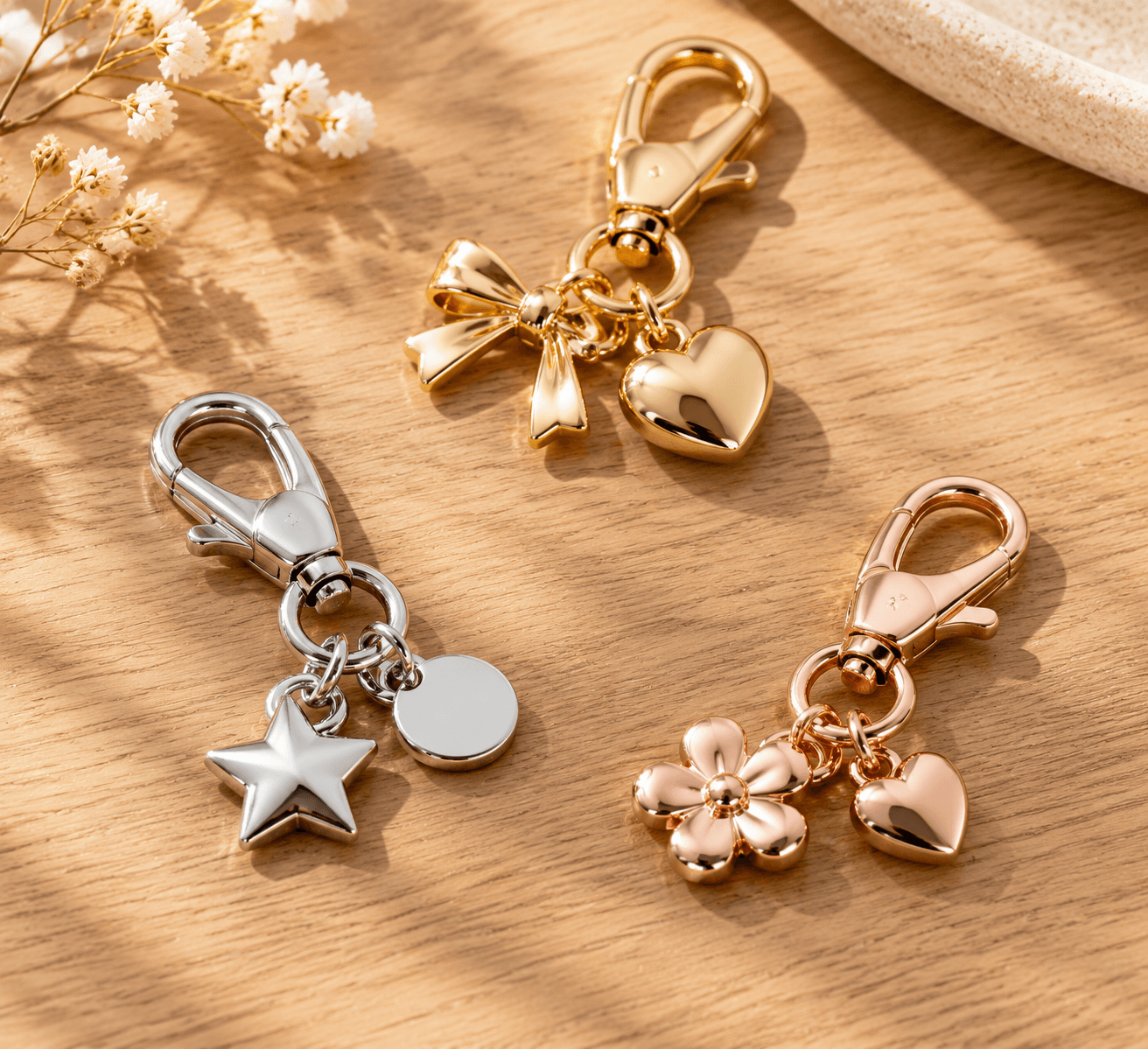
For gold plated, rose gold plating, and silver finish options, compare the approved sample with subsequent production samples under neutral lighting. Check for uneven color, visible surface defects, inconsistent coverage, and scratches.
Request appropriate wear-resistance and corrosion-related test information. Salt spray testing is useful evidence under controlled conditions, but it does not reproduce every real-world exposure. Combine laboratory reports with practical inspection and documented quality standards.
- ☐ Check color consistency across production samples.
- ☐ Request available PVD process and coating specifications.
- ☐ Inspect for scratches, discoloration, and uneven coverage.
- ☐ Ask about abrasion and corrosion testing where applicable.
- ☐ Confirm the factory's rejection criteria for surface defects.
Step 3: Establish a Repeatable Quality Control Process
Quality control should operate at several stages, not only when finished products are ready to ship. A professional factory should have defined inspection procedures for incoming material, manufacturing, surface finishing, assembly, and final packaging.
Ask whether the supplier uses approved samples, measurement records, visual inspection standards, and batch-level inspection reports. For larger bulk charm orders, discuss an appropriate sampling plan and acceptable defect levels before production begins.
Specify critical defects separately from minor cosmetic variations. For example, a broken attachment point or sharp edge should be treated differently from a small, acceptable visual variation defined in the approved specification.
- ☐ Agree on written product specifications.
- ☐ Establish measurable dimensional tolerances.
- ☐ Define acceptable surface and assembly standards.
- ☐ Set inspection checkpoints during production.
- ☐ Require final inspection before shipment.
- ☐ Document corrective actions for recurring defects.
Step 4: Assess Product Photography and Listing Support
For e-commerce sellers, photography is a commercial requirement, not an optional extra. A factory should understand how its products will be presented on online storefronts and product detail pages.
Request clean product images showing the complete charm, front design, attachment mechanism, surface finish, and overall dimensions. Include close-up photographs of important decorative details. A neutral background helps customers evaluate color and construction without visual distractions.
Where possible, prepare both catalog images and lifestyle photographs showing a charm attached to a suitable bag accessory. Keep the product itself clearly identifiable. Use consistent image proportions and lighting across the entire collection.
Ask whether the supplier can provide high-resolution sample photographs, approved product specifications, and packaging images for listing preparation. Confirm image ownership and permitted commercial usage in writing.
- ☐ Obtain front, back, side, and detail photographs.
- ☐ Request consistent white-background catalog photography.
- ☐ Include dimensions and weight in listing specifications.
- ☐ Check that photographs represent the actual approved sample.
- ☐ Confirm permission to use supplied images commercially.
Step 5: Verify Shipping, Packaging, and Dropship Options
Reliable production is only part of a successful e-commerce supply chain. The supplier must also protect products during packing and provide realistic shipping information.
Discuss individual protective packaging, bulk carton specifications, labeling, packing lists, and private-label packaging options. For products with decorative surfaces, request packaging that minimizes contact between individual pieces during transportation.
Ask the factory to provide estimated production lead times, dispatch schedules, carton dimensions, gross weight, and available shipping methods. Confirm whether shipping estimates include customs clearance or final delivery, and clarify responsibility for duties, taxes, and import documentation.
If you operate a dropshipping business, do not assume that every factory offers direct-to-customer fulfillment. Confirm whether individual-order processing, address management, tracking updates, neutral packaging, and order consolidation are available. Request written service conditions and test the process with a small trial order before scaling.
- ☐ Confirm packaging protection for individual charms.
- ☐ Review private-label packaging options.
- ☐ Request realistic production and shipping schedules.
- ☐ Verify carton dimensions and shipping weights.
- ☐ Clarify customs documentation and import responsibilities.
- ☐ Test dropship procedures before committing to high order volumes.
Step 6: Compare MOQ, Pricing, and Long-term Supply Capacity
The lowest quoted price is not necessarily the best sourcing decision. Evaluate the complete landed cost, including product pricing, packaging, sampling, transportation, import charges, and potential quality-related expenses.
Discuss MOQ flexibility, especially if you plan to launch a collection with several coordinated designs. A supplier that supports low MOQ charm production can help e-commerce businesses test customer demand without immediately committing to excessive inventory.
Request separate quotations for samples, initial production, repeat orders, and customized packaging. Make sure the quotation identifies the exact product specifications and finish requirements.
For ongoing operations, confirm how the factory manages repeat orders, design changes, seasonal demand, and production scheduling. Consistency matters more than a one-time attractive quotation.
- ☐ Compare quotations using identical product specifications.
- ☐ Confirm MOQ for each design and finish.
- ☐ Calculate complete landed costs.
- ☐ Ask about sample charges and production lead times.
- ☐ Verify repeat-order consistency and capacity.
- ☐ Establish written terms for quality claims and corrective actions.
Questions to Ask Before Selecting a China Bag Charm Supplier
What Makes a Reliable OEM Charm Supplier?
A reliable supplier demonstrates control over material specifications, manufacturing processes, surface finishing, assembly, inspection, and delivery. It should provide physical samples, relevant test documentation, transparent quotations, and written production standards. Strong communication and practical problem-solving are equally important.
Are 316L Stainless Steel Charms Suitable for Everyday Bag Accessories?
Yes. 316L stainless steel is a practical choice for decorative accessories because of its durability and corrosion resistance. Finished-product performance still depends on construction, surface treatment, attachment quality, and normal care. Buyers should evaluate representative samples and relevant test reports before approving a collection.
Can a Factory Guarantee That PVD Gold Plating Will Never Wear?
No responsible supplier should promise unlimited finish life under every condition. Performance depends on coating specifications, preparation, usage, friction, chemicals, and environmental exposure. Request documented test results, clarify the conditions covered by any warranty, and publish realistic product-care instructions.
What Documents Should US and Canadian Buyers Request?
Start with material specifications, relevant RoHS and REACH documentation, Nickel Release EN1811 reports where applicable, corrosion test information, product specifications, and commercial shipping documents. Confirm additional requirements for your intended product and market with a qualified compliance professional.
Partner With Lancy Jewelry for Reliable OEM and ODM Charm Production
Choosing the right stainless steel cute bag charm factory in China requires a disciplined approach to material verification, product construction, durability testing, production consistency, and e-commerce fulfillment. Do not approve a supplier simply because its catalog looks attractive or its initial quotation is competitive. Demand evidence, inspect samples, establish written standards, and evaluate the complete supply chain.
Lancy Jewelry supports boutique brands, gift companies, charm bar retailers, distributors, and private-label buyers with 316L stainless steel charm manufacturing. Our modern manufacturing facility uses CNC equipment, laser cutting, laser marking, welding, and polishing to support detailed product development and consistent production.
Our OEM and ODM capabilities include custom logo engraving, PVD plating, enamel color filling, crystal setting, coordinated collection development, and private-label packaging. We also provide sample development support and low MOQ options to help buyers plan new product launches and manage inventory requirements.
Our SGS certification covers RoHS, REACH, Nickel Release EN1811, and Salt Spray 240H, providing buyers with relevant testing credentials for supplier evaluation.
Explore our 316L stainless steel charm collections to review available product directions. If you are planning a customized collection, visit our OEM and ODM manufacturing service page to understand our development capabilities.
Ready to discuss your specifications, target quantities, finish requirements, and packaging needs? Submit an RFQ and request a quotation. Work with Lancy Jewelry to develop dependable, boutique-ready bag charm collections backed by practical manufacturing support.