Hook: In global charm sourcing, selecting the right stainless steel car mirror charms supplier is not just about price. It’s about material reliability, plating consistency, and documented compliance that withstands multi-market use. This deep-dive guide is designed for procurement teams who want a rigorous, step-by-step vetting framework focused on 316L stainless steel charms. It blends materials science with practical supplier evaluation, enabling fast decisions without sacrificing quality or risk management.
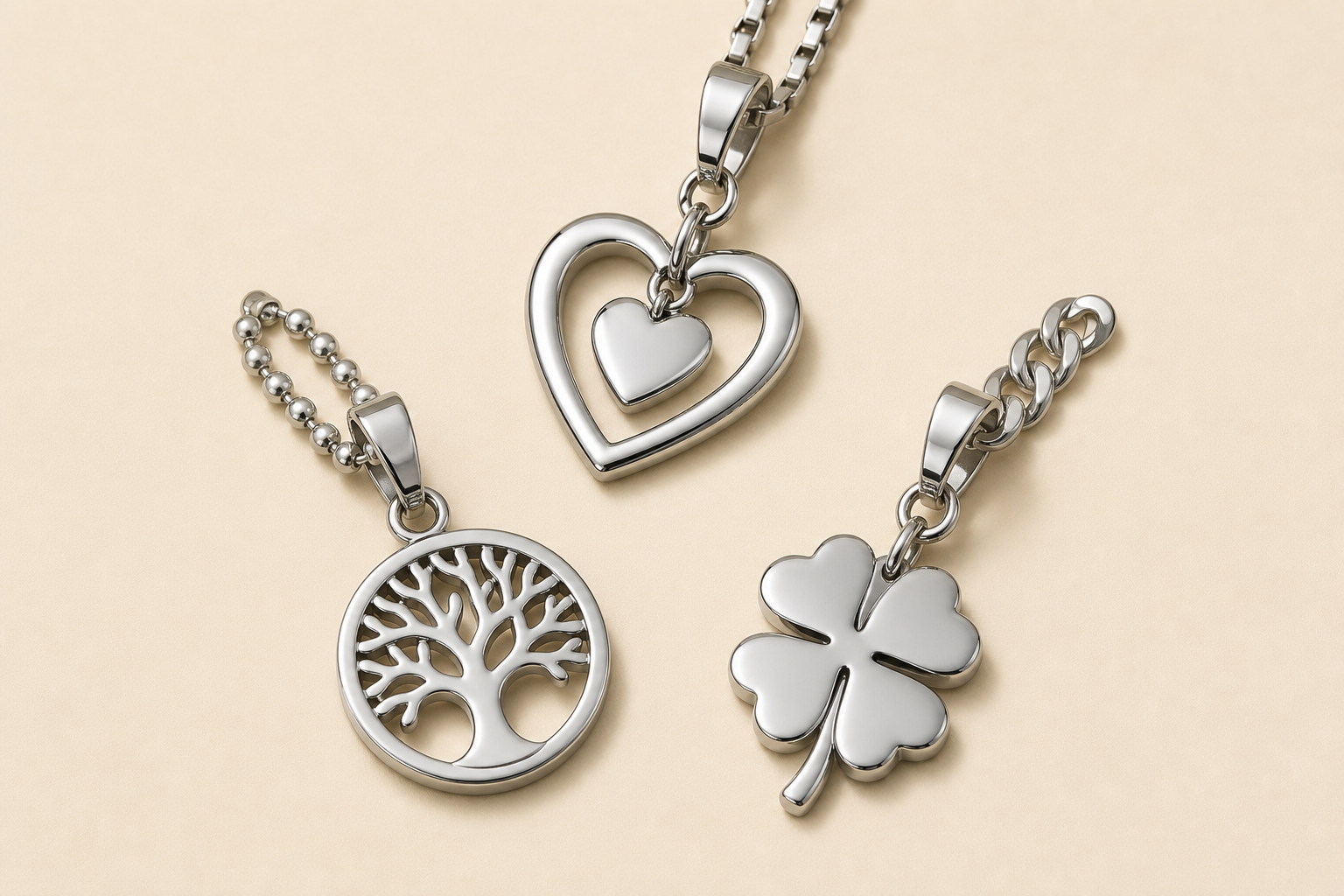
Stainless Steel Car Mirror Charms Supplier Vetting: 316L Focus
316L alloy chemistry and what it means for car mirror charms
316L stainless steel is an austenitic substrate with typical composition around 16-18% chromium, 10-14% nickel, and 2-3% molybdenum, with carbon limited to 0.03% or less. This low carbon content minimizes carbide precipitation during welding and heat treatment, preserving corrosion resistance and formability. For car mirror charms that travel across climates and salt-spray environments, the 316L base provides a stable platform for surface finishes such as PVD plating, enamel color filling, or crystal inlay without accelerating substrate corrosion or coating delamination. When a supplier emphasizes 316L as the base, it signals a predictable chemistry the QA team can trace through certificates and test reports.
Why corrosion resistance and plating compatibility matter
- High corrosion resistance in chloride-rich environments helps protect charm appearances in coastal markets and humid regions.
- Low-carbon 316L supports reliable adhesion for PVD gold, silver, or rose gold finishes, as well as enamel and crystal infill, with controlled plating thickness.
- Consistent surface finish and polish across batches reduces the risk of color variance, flaking, or dulling on a private-label line.
Finish options and the role of the base material
Finish options such as PVD plating, enamel color filling, and crystal inlay can be applied to 316L stainless steel charms without changing the substrate. However, plating thickness, bath chemistry, and adhesion testing must be controlled. A well-qualified supplier will provide process documentation, plating thickness targets, and color standard references to ensure uniformity across large orders.
Common vetting pitfalls to avoid
- Overstated claims about “alloy-agnostic” finishes without substrate-specific testing.
- Missing material traceability data or absent chemistry certificates for the 316L base.
- Plating or enamel processes without clear adhesion/interfacial testing results.
- Inadequate packaging and labeling documentation for private-label programs.
Benefits/Why it matters
Why rigorous vetting reduces risk
For procurement teams, a thorough vetting process helps ensure that the supplier can meet regulatory, quality, and delivery requirements across markets (US, EU, UK, AU, CA, DE, FR, ES, NE, RU). SGS-certified facilities that demonstrate RoHS, REACH compliance, Nickel Release EN1811, and Salt Spray 240H testing provide a strong assurance baseline. When these certifications accompany material declarations and process controls, you reduce the likelihood of non-conformances, recalls, or private-label delays—crucial for your wholesale and private-label programs.
Key benefits to your sourcing program
- Low MOQ charm production capabilities enable rapid prototyping and scalable private-label launches.
- Consistent plating quality across lots supports boutique-ready series planning.
- Private-label packaging options streamline branding for charm bars and gift programs.
- Explicit sample development paths shorten lead times from concept to market.
In our experience at Lancy Jewelry, a modern factory with CNC, laser cutting, laser marking, welding, and finishing capabilities can prove essential for reliable OEM/ODM partnerships. We also maintain SGS-certified processes and offer private-label packaging aligned with global compliance requirements.
Detailed analysis/Guide
Step 1 — Define required specs for the 316L base
- Base material: 316L stainless steel with documented composition (Cr, Ni, Mo, C, Mn, Si, P, S).
- Mechanical integrity: controlled hardness and tensile properties suitable for forming and plating.
- Finish compatibility: PVD plating thickness targets, enamel color system, crystal settings, and finishing tolerances.
- Size and form factor: standard charm dimensions (8-18 mm range for most charms), bail/hole dimensions, and compatibility with standard jump rings or clasps.
Step 2 — Build a short‑list of capable manufacturers/suppliers
- Manufacturing capabilities: CNC, laser cutting, laser marking, welding, polishing, and quality control benches.
- Private-label and OEM/ODM readiness: ability to handle logo engraving, custom packaging, and private-label branding.
- Material control: traceability records, chemistry certificates, and test reports for the 316L base.
- Compliance posture: RoHS/REACH, EN1811 nickel release, Salt Spray 240H, and related SGS certifications.
Step 3 — Gather critical documentation
Request the following documentation and verify authenticity with independent testing as needed:
- Material composition certificate or MTR for 316L stainless steel (Cr/Ni/Mo contents, carbon limit).
- SGS or equivalent certification coverage (RoHS, REACH, Nickel Release EN1811, Salt Spray 240H).
- Documentation of plating process controls (PVD bath specs, thickness tolerances, adhesion test results).
- Finish color standards and enamel color formulation references for repeatability.
- Traceability records for lot numbers, supplier lot control, and packaging/labeling compliance.
Step 4 — Conduct factory audits or remote assessments
Audit whether the facility can consistently deliver 316L stainless steel charms with the required finishes. Focus areas include process flow, QC checkpoints, plating line maintenance, chemical management, and sanitation controls. A supplier with a robust nonconformance handling process and documented CAPA (Corrective and Preventive Actions) is better positioned for long-term collaborations.
Step 5 — Initiate sample development and evaluation
Ask for a small batch of samples representing your target finishes (PVD plated, enamel-filled, or crystal-inlaid). Evaluate:
- Dimensional accuracy and bail/hole geometry to ensure reliable attachment to standard jump rings and clasps.
- Plating thickness consistency and color uniformity across samples.
- Enamel fill quality, color stability, and crack resistance under bending.
- Crystal settings security and impact resistance on real-world handling.
Leverage a formal sample development program to manage revision cycles and set clear lead times and acceptance criteria. This aligns with wholesale and private-label initiatives and supports a predictable launch cadence.
Step 6 — Evaluate plating quality and long-term reliability
- Thickness tolerance and adhesion: verify with cross-section checks where appropriate.
- Color stability under UV exposure and typical retail lighting conditions.
- Edge finishing, burrs, and overall tactile feel consistent with boutique-grade items.
Step 7 — Verify packaging, labeling, and private-label readiness
Confirm packaging options, branding capabilities, and labeling compliance for your target markets. Private-label packaging reduces time-to-market and supports consistent brand experiences across channels.
Step 8 — Confirm commercial terms
- MOQ expectations and whether low MOQ charm production is available for prototypes and initial runs.
- Lead times, minimum packaging requirements, and bulk order scheduling for ongoing programs.
- OEM/ODM arrangements, logo engraving capabilities, and integration with your product roadmap.
- RFQ process, payment terms, and warranty/quality commitments.
Step 9 — Legal and risk considerations
Ensure supplier agreements include material compliance disclosures, traceability, and non-disclosure terms for logo and packaging designs. Maintain a documented audit trail to support ongoing supplier relationship management and risk mitigation across markets.
Step 10 — Make a decision and start production
With a vetted supplier, a finalized sample package, and agreed commercial terms, initiate the first production run. Maintain ongoing QA checkpoints, monitor plating consistency across lots, and leverage private-label packaging to accelerate market entry.
FAQ
Q: What is 316L stainless steel, and why is it preferred for charms?
A: 316L is an austenitic stainless steel with low carbon content that improves weldability and reduces carbide precipitation, enhancing corrosion resistance. Its chemical stability, strength, and compatibility with premium surface finishes make it a reliable base for 316L stainless steel charms used across diverse markets, including car mirror accessories. It also supports consistent compliance across RoHS/REACH frameworks when properly sourced and validated.
Q: What documents should I request from a car mirror charms supplier?
A: Request material composition certificates for 316L stainless steel, process certifications, and third-party test reports (SGS or equivalent) covering RoHS, REACH, Nickel Release EN1811, and Salt Spray 240H. Also obtain plating thickness specs, adhesion test results, enamel color standards, and packaging/labeling documentation for private-label programs.
Q: How do I assess plating quality and color consistency?
A: Evaluate plating thickness tolerance, color uniformity across multiple samples, adhesion performance under simulated wear, and resistance to chipping or peeling. Require a defined process for controlling bath chemistry, temperature, and plating time, plus a routine to monitor batch-to-batch variability.
Q: How should private-label packaging and OEM/ODM agreements be structured?
A: Outline logo engraving options, packaging materials, labeling requirements, and branding placement. Define MOQs for initial runs, lead times, quality acceptance criteria, and a clear RFQ submission path. Ensure the contract includes change management procedures for model updates and a dispute resolution mechanism.
Call to action — Partner With Us
As a dedicated stainless steel charms manufacturer and supplier, Lancy Jewelry offers OEM/ODM capabilities, low MOQ charm production, and private-label packaging designed for boutique brands and private-label buyers. Our modern facility supports CNC, laser cutting, laser marking, welding, and polishing, backed by SGS-certified RoHS, REACH, Nickel Release EN1811, and Salt Spray 240H testing. We invite procurement teams to explore collaboration opportunities and request a formal RFQ or sample package through our official channels.
Explore our catalog to understand available finishes and form factors, learn more about our OEM/ODM services, or start a formal inquiry with our team via contact. For fastest initial engagement, you can initiate a quote or sample request here: Request a Quote / Sample and begin the private-label journey with confidence.