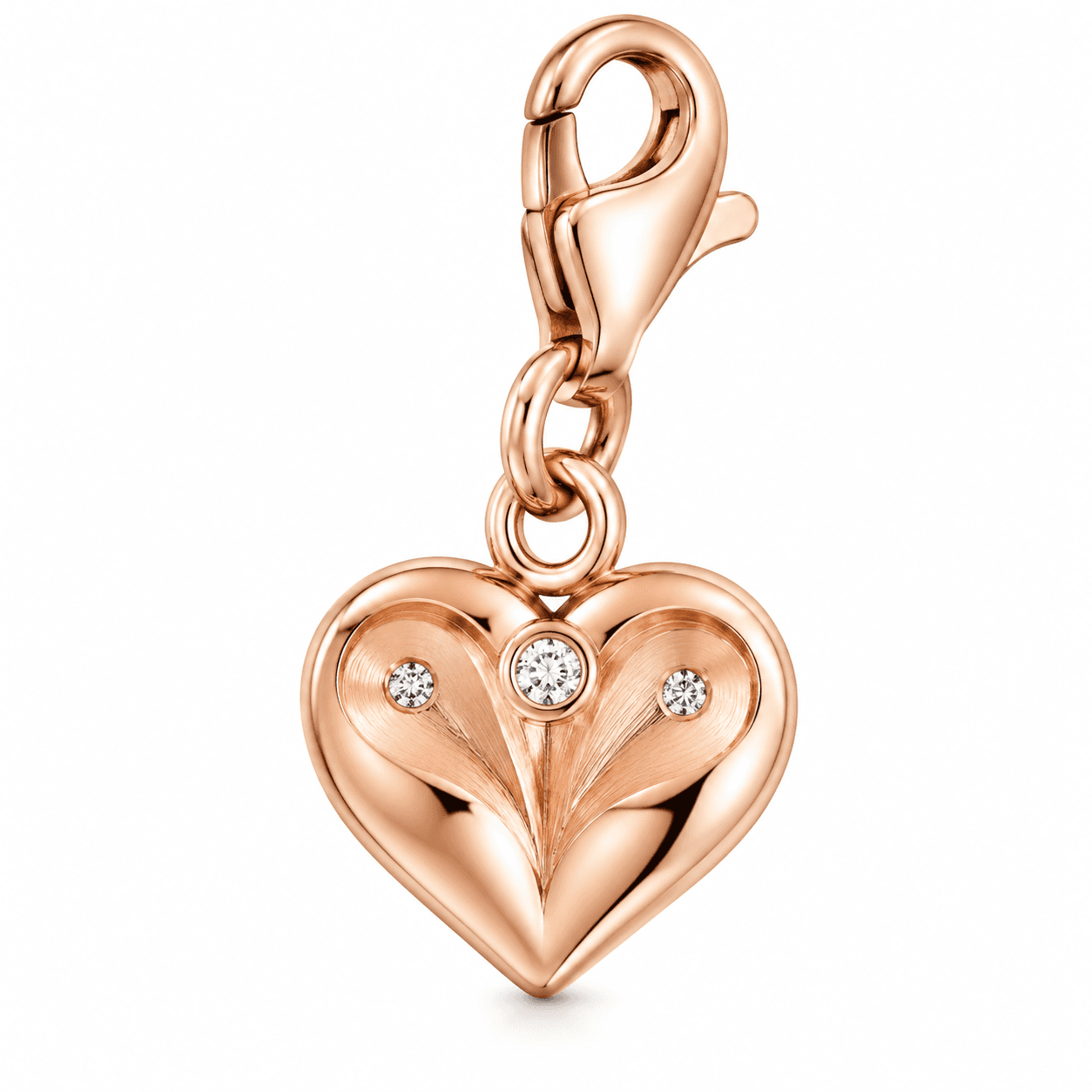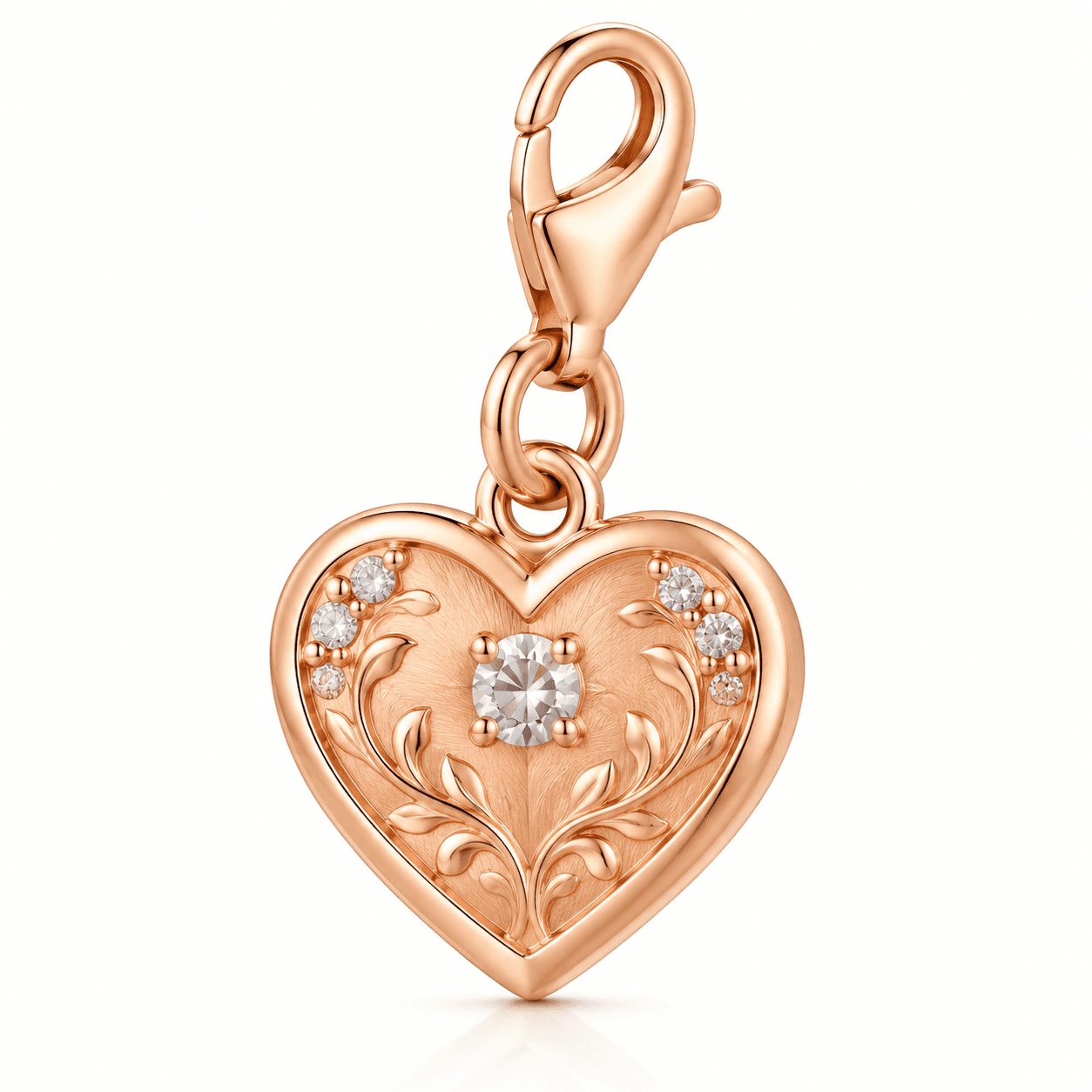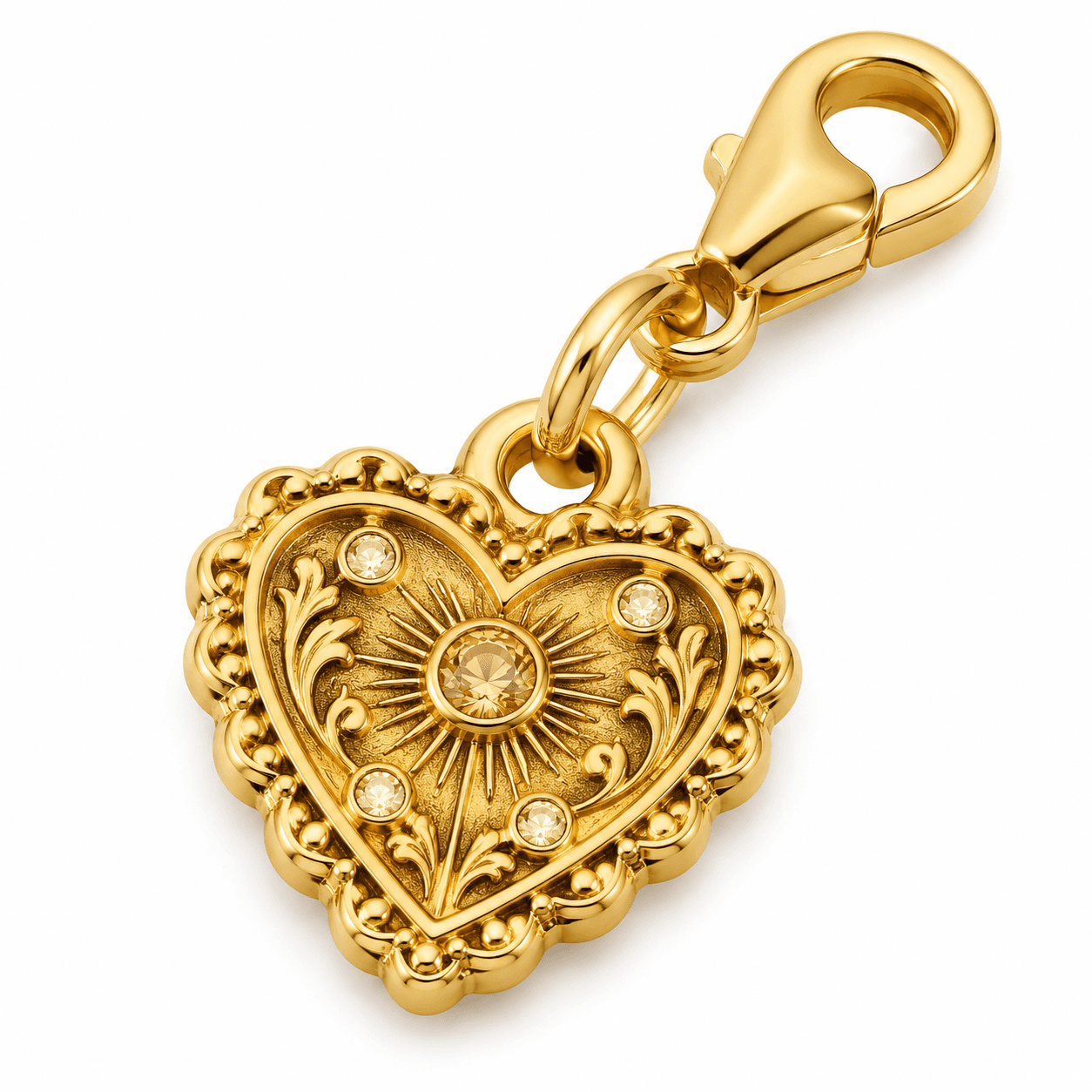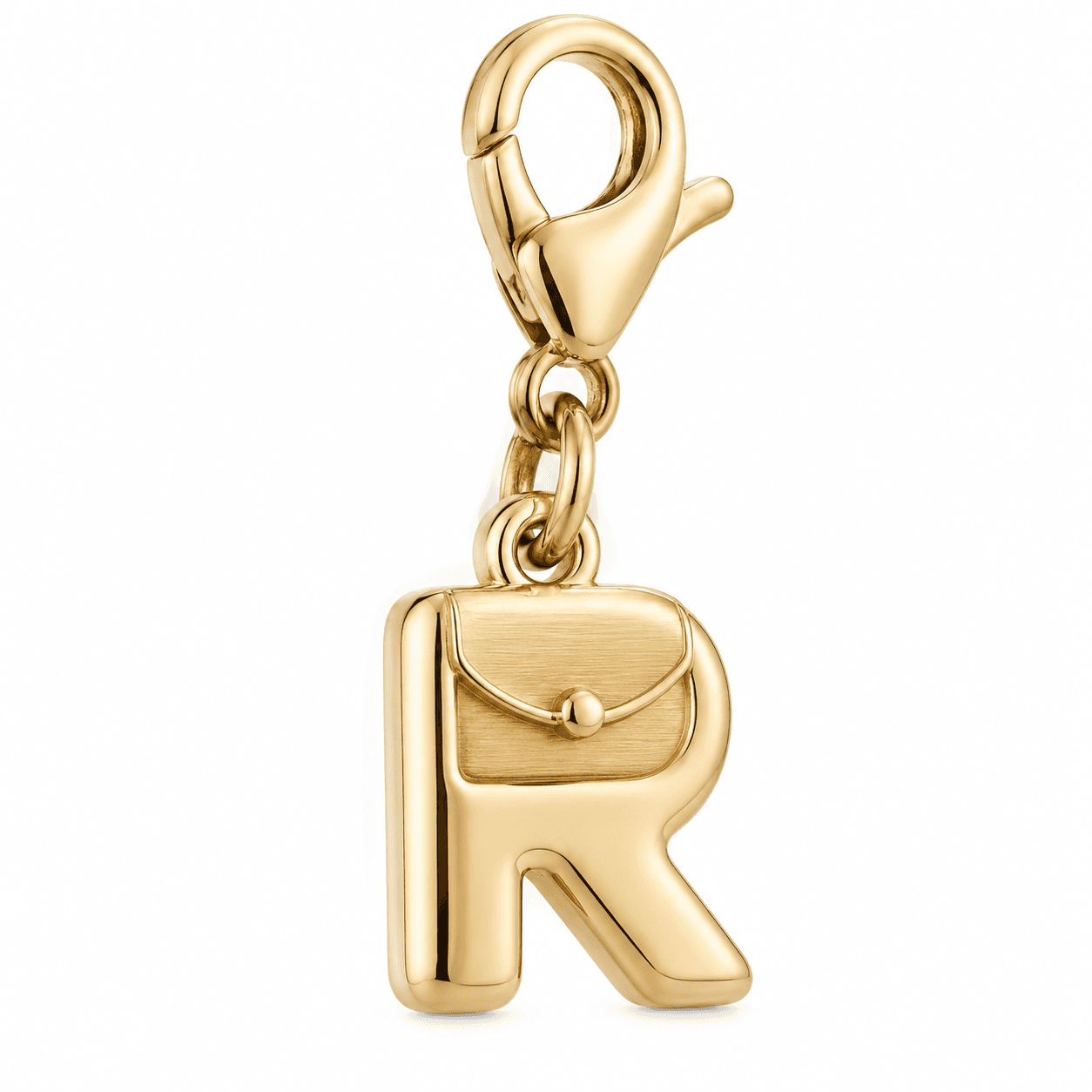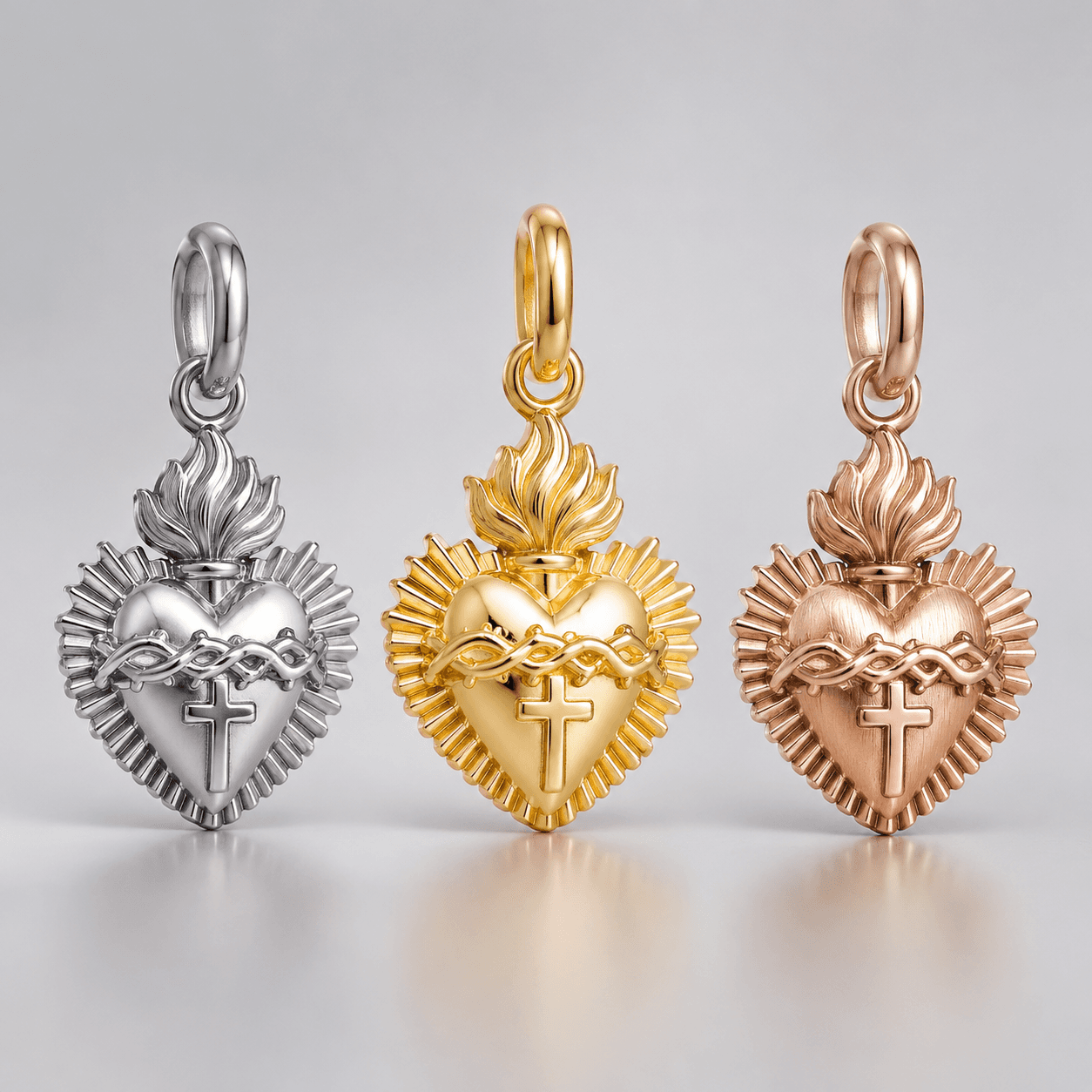
A sacred heart charm combines meaningful symbolism with decorative detail, making material selection and surface engineering important considerations for jewelry designers. From sculpted heart contours and dimensional detailing to enamel color filling and crystal inlay, every design decision affects the finished appearance, production complexity and long-term performance. Understanding how 316L stainless steel behaves during machining, polishing, engraving and finishing helps designers develop products with consistent quality and practical manufacturing requirements.
At Lancy Jewelry, sacred heart charm development focuses exclusively on 316L stainless steel as the base material. Available customization options include PVD gold plated finishes, silver finish, rose gold plating, enamel detailing, crystal inlay and custom logo engraving. As a stainless steel charms manufacturer, Lancy supports OEM and ODM development, sample development, low MOQ discussions and private label production for boutique jewelry brands, charm bar retailers and gift companies.
Understanding Sacred Heart Charm Design and Material Selection
Understanding Sacred Heart Charm Design and Material Selection
A sacred heart charm is typically characterized by a recognizable heart silhouette, a central decorative field and optional surrounding details such as rays, flame-inspired contours, engraved lines or symmetrical surface patterns. For jewelry designers, the first development decision should be the relationship between the visual concept and the physical construction. A simple outline requires different tooling and finishing considerations from a sculpted design with recessed sections, raised borders and multiple decorative surfaces. Defining these features before prototyping reduces unnecessary revisions and makes the manufacturing specification easier to communicate.
316L stainless steel provides a practical foundation for detailed charm production because it offers a combination of corrosion resistance, mechanical strength and suitability for precision manufacturing. Its chromium-containing passive surface layer helps resist ordinary environmental corrosion. The material also supports polishing, engraving, PVD coating and other controlled surface treatments. Designers should distinguish the properties of the base material from those of the final surface finish: corrosion performance, appearance retention and wear resistance depend on the complete manufacturing process, not simply the material designation.
For a custom stainless steel charms project, the initial specification should identify the overall dimensions, thickness, attachment position, front and reverse artwork, edge treatment and intended application. A typical decorative charm may fall within an 8–18 mm size range, although the final dimensions should follow the visual requirements and mechanical constraints of the design. Lancy develops 316L stainless steel charms for boutique collections and supports OEM manufacturing with technical review before sampling. Explore the complete product catalogue to review available decorative directions and product forms.
Why 316L Stainless Steel Matters for Sacred Heart Charms
Why 316L Stainless Steel Matters for Sacred Heart Charms
Material engineering influences more than the appearance of a sacred heart charm. It affects dimensional stability, surface preparation, manufacturing consistency and expected performance during normal wear. 316L stainless steel is a low-carbon stainless steel grade containing chromium, nickel and molybdenum. Chromium supports the formation of a protective passive film, while molybdenum contributes to improved resistance to localized corrosion in suitable environments. The low-carbon composition also supports the material's resistance to sensitization under relevant processing conditions. These characteristics make 316L a widely used choice for precision jewelry components.
However, a material designation alone does not establish the performance of a finished product. Surface contamination, machining residues, polishing quality, coating condition and exposure conditions all influence the result. Sharp internal corners and deep recesses can create finishing challenges, while poorly controlled polishing may leave visible inconsistencies. Designers should therefore consider manufacturability alongside visual appearance. Rounded transitions, accessible polishing surfaces and appropriately designed recesses help improve production repeatability.
For sourcing managers and jewelry designers, material verification should include documentation identifying the actual 316L stainless steel grade and relevant component specifications. Where applicable, request material test reports and supplier traceability records. Lancy focuses on 316L stainless steel charms rather than alternative base materials, allowing production specifications and quality controls to remain aligned with this material system. For wholesale stainless steel charms and bulk charm orders, agreeing on material specifications before mass production provides a stronger basis for repeat orders, inspection and consistent collection planning.
PVD Gold Plated, Silver Finish and Rose Gold Surface Technology
PVD Gold Plated, Silver Finish and Rose Gold Surface Technology
Surface finishing is one of the most influential design decisions for a sacred heart charm. A polished silver finish can emphasize sculpted contours and engraved details, while PVD gold plated surfaces create a warmer visual appearance. Rose gold plating offers another color direction for coordinated collections. The choice should consider the intended retail positioning, the complexity of the artwork, the visibility of recessed areas and the desired consistency across different production batches.
PVD, or physical vapor deposition, is a vacuum-based coating technology in which material is deposited onto a prepared surface under controlled conditions. The coating process requires suitable surface cleaning, preparation and process parameters. A smooth and consistently prepared substrate helps achieve a more uniform appearance. For charms featuring raised borders, recessed patterns or intricate lettering, designers should consider how the geometry affects coating coverage and visual uniformity. PVD performance also depends on coating composition, thickness, adhesion, substrate preparation and subsequent use conditions. No finish should be described as permanently scratch-proof or completely immune to wear.
During sample development, evaluate color consistency under neutral lighting and compare the front, reverse, edges and recessed areas. If a collection includes several colors, establish approved visual standards and retain reference samples for production comparison. Lancy supports PVD finishing for custom 316L stainless steel charms, including gold plated and rose gold plating options, with silver finish available according to the product specification. Discuss the intended finish and target appearance through the OEM and ODM manufacturing service so the design can be assessed before tooling and sample approval.
Enamel Color Filling and Crystal Inlay Design Techniques
Enamel Color Filling and Crystal Inlay Design Techniques
Enamel and crystal inlay can add visual contrast to a sacred heart charm without changing its 316L stainless steel base. Enamel color filling is particularly suitable for recessed decorative areas, outlined heart shapes and selected graphic elements. The design normally requires a clearly defined boundary between the recessed field and surrounding raised metal. Recess depth, wall thickness, color separation and filling accessibility should be considered during the initial drawing stage. Very narrow channels and excessively small color compartments can increase filling difficulty and make consistent finishing more challenging.
For multi-color enamel designs, designers should provide a numbered color map and specify the intended color references. The sample review should examine color uniformity, surface leveling, edge cleanliness and the relationship between enamel and surrounding metal. Color perception may vary with lighting conditions and display settings, so physical sample approval is preferable to relying exclusively on digital artwork. Designers should also specify whether the enamel should sit level with the surrounding surface or have a particular recessed appearance.
Crystal inlay introduces another set of engineering considerations. The artwork must define the number, size, position and arrangement of each crystal, together with the intended setting structure. The receiving seats must be designed to retain the decorative components securely without creating unnecessarily thin surrounding walls. Crystal alignment, setting consistency and visual symmetry should be inspected during sample approval. Combining enamel, crystal inlay and PVD finishing can produce a more elaborate sacred heart charm, but every additional process increases coordination requirements. Lancy provides enamel color filling and crystal setting as part of its OEM and ODM development capabilities, with prototypes used to evaluate appearance and manufacturability before bulk production.
Attachment Engineering, Dimensions and Functional Durability
Attachment Engineering, Dimensions and Functional Durability
A well-designed sacred heart charm must function as reliably as it looks. The attachment system is therefore an essential part of the technical drawing rather than an afterthought. Depending on the intended jewelry application, the charm may use an integrated top loop or a separate jump ring threaded through a properly dimensioned hole. The opening should provide sufficient clearance for the intended connection while maintaining enough surrounding material to support normal handling. Designers should pay attention to the relationship between the charm's center of gravity, attachment location and orientation when suspended.
Thickness and edge geometry influence both perceived quality and mechanical performance. A charm that is too thin may feel less substantial and can be more sensitive to deformation, while excessive thickness may increase weight and complicate the attachment design. Polished edges improve handling and appearance, but the polishing specification must preserve the intended outer silhouette and decorative details. For dimensional review, define length, width, thickness, hole diameter, loop dimensions and acceptable tolerances. A technical drawing should identify critical dimensions separately from non-critical decorative measurements.
Durability evaluation should reflect realistic usage rather than relying on appearance alone. Consider normal contact with clothing, repeated attachment and removal, exposure to perspiration, humidity, cosmetic products and routine cleaning. Inspect the surface finish, attachment structure, decorative setting and enamel condition after relevant evaluation procedures. For charms intended for charm bar accessories, bag charms or gift accessories, the connection system should also be reviewed for the particular handling frequency and expected loading conditions. Lancy can assess attachment geometry and prototype specifications during sample development before confirming production requirements.
Quality Testing, SGS Documentation and International Compliance
Quality Testing, SGS Documentation and International Compliance
Professional sourcing requires evidence that supports material and product quality claims. For sacred heart charm projects, buyers should distinguish between raw material identification, finished-product testing and coating performance evaluation. A material report may identify the composition of the 316L stainless steel substrate, whereas finished-product testing examines the actual manufactured item and its relevant regulatory or performance characteristics. Test scope, sample identification, laboratory methods and report dates should be checked before interpreting any result as evidence for an entire product range.
SGS testing and documentation can support several important areas of assessment. RoHS relates to restrictions on specified hazardous substances within its applicable scope. REACH addresses chemical substances and relevant obligations under the European regulatory framework. EN1811 is a reference test method for nickel release from certain products intended for direct and prolonged contact with the skin, subject to the applicable product classification and regulatory requirements. Salt Spray testing evaluates corrosion behavior under specified laboratory conditions. A salt spray result is not a direct prediction of an exact service life, and a passing report should not be interpreted as a guarantee that every finish will remain unchanged under all conditions.
Buyers should request the actual SGS report or relevant laboratory documentation, confirm the tested sample description and verify whether the tested finish and production specification match the goods being purchased. Reports should be reviewed for test method, acceptance criteria, limitations and applicable regulatory version. Lancy's quality planning for 316L stainless steel charms can include material verification, appearance inspection, dimensional checks, coating assessment and appropriate third-party testing arrangements according to project requirements. Clear inspection criteria should be agreed before production, particularly for recurring wholesale and private label programs.
From Design Drawing to OEM Sample Development
From Design Drawing to OEM Sample Development
Successful custom sacred heart charm development begins with a manufacturing-ready brief. Designers should prepare a front-view illustration, reverse-view illustration and side profile whenever possible. Include overall dimensions, thickness, hole or loop position, surface finish, enamel color references and crystal specifications. If the design includes a logo or engraved message, identify the location, artwork format and minimum readable detail. Vector artwork is useful for precise outlines, while dimensioned drawings help engineers evaluate tooling and physical construction. Photographs may communicate the desired aesthetic, but they should be accompanied by original artwork and independent specifications.
The next stage is a technical feasibility review. The manufacturer evaluates the silhouette, wall thickness, decorative depth, attachment geometry, polishing access and proposed surface treatments. Design revisions may be recommended when details are too small, recessed areas are difficult to finish or the attachment system does not provide sufficient clearance. A prototype then allows the designer to evaluate physical proportions, weight, color, texture, engraving and functional details. Feedback should be consolidated into a single revision document to reduce confusion between sample versions.
After approval, the manufacturer establishes the production specification and inspection checkpoints. These may cover substrate identification, dimensions, surface appearance, PVD color, enamel filling, crystal setting, logo position and packaging. For a boutique collection, it is useful to plan a coordinated series rather than develop every charm independently. Related sacred heart designs can share a finish palette, visual language and packaging direction while maintaining distinct artwork. Lancy supports OEM charms manufacturer services, ODM charm supplier development, low MOQ discussions and private label charms programs. Buyers can learn more about the custom manufacturing process before preparing an RFQ.
Building a Coordinated Sacred Heart Charm Collection
Building a Coordinated Sacred Heart Charm Collection
A successful charm collection needs a consistent design system that makes individual products feel connected while giving each design a clear purpose. For a sacred heart charm range, designers can develop variations through outline shape, central relief, decorative borders, engraved details, color placement and surface finish. A restrained design may use a single polished surface, while a more detailed version may incorporate enamel sections or crystal inlay. Keeping the main silhouette consistent across several designs can create a recognizable collection structure without making every item visually identical.
Collection planning should also account for product dimensions, retail display and packaging. A group of charms with consistent attachment proportions is easier to organize within a boutique display or charm bar program. Different finishes can be planned as coordinated variations, provided that the underlying product specification and quality standards remain clearly documented. Consider whether the collection needs introductory designs, more detailed statement pieces and seasonal additions. These decisions help establish a practical assortment for inventory planning and reduce the risk of excessive design duplication.
Designers developing complementary botanical, celestial or symbolic products may also review Lancy's special symbol collection, heart collection and cross collection. These internal product categories provide additional directions for collection planning using the same 316L stainless steel manufacturing focus. A consistent material specification, approved finish samples and shared packaging standards can simplify replenishment and quality review across multiple SKUs. For distributors and boutique brands, a structured assortment also makes it easier to communicate product differences to retail teams and end customers.
Sacred Heart Charm Maintenance and Long-Term Appearance
Sacred Heart Charm Maintenance and Long-Term Appearance
Maintenance recommendations should reflect the actual construction of the finished sacred heart charm. For routine care, use a soft clean cloth to remove surface moisture, fingerprints and ordinary residue. When necessary, use mild cleaning methods appropriate for the approved finish, then dry the product thoroughly. Avoid abrasive polishing compounds, aggressive chemicals and unnecessary exposure to concentrated cleaning solutions because these can affect surface treatments, decorative filling or crystal settings. Ultrasonic cleaning should not be recommended universally, particularly for designs that contain enamel or set decorative components, unless the specific construction has been evaluated for that process.
Storage also influences long-term appearance. Keeping charms dry and separating finished pieces can reduce unnecessary surface contact and abrasion during transport or inventory handling. Packaging should prevent products from rubbing against one another and should provide suitable protection for decorative surfaces. For private-label orders, buyers should consider individual protective packaging or compartmentalized display trays depending on the product finish and distribution channel. Retail care instructions should be clear, realistic and consistent with the finished product's verified characteristics.
From a manufacturing perspective, long-term appearance is supported by controlled polishing, clean surface preparation, consistent PVD processing, reliable enamel application and appropriate inspection. Quality control should distinguish cosmetic acceptance criteria from functional requirements, such as secure attachment loops and consistent dimensions. Buyers can establish reference samples for approved color and finish, then use them during repeat production inspections. For additional sourcing information, review the Lancy Jewelry contact page to discuss care requirements, quality documentation and the inspection criteria relevant to a planned sacred heart charm program.
Frequently Asked Questions About Sacred Heart Charms
Practical Sourcing Checklist for Professional Jewelry Designers
Practical Sourcing Checklist for Professional Jewelry Designers
Before requesting a quotation, organize the project into material, design, finishing, testing and commercial specifications. The material requirement should explicitly state 316L stainless steel as the only base material. Design documentation should include the charm's dimensions, thickness, weight target where applicable, front and reverse artwork, attachment construction and acceptable tolerances. Finishing requirements should identify silver finish, PVD gold plated or rose gold plating, together with any enamel colors, crystal inlay positions or logo engraving details. This structure gives the manufacturer a clearer basis for assessing feasibility and calculating production costs.
Quality requirements should identify the documents and inspections relevant to the target market. For example, buyers may request material verification and applicable SGS testing information covering RoHS, REACH, EN1811 or Salt Spray. Clarify which reports are available, whether additional testing is required and whether the tested sample represents the final product specification. Define visual acceptance standards for coating color, polished surfaces, engraving, enamel filling and crystal alignment. If the order includes multiple variations, create a separate specification for each SKU and identify shared components or finishing requirements.
Commercial information should include the expected MOQ, sample requirements, estimated bulk order quantity, packaging needs and target delivery schedule. A clear brief helps an OEM charms manufacturer evaluate tooling, production planning and sample development more efficiently. Lancy Jewelry works with boutique brands, gift companies, distributors and private-label buyers to develop custom stainless steel charms for international markets. To begin, review available product categories, explore OEM and ODM services or prepare an inquiry through the request a quote page.
Start Your Sacred Heart Charm Development With Lancy
Start Your Sacred Heart Charm Development With Lancy
Ready to turn a sacred heart charm concept into a manufacturable 316L stainless steel design? Lancy Jewelry supports professional jewelry designers and sourcing teams with OEM and ODM development, sample support, PVD finishing, enamel color filling, crystal setting, logo engraving and private-label packaging. Each project begins with a review of the design, material specification and intended production requirements.
For an accurate RFQ, send your front and reverse artwork, preferred dimensions, thickness, attachment design, desired finish, enamel color references, crystal details and logo requirements. Include your target market, estimated MOQ or bulk order quantity, sample expectations, packaging specifications and any required SGS testing documentation. If you have a reference sample or technical drawing, include it with your inquiry so the development team can evaluate the physical construction and manufacturing feasibility.
After reviewing the brief, Lancy can discuss technical adjustments, sample development, finish approval, inspection requirements and production planning. Clear specifications at the beginning help reduce revisions and support consistent quality across repeat orders. Visit the OEM service page for customization information, submit your project through Request a Quote or contact the team through Lancy Jewelry to discuss your sacred heart charm project.
Related resources
Related resources
- 316L Alloy Guide: Choosing a Stainless Steel Rabbit Bag Charm Factory China
- 316L Stainless Steel Custom Enamel Sterling Charms: A Buyer’s Guide
- Stainless Steel Custom Enamel Charms: A Buyer’s Quality Guide
- How to Choose a Stainless Steel Custom Enamel Bracelet Charms Supplier
- Antique Distressed Finish on Stainless Steel Charms: A Buyer’s Guide to Durability
- How to Source Minimalist Stainless Steel Charms: Finishing Guide
- How to Choose the Best Custom Car Charms in Stainless Steel
- Stainless Steel Wholesale Bag Charms Keyrings: Quality Checklist
- Stainless Steel Race Car Charms Wholesale: A Buyer’s Quality Checklist
- 316L Stainless Steel Chinese Zodiac Charms Wholesale: A Finishing Guide