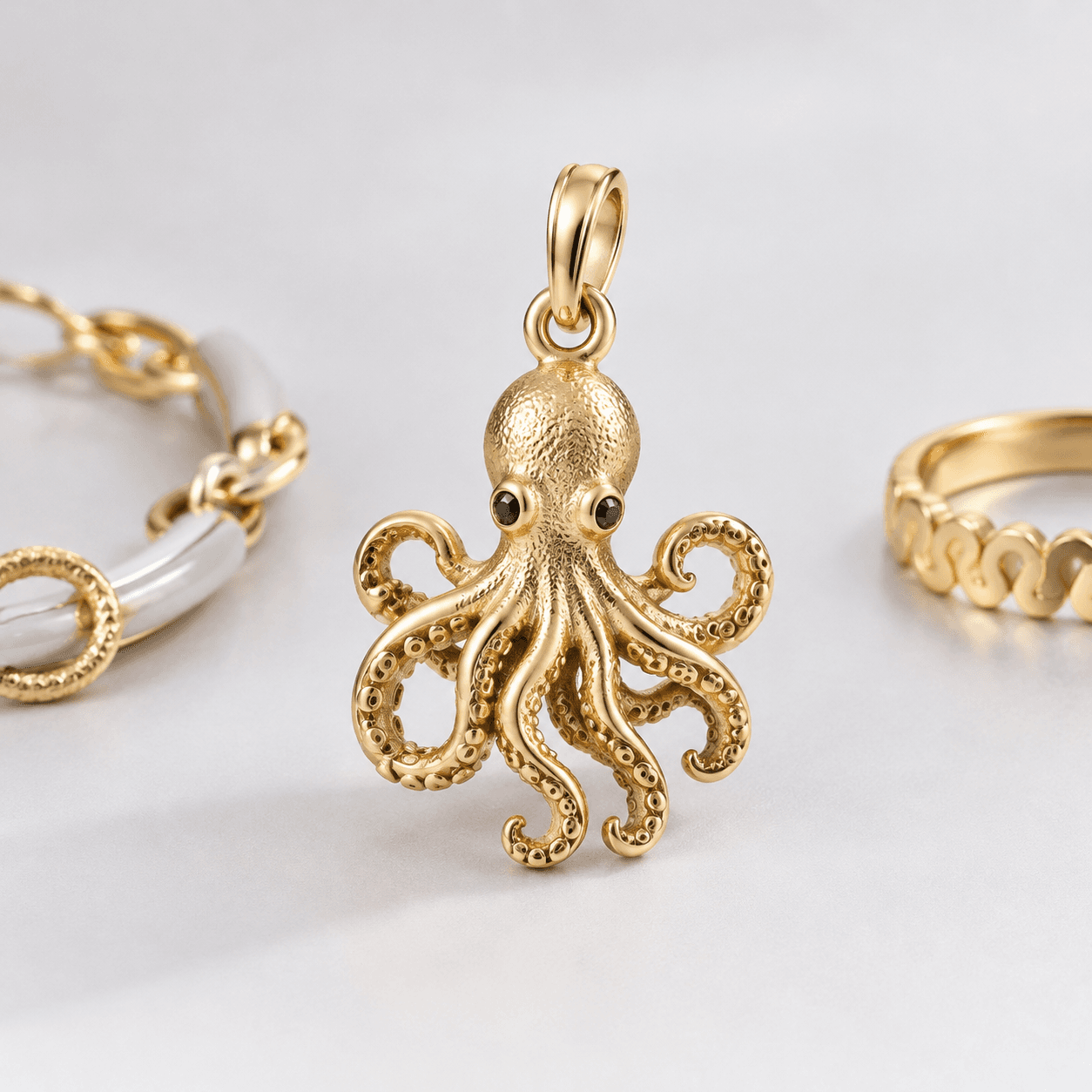
A charm octopus design combines distinctive marine anatomy with a wide range of creative opportunities for jewelry designers. Curved tentacles, a defined central body, textured surfaces, and small decorative details create a design that requires careful planning before manufacturing. For commercial collections, understanding the relationship between geometry, material properties, surface finishing, and attachment hardware helps transform an initial sketch into a practical, repeatable product.
Lancy Jewelry focuses on 316L stainless steel charms for boutique brands, charm bar retailers, gift companies, and private-label buyers. A charm octopus can be developed with a polished silver finish, gold plated or rose gold plating through PVD, enamel color filling, crystal inlay, and custom logo engraving where the design allows. This guide explains the technical considerations that jewelry designers should evaluate when preparing a custom specification, reviewing a sample, and planning wholesale production.
Charm Octopus Design Fundamentals: From Concept to Manufacturable Form
A successful charm octopus starts with a clear design hierarchy. The central body establishes the main silhouette, while the tentacles provide movement and recognition. Designers should determine which features must remain visible at a small scale and which can be simplified without weakening the concept. For a charm intended for bracelets, bangles, necklaces, earrings, or a coordinated jewelry collection, a finished size around 8–18 mm is a useful starting range, although the ideal dimensions depend on the intended application. Small details that appear clear in a large illustration may become indistinct after reduction, so the production drawing should be evaluated at actual size.
Next, define the front profile, side profile, overall thickness, edge treatment, and attachment position. A balanced silhouette should avoid unnecessarily thin tentacle tips, fragile bridges, and narrow sections that could be difficult to finish consistently. The designer should also specify whether the octopus is a flat relief, a dimensional sculptural form, or a layered visual composition. These choices influence tooling, surface access, polishing, color placement, and the appearance of the finished product. The attachment hole or loop must be integrated into the geometry rather than added as an afterthought.
For a stainless steel charms manufacturer, manufacturability depends on more than the artwork. A useful design package includes a dimensioned drawing, reference images, target finish, proposed color areas, acceptable detail level, and intended use. Lancy Jewelry can review these requirements during OEM or ODM development and identify practical adjustments before sample production. Explore the OEM manufacturing service to understand the custom development pathway, from concept review through sample evaluation and production planning.
Why 316L Stainless Steel Matters for an Octopus Charm
316L stainless steel is a low-carbon stainless steel grade containing chromium, nickel, and molybdenum. Its composition supports corrosion resistance through a passive chromium-rich surface layer, while molybdenum improves resistance to certain forms of localized corrosion compared with less corrosion-resistant stainless steel grades. The low carbon content helps limit sensitization risks during appropriate processing. These material characteristics make 316L stainless steel a practical base for jewelry charms that require defined edges, detailed relief, repeatable finishing, and a consistent foundation for decorative treatments.
Material selection should be considered together with the product geometry and finishing process. An octopus charm with deep grooves, closely spaced tentacles, or recessed suction-cup details may be more challenging to polish than a simple outline. Designers should assess whether the intended surface is mirror polished, brushed, textured, or selectively colored. Recesses need enough definition to remain visible after finishing, and edges should be designed to avoid unwanted sharpness. Because corrosion resistance does not make a product immune to every environment, the finished charm still benefits from appropriate cleaning, handling, storage, and quality inspection.
Lancy uses 316L stainless steel as the base material for its stainless steel charms. Decorative options include silver finish, gold plated and rose gold plating achieved through PVD, enamel, and crystal inlay where the design supports those treatments. Buyers should distinguish the base material from the surface finish: PVD changes the decorative surface, but it does not change the underlying grade of the charm. For a custom stainless steel charms project, confirm the specified base material, the exact finish, the intended use, and the documentation available for the production lot before approving a sample or bulk order.
Tentacle Geometry, Surface Detail, and Attachment Engineering
The defining challenge of a charm octopus is creating a recognizable tentacle arrangement within a compact footprint. Tentacles can curve around the body, spread outward, or form a controlled radial silhouette. Each configuration introduces different design constraints. Closely overlapping arms can create narrow openings that are difficult to finish and inspect, while long projecting tips can become vulnerable to deformation under handling stress. A clear production drawing should identify minimum feature widths, recessed lines, raised elements, and the locations where the tentacles connect to the central body. These decisions help maintain visual clarity while supporting practical manufacture.
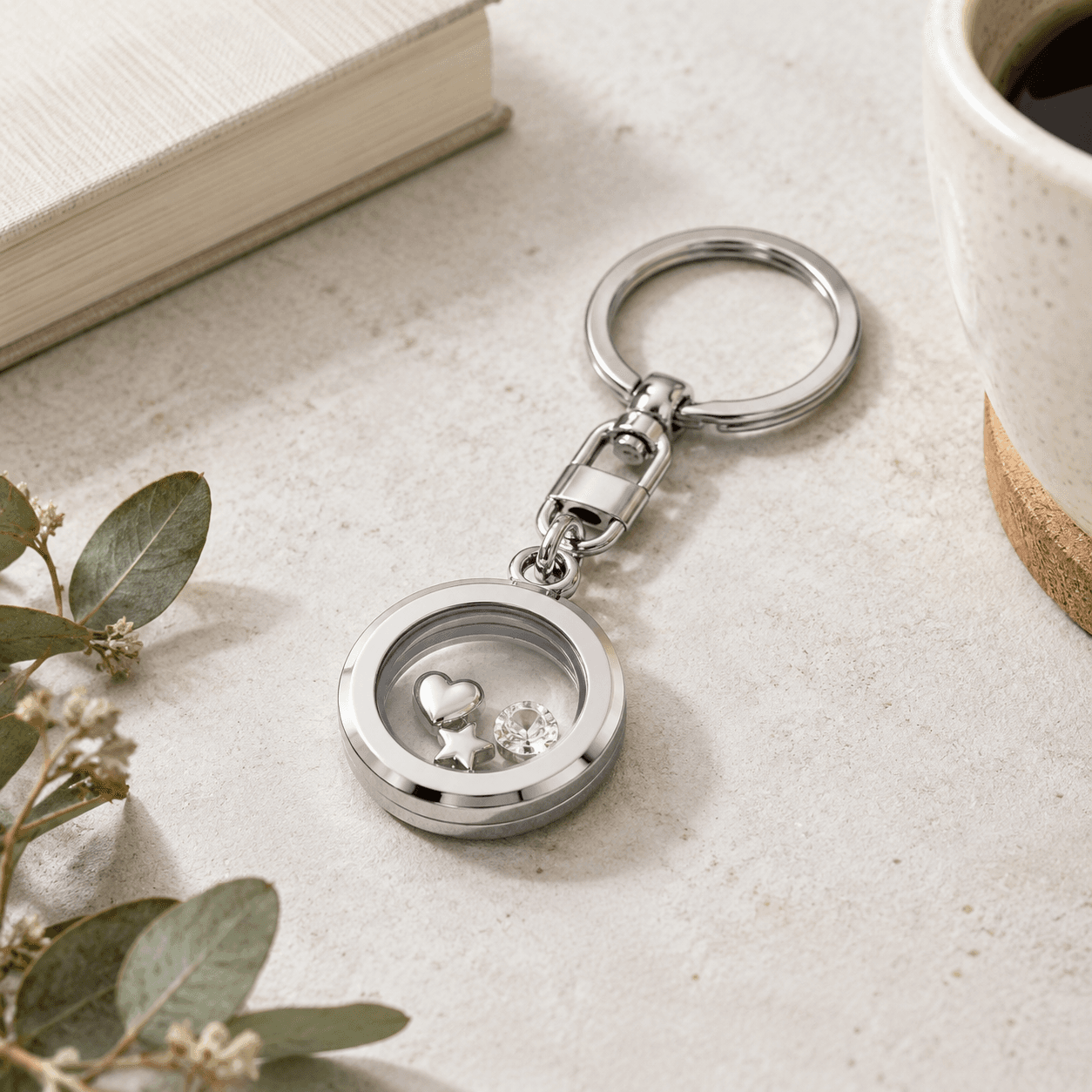
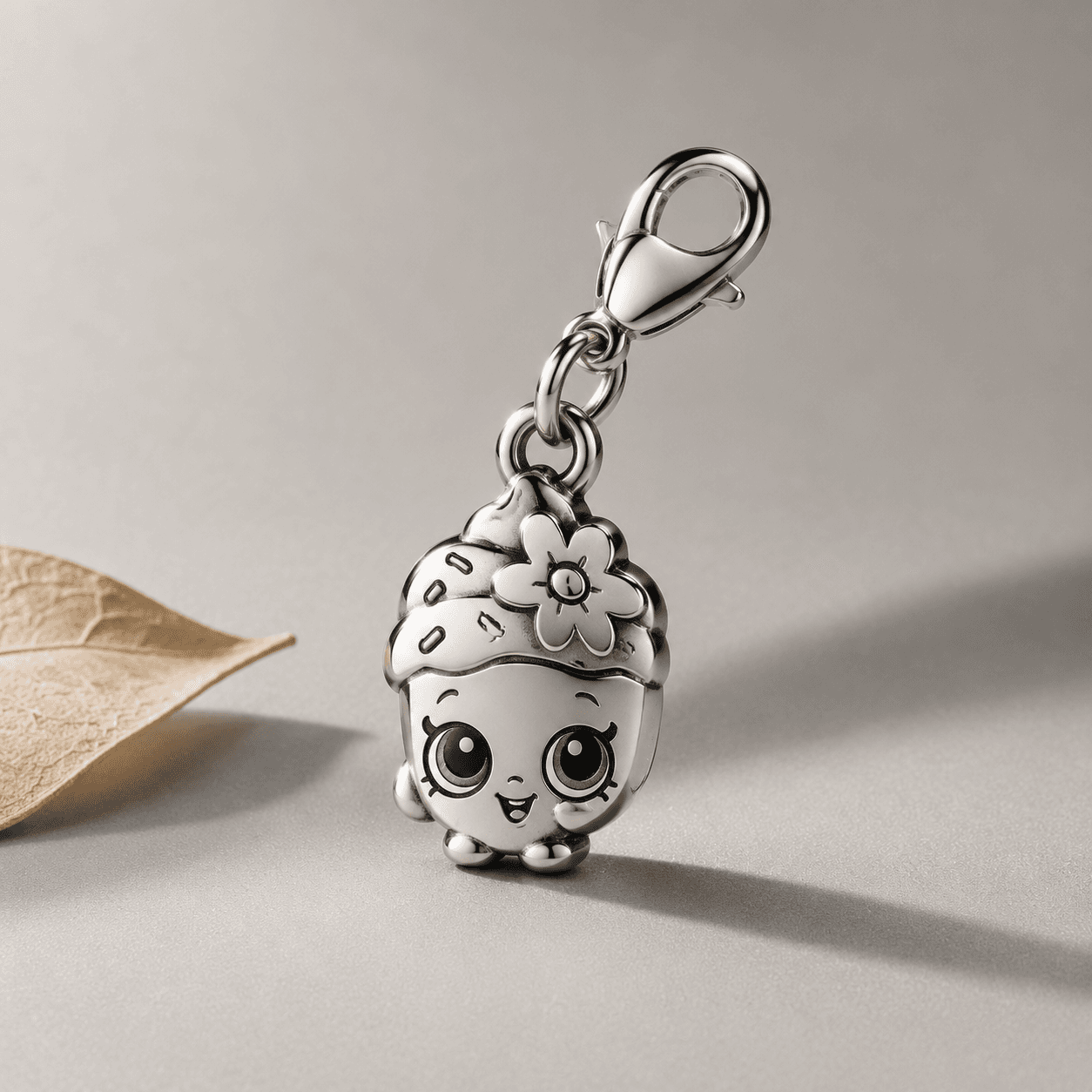
Attachment engineering deserves the same attention as the decorative face. A bail or jump ring should pass through a genuine hole or closed loop with enough clearance for the intended connector. Its position should keep the octopus oriented correctly during wear or display and avoid excessive rotation caused by an unbalanced center of mass. Designers should specify the opening dimensions, connector wire thickness where applicable, and expected movement. The connection must remain physically plausible and inspectable; decorative elements should not obscure a functional opening or create the appearance of a connector that is not actually attached.
Prototype reviews should cover the front, back, side profile, overall thickness, and connector behavior. Check whether the charm hangs in the intended orientation, whether adjacent tentacles snag during normal handling, and whether recesses collect visible finishing residue. For jewelry designers, a useful sample approval record includes measured dimensions, agreed tolerances, photographs, finish references, and written notes on any revisions. Lancy Jewelry can support sample development so that geometry, finish, and attachment details are evaluated together before the specification is released for wholesale stainless steel charms production.
PVD Finishes, Enamel Color Filling, and Crystal Inlay
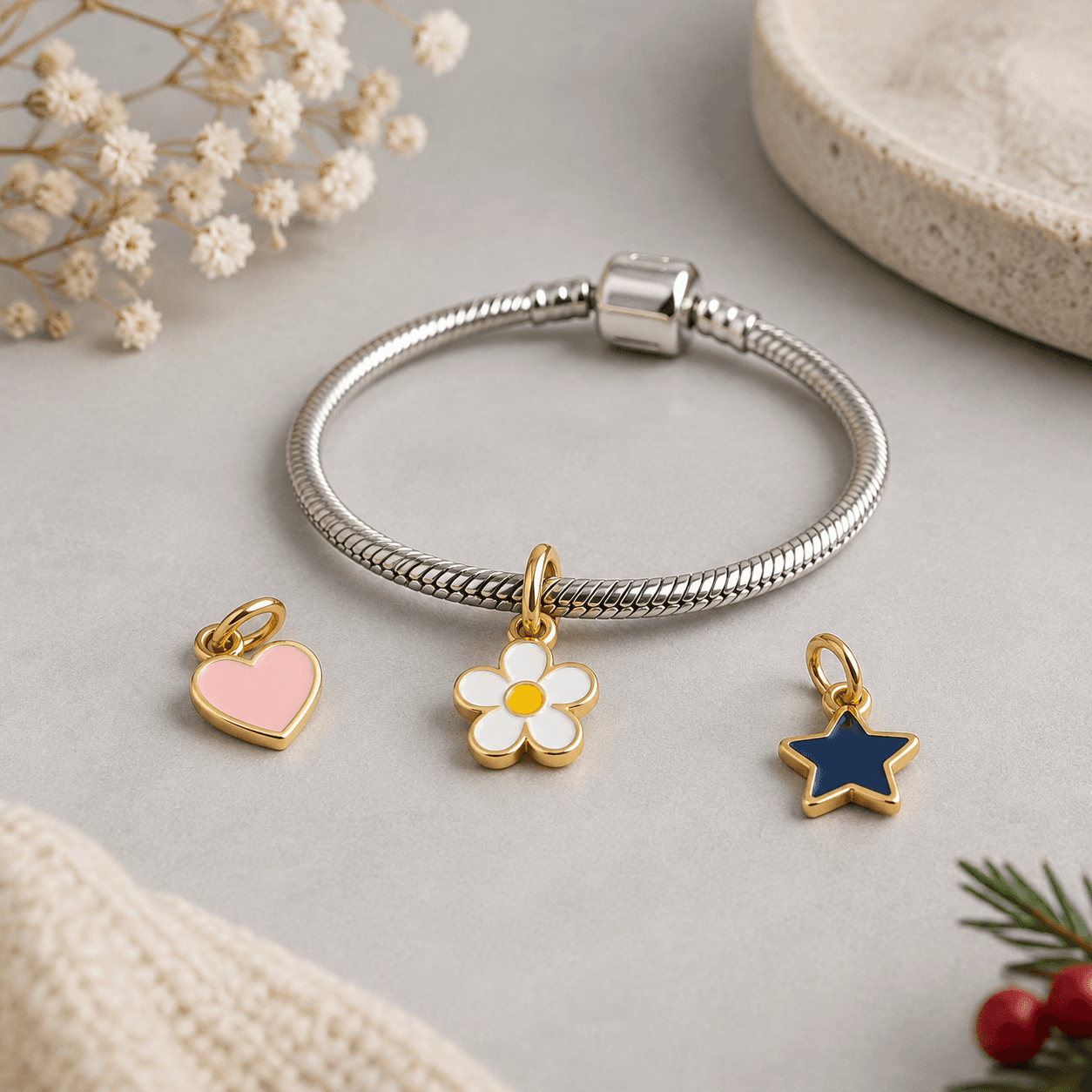
Surface treatments give a charm octopus distinct visual directions without changing its 316L stainless steel base. A polished silver finish emphasizes the silhouette and reflective surfaces, while gold plated and rose gold plating through PVD can create warmer color options. PVD, or physical vapor deposition, describes a coating process in which material is deposited onto a prepared surface under controlled conditions. Final appearance and wear performance depend on the coating system, substrate preparation, geometry, process control, and handling. Buyers should therefore evaluate actual production samples rather than selecting a finish solely from a digital rendering or color description.
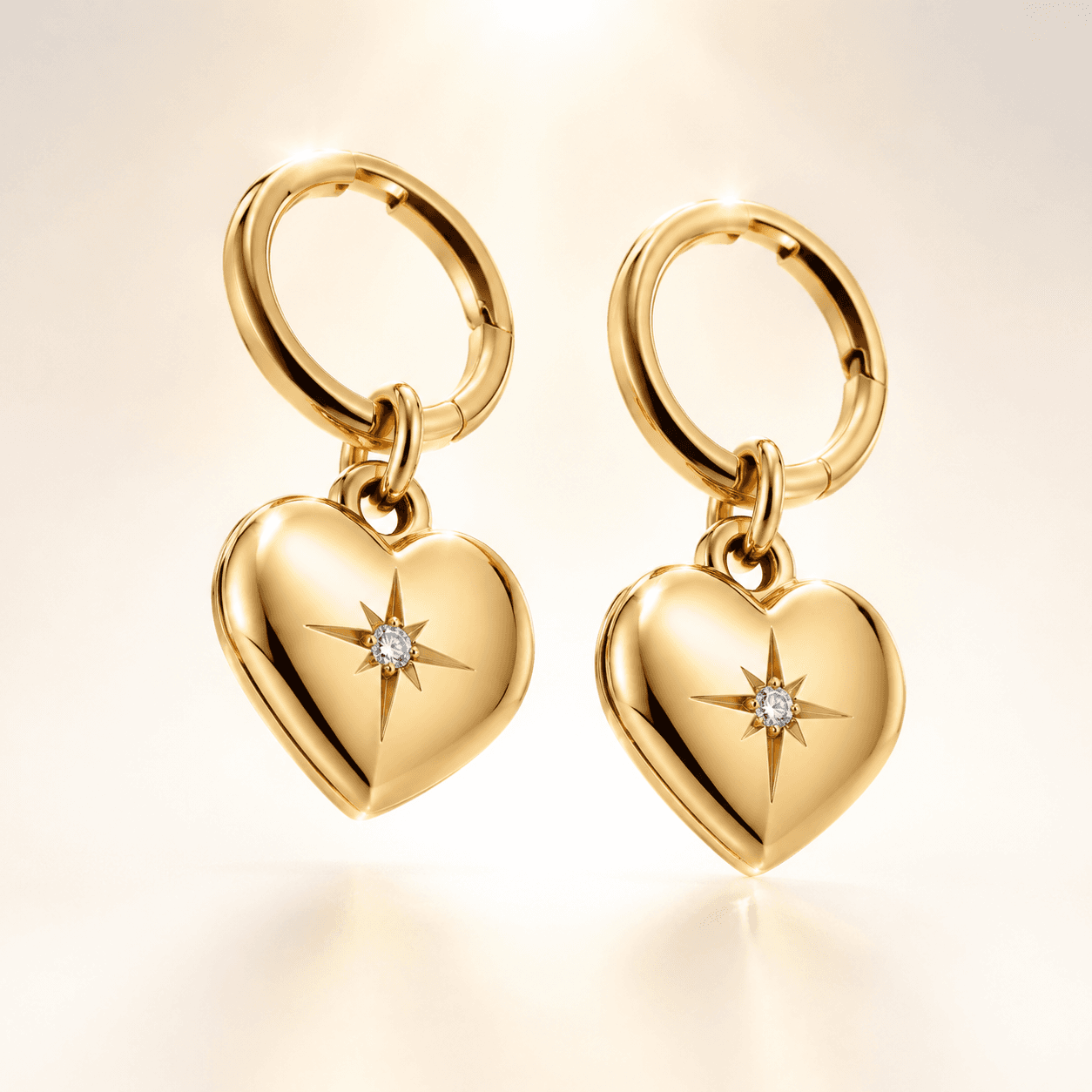
Enamel color filling is useful for distinguishing the central body, tentacle sections, or selected decorative motifs. A strong specification identifies each color area, its approximate boundary, the required visual contrast, and the acceptable level of color variation. Narrow recesses and very small compartments may limit filling accuracy, so the sample should be inspected for clean borders, complete coverage, visible voids, and consistent color distribution. Crystal inlay can introduce points of reflected light, but the available setting area, retention structure, and surrounding metal thickness need to be reviewed before finalizing the design. Not every fine detail is suitable for every finishing method.
For efficient approval, compare the sample against a documented reference under consistent lighting. Review color, gloss, surface uniformity, edge coverage, and the appearance of recessed details. Record which finish is approved and whether different variants require separate samples. A PVD plated stainless steel charms program may use one shared design with multiple finish options, but each option should have its own clear specification and quality acceptance criteria. Lancy can assess PVD plating, enamel color filling, crystal setting, and logo engraving requirements during OEM development, helping designers balance visual ambition with repeatable production.
Prototype Planning and Quality Verification for Custom Octopus Charms
Sample development is the stage where a concept becomes a measurable manufacturing specification. Before requesting a sample, prepare the artwork, intended dimensions, base material requirement, finish selection, color references, attachment design, target quantity, and packaging expectations. Identify which details are mandatory and which may be adjusted to improve manufacturability. For example, a designer may prioritize a clearly defined central body over extremely fine tentacle texture, or choose fewer enamel sections to maintain cleaner boundaries at a compact size. Documenting these priorities reduces uncertainty when the factory reviews the concept.
Quality verification should cover both material identity and finished-product performance. Depending on the product, destination market, and applicable requirements, buyers may request relevant material declarations, test reports, or third-party laboratory evidence. SGS is an independent testing and inspection organization; a report issued by SGS should be checked for the exact product or sample tested, the test method, the date, the reported results, and the issuing laboratory. RoHS concerns restrictions on specified hazardous substances in applicable electrical and electronic equipment and should not automatically be treated as a universal jewelry certification. REACH relates to chemical obligations under European Union law, including relevant substance restrictions and duties that may apply to articles.
EN 1811 is a reference method for testing nickel release from certain post assemblies inserted into pierced parts of the human body and from articles intended for direct and prolonged skin contact, within its defined scope. Its applicability depends on the item and the relevant regulatory requirements. Salt spray testing evaluates corrosion behavior under specified test conditions; the result does not guarantee performance in every real-world environment. These are distinct assessments, not interchangeable certificates. Buyers should verify the current applicable standard, test scope, acceptance criteria, and supporting report before making a compliance claim. Lancy can discuss quality requirements and available documentation during sampling, while the buyer remains responsible for confirming the legal obligations that apply to the final product and market.
Planning Wholesale Collections, Private Label Details, and MOQ
A commercial octopus charm program benefits from a deliberate assortment plan rather than a collection of unrelated designs. Start with a core silhouette and determine which variations justify separate SKUs. Possible variations include a silver finish, a PVD gold plated version, rose gold plating, selected enamel colors, or a crystal inlay detail. Keeping the primary geometry consistent can simplify visual merchandising and help buyers present a coordinated range, provided that each finish and color variant receives its own approved specification. For charm bar retailers and gift companies, consider how the charm will be displayed, how easily the attachment can be handled, and whether the design fits the intended price positioning.
MOQ, or minimum order quantity, should be clarified at the beginning of a sourcing discussion. The applicable minimum can vary according to design complexity, tooling needs, finish options, enamel requirements, packaging, and the number of variants in the order. A project with one design and one finish may have a different production structure from a program requiring several colors and individually branded packaging. Low MOQ support can be useful when testing a new collection, but the buyer should confirm actual minimums, sample charges, production lead times, and any setup costs directly rather than relying on general assumptions.
Private label charms also require careful coordination of branding and packaging. Provide the approved logo artwork, preferred engraving location, packaging dimensions, required labeling information, and any destination-market instructions before production begins. Check that the engraving remains legible at the chosen scale and does not interfere with the charm's decorative details or attachment structure. Lancy Jewelry supports OEM and ODM development, private-label packaging, and custom logo charms based on confirmed project specifications. Browse all products for collection planning, then use the RFQ and quote request page to communicate quantities, variants, and sourcing requirements for your wholesale stainless steel charms project.
Design Review Checklist Before Releasing a Charm Octopus Order
Before sample approval, review the complete product specification rather than assessing appearance alone. Confirm that the drawing identifies the overall height and width, thickness, attachment-hole dimensions, and any critical raised or recessed features. Ensure the specified 316L stainless steel base material is recorded separately from the surface finish. Identify whether the design requires PVD plating, enamel color filling, crystal inlay, logo engraving, or a combination of processes. If more than one variant is planned, assign each version a distinct reference and maintain a clear link between its artwork, approved sample, and production requirements.
Next, evaluate function and finish together. Confirm that the bail or jump ring passes through the intended hole or loop, the charm hangs at the required angle, and the connector does not conceal key design features. Inspect the edges, recessed areas, surface color, plating consistency, enamel boundaries, crystal retention, and any engraved text. Define acceptable cosmetic limits and measurement tolerances before bulk production. Where testing is required, agree on the relevant methods, sample selection, documentation, and acceptance criteria in advance. A general statement that a product is tested is less useful than a report that clearly identifies the tested sample and the applicable requirements.
Finally, align commercial details with the technical specification. Confirm the quantity for each SKU, MOQ, packaging configuration, labeling requirements, sample approval status, estimated schedule, and shipping expectations. Record who approves design changes and how revised samples will be documented. For buyers developing a new category, a staged process—design review, sample evaluation, written approval, and controlled production release—can reduce avoidable revisions. Lancy's OEM service provides a starting point for discussing custom requirements, while the contact page can be used to clarify project-specific manufacturing questions before an RFQ is finalized.
Frequently Asked Questions About Charm Octopus Manufacturing
How Lancy Supports Custom Stainless Steel Charm Development
Developing a commercially viable charm octopus requires coordination between design intent and manufacturing constraints. Lancy Jewelry supports OEM and ODM projects built around 316L stainless steel charms, with development options including custom geometry, logo engraving, PVD plating, enamel color filling, crystal setting, and private-label packaging. The appropriate process depends on the design, required detail, target finish, and order structure. Early technical review helps establish which features can be retained at the intended scale and which details may need refinement before sampling.
For boutique jewelry brands and gift companies, a structured development process makes it easier to manage several design variants without losing control of specifications. Start by defining the core shape, dimensions, attachment method, and base material. Then document finish and decoration choices, review the sample, and confirm the acceptance criteria for bulk production. If you are planning a coordinated series, establish which dimensions and visual elements are shared across SKUs and which are unique to individual designs. This creates a clearer basis for sample approval, repeat orders, and quality checks.
Commercial discussions should also cover MOQ, expected quantities, sample costs, packaging, estimated timelines, and documentation requirements for the destination market. Lancy's OEM and ODM service is a starting point for custom development, and direct contact with the team can help clarify details before an RFQ is submitted. For additional product discovery, use the product catalog to evaluate possible assortment directions. Clear technical and commercial inputs help the manufacturer assess feasibility and prepare a more relevant proposal.
Start Your Custom Charm Octopus Project With Lancy
Ready to evaluate a custom charm octopus for your next jewelry collection? Send Lancy Jewelry a concise RFQ containing your drawing or reference image, target dimensions, required 316L stainless steel base material, preferred finish, enamel colors or crystal inlay requirements, attachment details, logo artwork, and packaging specifications. Include the intended application, destination markets, estimated quantity per SKU, desired sample schedule, and expected bulk-order timing.
If you do not yet have a production-ready drawing, share your concept and identify the essential design features. The team can review the requested geometry and decorative options, discuss sample development, and clarify the applicable MOQ, setup costs, quotation details, and available documentation. If SGS testing or reports related to RoHS, REACH, EN 1811, or salt spray performance are relevant to your project, state the exact requirement and market so the available evidence can be assessed appropriately.
Begin with the RFQ and quote request page, review custom manufacturing services, or use contact Lancy Jewelry to discuss your requirements. A complete brief helps align design, finish, sample approval, private-label packaging, and wholesale production from the outset.
Related resources
Related resources
- How to Evaluate 316L Stainless Steel Zodiac Bracelet Charms Wholesale Suppliers
- 316L Stainless Steel Chinese Zodiac Charms Wholesale: A Finishing Guide
- Lancy Charms Bar
- Custom Stainless Steel Charm Bracelet Tutorial: A Buyer’s Guide to Quality
- Antique Distressed Finish on Stainless Steel Charms: A Buyer’s Guide to Durability
- The Ultimate ODM stamped 316L stainless steel angel charm customization Buying Guide
- Stainless Steel Animal Jewelry Charms Wholesale: Quality Guide
- How to Source Minimalist Stainless Steel Charms: Finishing Guide
- Custom OEM/ODM Guide to Stainless Steel African Jewelry Charms Wholesale
- Gold-Tone Finish ODM Stamped 316L Steel Angel Charm: Buyer Guide