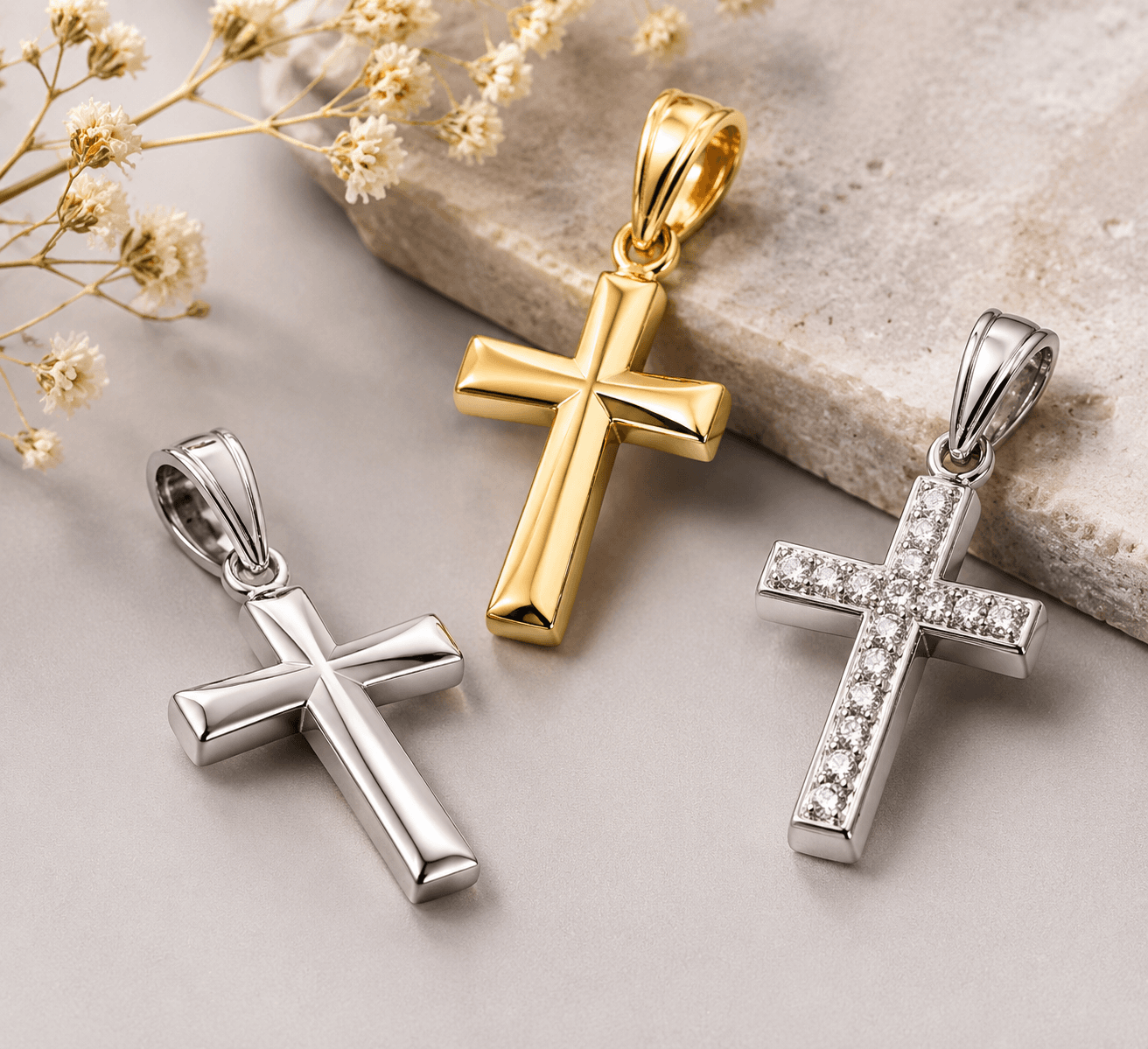
Cross charms for necklaces combine meaningful symbolism with versatile jewelry design. For jewelry designers developing distinctive collections, selecting the right material, surface finish, dimensions, and attachment structure is essential to achieving a reliable finished product. 316L stainless steel offers a practical foundation for cross charms because of its corrosion resistance, structural strength, and suitability for detailed manufacturing.
This material guide explains how 316L stainless steel cross charms are developed, finished, tested, and prepared for commercial production. It covers PVD gold plating, silver finish, rose gold plating, enamel color filling, crystal inlay, dimensional planning, and prototyping considerations. As a stainless steel charms manufacturer, Lancy Jewelry supports OEM and ODM development, low MOQ production planning, custom engraving, and private-label programs for international jewelry businesses.
Understanding 316L Stainless Steel Cross Charms for Necklaces
Why Material Selection Matters in Cross Charm Design
Cross charms for necklaces must balance visual proportions, structural reliability, surface quality, and comfortable everyday handling. The base material influences how precisely the cross silhouette can be manufactured, how decorative details are applied, and how the finished surface performs during normal use. 316L stainless steel is a widely used jewelry manufacturing material because it combines good corrosion resistance with mechanical strength and a stable foundation for different finishing processes.
From a material science perspective, 316L is an austenitic stainless steel grade containing chromium, nickel, and molybdenum. Its chromium content supports the formation of a passive surface layer that helps resist corrosion. The low-carbon specification also contributes to its corrosion performance in suitable manufacturing and service conditions. These properties make it a practical choice for cross charms intended for recurring wear and commercial jewelry collections.
Understanding the Manufacturing Advantage
For designers, the value of 316L stainless steel extends beyond durability. Its manufacturing characteristics support defined edges, controlled surface textures, engraved details, and repeatable dimensions. A stainless steel charms manufacturer can develop cross designs with smooth contours, recessed decorative areas, polished surfaces, and carefully positioned attachment loops. The material also provides a consistent substrate for PVD finishes and selected decorative treatments.
Lancy focuses exclusively on 316L stainless steel charms as its base-material platform. This makes material specifications easier to standardize across a coordinated collection. Designers can explore different cross silhouettes, proportions, surface treatments, and decorative details while maintaining a consistent material foundation for OEM development and future replenishment.
Material Properties and Functional Benefits of Cross Charms
Evaluating Strength, Corrosion Resistance, and Surface Stability
When evaluating cross charms for necklaces, designers should consider more than appearance. The finished charm needs to retain its intended shape, provide a secure attachment point, and maintain an acceptable surface condition through ordinary handling. 316L stainless steel offers a useful combination of mechanical strength and corrosion resistance. Its properties support relatively thin decorative profiles while allowing designers to develop more dimensional forms, including raised central details, recessed borders, and textured surfaces.
Corrosion Resistance and Daily Wear
The passive chromium-rich surface layer helps protect 316L stainless steel against many common environmental conditions. However, corrosion resistance should never be interpreted as complete immunity to chemical exposure. Chloride-containing environments, aggressive cleaning products, perspiration accumulation, and prolonged exposure to unsuitable substances may affect surface condition. Good finishing, appropriate cleaning, and sensible product-care guidance remain important parts of collection development.
Dimensional Stability and Structural Planning
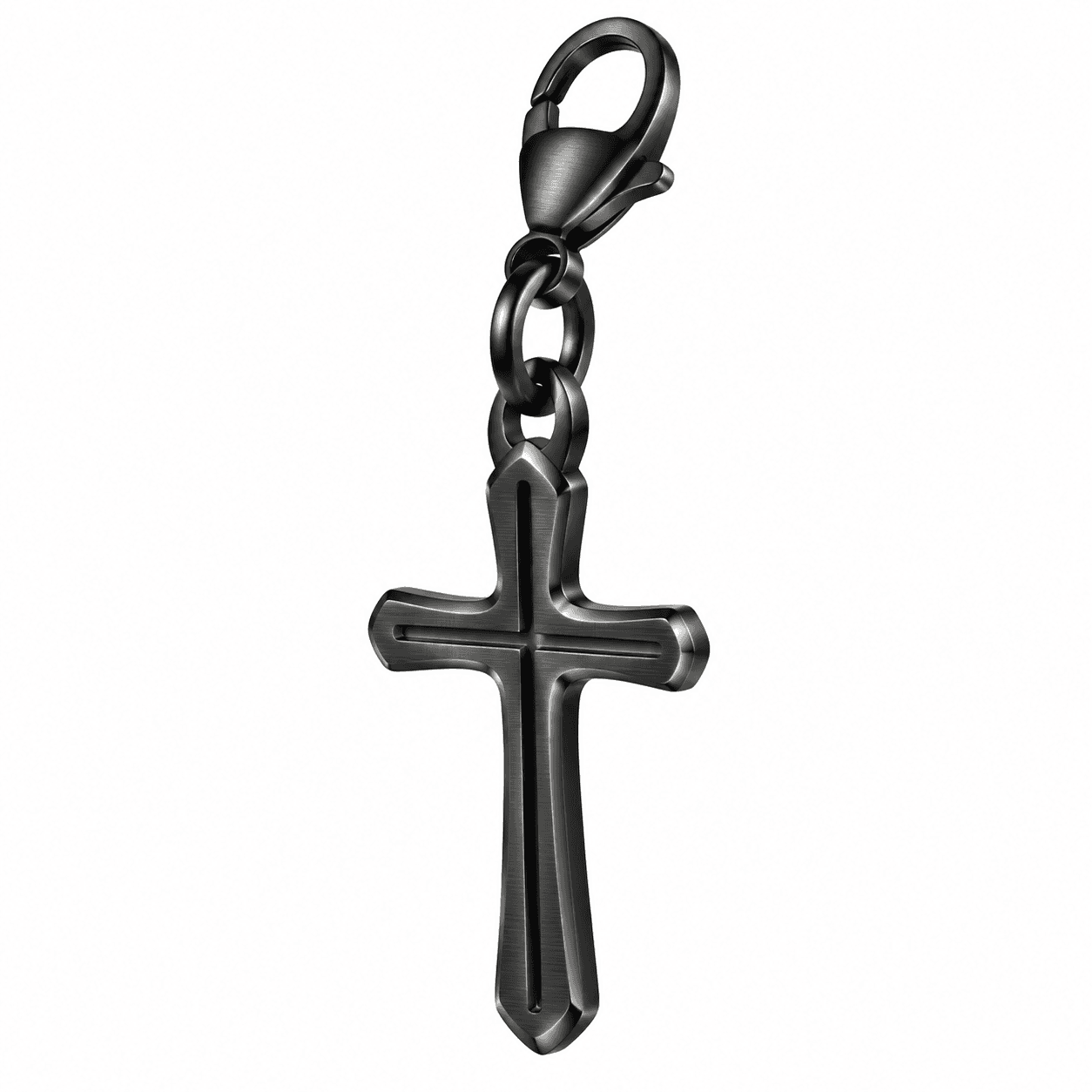
Cross charms are often designed with vertical and horizontal arms, a central intersection, and a top attachment loop. These features need sufficient structural support to withstand ordinary handling. Designers should evaluate arm width, thickness, edge transitions, and the relationship between the decorative body and the bail or jump ring. Excessively narrow sections can create unnecessary structural risks, while oversized proportions may make a charm uncomfortable or visually unbalanced.
For most necklace applications, a design-development range of approximately 16–25 mm may be considered for larger statement cross pendants, while smaller charm formats can be developed around 10–16 mm. These are starting points rather than fixed specifications. Final dimensions should reflect the intended jewelry format, design complexity, weight distribution, and attachment requirements.
Consistency Across Production
Material specifications, incoming inspection, dimensional tolerances, surface preparation, and finishing controls all influence repeatability. For bulk charm orders, documenting the approved sample and its critical measurements provides a useful reference for subsequent production batches. This approach helps designers maintain consistent proportions and finish expectations when expanding a coordinated necklace collection.
PVD Gold Plating and Surface Finish Options
Choosing the Right Finish for Cross Charms for Necklaces
Surface finish changes how a cross charm interacts with light, surrounding jewelry components, and the overall visual direction of a collection. Lancy supports multiple finishing options on a 316L stainless steel base, including PVD gold plating, silver finish, and rose gold plating. Each option creates a different visual character, allowing designers to develop coordinated product families without changing the underlying material specification.
PVD Gold Plating
PVD, or Physical Vapor Deposition, is a vacuum-based coating technology in which material is deposited onto a prepared surface. The process can create a controlled decorative finish with good adhesion when the substrate preparation, coating parameters, and production controls are properly managed. PVD gold plated cross charms are suitable for collections requiring a warm metallic appearance and consistent visual presentation.
Before specifying a PVD finish, designers should confirm the intended color tone, surface gloss, coverage requirements, and acceptable variation between production batches. A polished surface produces a different visual result from a brushed or textured surface, even when the coating specification is unchanged. An approved physical sample is therefore an important reference for color and appearance control.
Silver Finish and Rose Gold Plating
A silver finish provides a bright, neutral metallic appearance, while rose gold plating introduces a warmer color direction. These options can support different merchandising themes and seasonal product programs. For coordinated collections, the same cross geometry can be evaluated in several finishes to determine which visual direction best matches the intended retail positioning.
Surface Preparation and Quality Inspection
Finishing quality begins before coating. Surface preparation, edge condition, polishing consistency, cleaning, and fixture positioning all influence the final appearance. Inspection should examine coating coverage around edges and attachment areas, visible color consistency, surface marks, and any localized defects. Buyers should define acceptance standards with the manufacturer before approving production. For repeat orders, retaining an approved finish reference supports more consistent sourcing and quality communication.
Enamel and Crystal Inlay Customization Techniques
Developing Decorative Details for Custom Cross Charms
Decorative treatments allow designers to transform a basic cross silhouette into a more distinctive product. Two useful customization directions are enamel color filling and crystal inlay. Both can be incorporated into 316L stainless steel cross charms, provided that the underlying geometry is designed to accommodate the decorative process and that the attachment structure remains functional.
Enamel Color Filling
Enamel color filling introduces defined areas of color into recessed sections of a charm. Designers can use a single accent color, contrasting color blocks, or carefully arranged small sections to establish a recognizable visual theme. For successful development, the artwork should identify the boundaries of each color area, the intended color references, the recess depth, and the desired relationship between the filled surface and the surrounding metal.
Recess geometry is particularly important. Areas that are too shallow may make color application difficult to control, while narrow or complicated sections can increase production complexity. Designers should also consider how small details will appear at the finished charm size. Artwork that looks clear on a large computer drawing may become difficult to reproduce at a compact jewelry scale.
Crystal Inlay and Decorative Setting
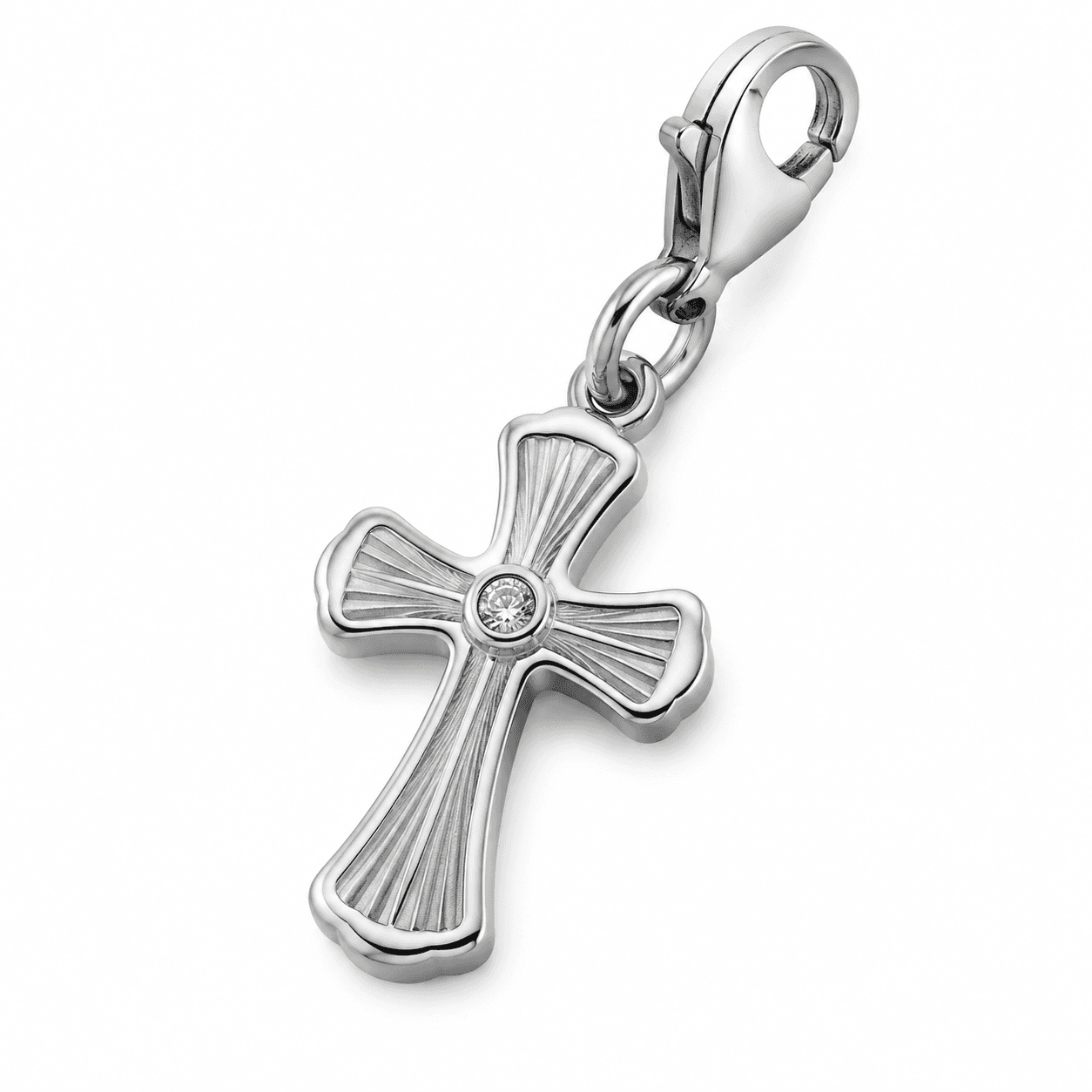
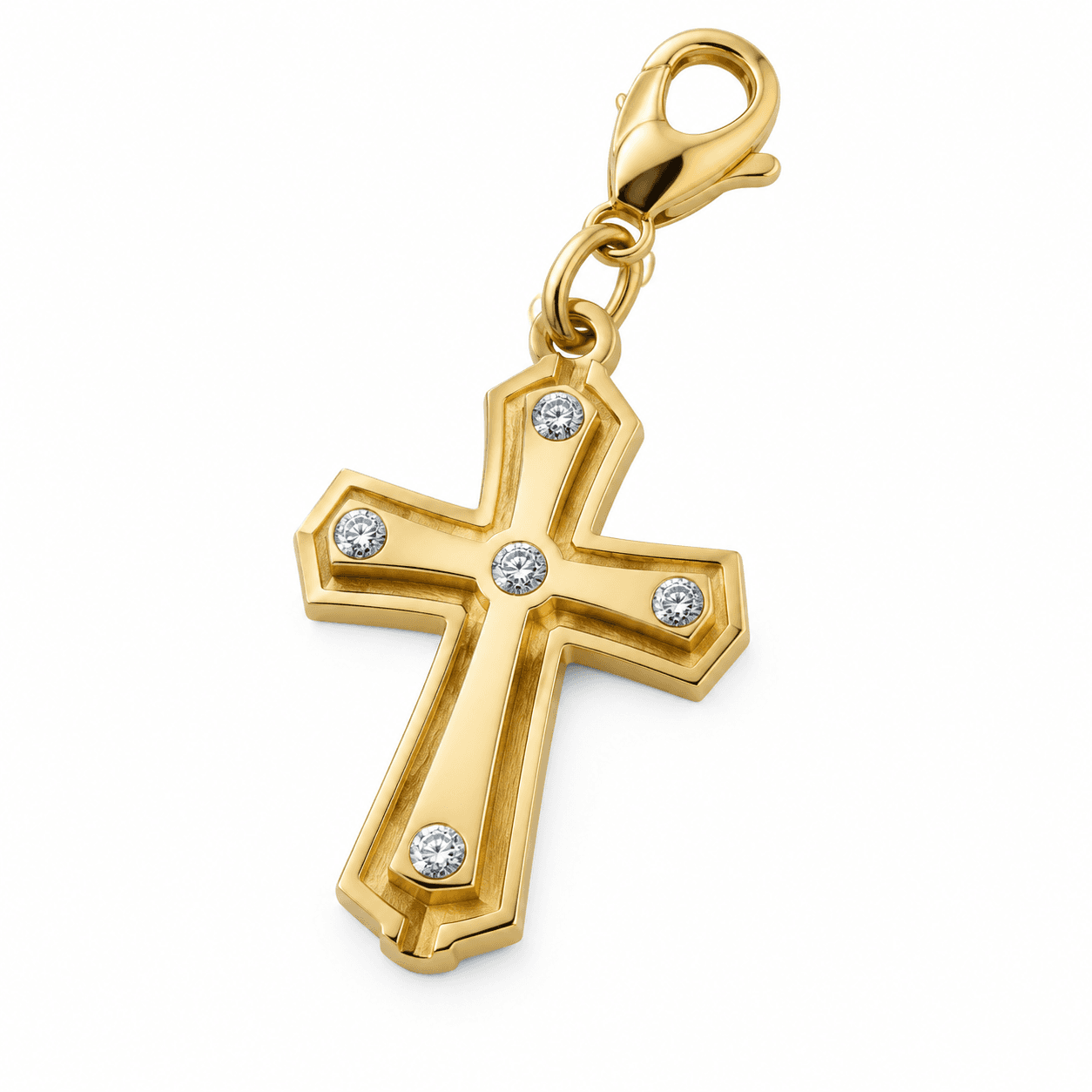
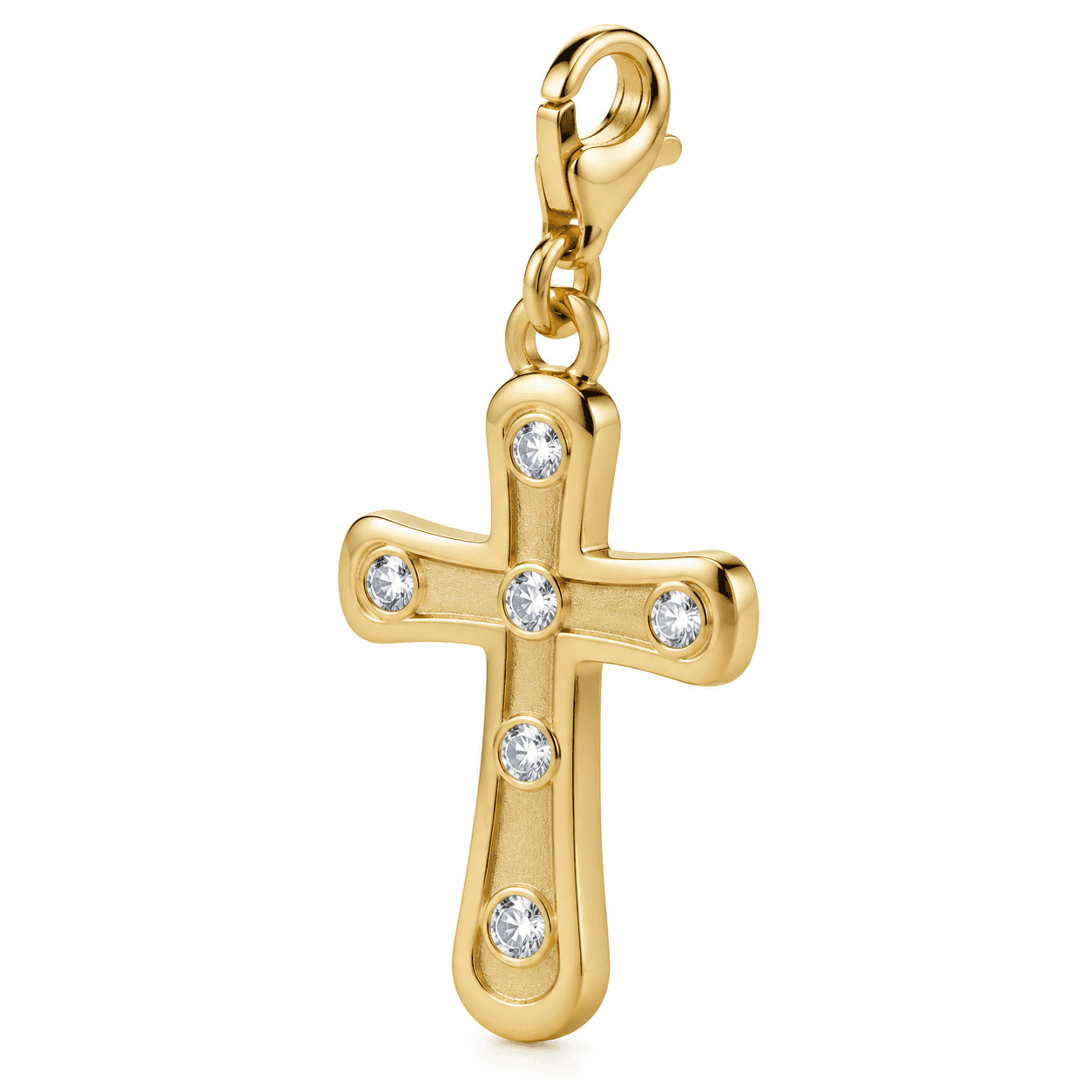
Crystal inlay introduces reflective detail and can emphasize the central intersection, border, or selected arms of a cross. The designer should define the number, size, color, and placement of the crystals before tooling and sample development. Setting locations require accurate dimensions and sufficient supporting geometry. Spacing should account for the finished crystal profile, the surrounding metal structure, and the intended visual balance.
Combining Decorative Processes
Some designs may combine a PVD gold plated surface with enamel color filling or crystal inlay. Such combinations require a clear process sequence and appropriate compatibility checks. Designers should confirm whether the proposed decorative treatment is suitable for the selected finish and how exposed edges, recessed sections, and setting areas will be inspected. Lancy supports custom stainless steel charms development with logo engraving, PVD finishing, enamel application, and crystal setting. Sample development provides an opportunity to assess the appearance and workmanship before confirming commercial production.
Cross Charm Geometry, Attachment Design, and Prototyping
Designing a Cross Charm That Functions Correctly
A well-designed cross charm requires more than an attractive front view. The complete component must have a mechanically plausible attachment structure, appropriate thickness, smooth edges, and balanced proportions. The bail or jump ring should pass through a genuine hole or integrated loop, remain properly closed where applicable, and provide sufficient clearance for the intended necklace chain. Attachment design should be considered during the first drawing stage rather than added after the decorative body has been finalized.
Step 1: Establish the Main Silhouette
Start with the overall height, width, arm proportions, and thickness. Define whether the cross should have straight edges, rounded ends, tapered arms, a dimensional center, or a rope-twist border. Maintain enough material around narrow sections to support manufacturing and normal handling. A front-view drawing should be accompanied by side and rear views when the design includes raised or recessed features.
Step 2: Specify the Attachment Mechanism
Identify the attachment position, opening diameter, loop thickness, and clearance requirements. A jump ring should pass through the intended loop without interfering with the decorative surface. If the charm uses an integrated bail, the loop must be large enough for the intended chain while maintaining a balanced appearance. The attachment should be checked under representative handling conditions during prototype evaluation.
Step 3: Prepare Artwork and Technical Specifications
Useful design documentation includes dimensioned drawings, front and rear artwork, color references, engraving details, surface-finish requirements, and decorative component positions. For crystal inlay, include the intended stone count and setting layout. For enamel, provide color references and a clear map of each filled area. These details reduce interpretation differences between the design team and the factory.
Step 4: Develop and Review a Physical Sample
Sample development allows designers to evaluate actual dimensions, weight, color, polishing, attachment movement, and decorative execution. Review the sample under neutral lighting and inspect both the front and rear. Check that the charm hangs in the intended orientation, that the attachment is secure, and that the edges are comfortable to handle. Any changes should be documented and incorporated into the approved specification before production begins.
For designers working with an ODM charm supplier, this structured approach helps turn an initial concept into a manufacturable product. Lancy provides OEM and ODM development support, enabling buyers to discuss custom geometry, logo engraving, finishing, and private-label requirements within one coordinated development process.
Quality Testing, SGS Documentation, and Production Standards
How to Evaluate Quality in 316L Stainless Steel Cross Charms
Technical documentation and physical inspection should support one another when evaluating cross charms for necklaces. A material declaration identifies the specified base material, while testing documentation provides evidence relating to particular chemical, physical, or regulatory requirements. Buyers should review the exact report scope, sample identification, test method, testing date, and applicable acceptance criteria rather than relying on a certificate name alone.
Understanding Relevant Testing Areas
- RoHS: Evaluates restrictions on specified hazardous substances within the scope of the applicable directive and test report. Buyers should verify which substances and product components were included.
- REACH: Addresses chemical safety obligations under the relevant European regulatory framework. Buyers should identify applicable substance restrictions and request documentation appropriate to the supplied product.
- EN 1811: Provides a reference test method for nickel release from certain articles intended for direct and prolonged skin contact. The applicable product category, test conditions, and regulatory interpretation should be confirmed.
- Salt Spray: Evaluates corrosion performance under defined artificial exposure conditions. Results depend on the test method, duration, sample preparation, and acceptance criteria. They should not be interpreted as a direct guarantee of unlimited real-world corrosion resistance.
What SGS Documentation Should Confirm
When buyers request SGS testing or certification documentation, they should confirm that the document is genuine, traceable, and relevant to the actual product specification. SGS is a testing, inspection, and certification organization; the existence of an SGS report does not automatically establish that every product variation or production batch has been tested. Check the report number, applicant, sample description, laboratory details, methods, results, and validity or applicability information.
Factory Quality Control
Quality standards for cross charms should cover incoming 316L material verification, dimensional inspection, surface preparation, finish consistency, decorative application, attachment integrity, and final visual inspection. Buyers can also establish an approved sample, defect classification, measurement tolerances, and inspection sampling plan before mass production. For PVD plated stainless steel charms, particular attention should be given to color consistency, coating coverage, visible surface defects, and the condition of edges and loops.
Lancy coordinates manufacturing checks across custom development and production, with attention to repeatability and the agreed product specification. Buyers should communicate their destination-market requirements early so that applicable chemical testing, documentation, labeling, and packaging expectations can be evaluated before an order is confirmed.
Planning a Commercial Cross Charm Collection
From Individual Design to a Coordinated Product Range
For boutique jewelry brands, charm bar retailers, and private-label buyers, a successful cross charm program should be planned as a product family rather than a single isolated SKU. A consistent 316L stainless steel foundation makes it possible to develop related designs with different dimensions, surface treatments, and decorative features while maintaining a recognizable material specification. This approach can simplify product documentation, sampling, merchandising, and replenishment planning.
Organize Designs by Visual Direction
Consider creating several design groups, such as minimalist cross silhouettes, dimensional rope-twist borders, engraved cross details, enamel-accented designs, and crystal-inlay options. Each group can have a defined finish palette and size range. Maintaining consistent attachment specifications across related models may also make collection planning more straightforward, provided that each finished design is independently checked for correct fit and function.
Plan SKU and Finish Variations
Before requesting a quotation, prepare a product matrix showing each design, dimensions, finish, decorative treatment, logo requirement, and proposed order quantity. This allows the manufacturer to identify which variations can share tooling or process settings and which require separate development. For example, changing the color of an existing finish may involve a different production setup, while changing the cross silhouette or attachment geometry may require more extensive development work.
Understand MOQ and Sampling Considerations
MOQ depends on design complexity, production setup, finishing requirements, decorative components, and packaging specifications. Low MOQ charm production may be available for selected development programs, but it should be confirmed against the exact SKU and process requirements. Combining several designs in a collection does not automatically mean that every finish or decorative variation can share one MOQ. Buyers should request a clear breakdown by model and finish.
Prepare for Bulk Orders and Private Label Packaging
Once the sample is approved, the buyer should confirm the final artwork, dimensions, material specification, finish reference, inspection criteria, packaging format, and shipment quantities. Private label charms can be planned with branded packaging cards or display solutions appropriate to the retail channel. Lancy supports private-label packaging and bulk charm orders, helping buyers coordinate product development and presentation requirements through a factory-direct process. Explore the complete product catalog or review OEM manufacturing services to understand the available development options.
Design Considerations for Different Necklace Applications
Matching Cross Charm Proportions to Jewelry Concepts
Cross charms for necklaces can serve different design purposes, from understated everyday accessories to prominent statement pieces. The appropriate proportions depend on the intended chain, wearing position, overall styling, and target customer. Designers should evaluate the charm as a complete component, including its body thickness, attachment height, decorative treatment, and total weight. A visually balanced design should hang naturally rather than rotating unpredictably or placing excessive stress on its attachment point.
Minimalist Necklace Designs
For minimalist concepts, a compact cross with clean contours and restrained surface detailing can provide a clear silhouette without excessive visual weight. A silver finish or subtle PVD gold plating can reinforce the intended design direction. Designers should prioritize smooth edges, consistent arm widths, and a compact attachment loop. Fine engraved details should be tested at the final size to confirm that they remain visible after manufacturing and finishing.
Decorative and Statement Designs
More expressive designs can use dimensional borders, textured surfaces, enamel sections, or crystal inlay. A rope-twist perimeter can add visual depth, while a central decorative element can establish a focal point. These features need to be proportioned carefully so they do not obscure the recognizable cross silhouette. Crystal positions should be symmetrical where the design requires symmetry, and color-filled areas should have clearly defined boundaries.
Coordinated Gift and Boutique Programs
Cross charms can also be developed for gift accessories and coordinated boutique collections. Buyers may consider multiple finishes, engraved messages, packaging cards, or different size options within a single product family. For commercial planning, the most useful approach is to define a consistent design language and then introduce controlled variations. This helps retail teams present a cohesive assortment while allowing customers to select different decorative expressions.
For every application, test the actual sample with the intended chain and attachment arrangement. Confirm that the charm faces forward, moves naturally, and does not have sharp edges or obstructive connectors. Final decisions should be based on the physical prototype and approved technical specifications rather than artwork alone.
Frequently Asked Questions About Cross Charms for Necklaces
Develop Your Custom Cross Charm Collection With Lancy
Start Your OEM or ODM Cross Charm Project
Developing cross charms for necklaces begins with a clear material specification and a practical understanding of the intended design. Lancy Jewelry supports boutique jewelry brands, charm bar retailers, gift companies, distributors, and private-label buyers with 316L stainless steel charm manufacturing, custom design development, PVD finishing, enamel color filling, crystal setting, logo engraving, and private-label packaging.
To receive an accurate RFQ and discuss sample development, send the following information:
- Design files: Front and rear drawings, reference artwork, dimensions, and any required technical specifications.
- Material: Confirm 316L stainless steel as the base material.
- Finish: Specify PVD gold plating, silver finish, rose gold plating, or another agreed surface treatment.
- Decoration: Identify enamel colors, crystal inlay positions, engraving details, and logo requirements.
- Attachment: Provide bail or jump ring dimensions and intended necklace-chain requirements.
- Quantity: Estimate the required quantity for each design and finish so MOQ and bulk production options can be evaluated.
- Testing: Identify destination markets and any requested SGS testing or regulatory documentation.
- Packaging: Specify private-label cards, individual packaging, display requirements, and branding artwork.
- Timeline: Share your target sample approval and delivery schedule.
Our team can review your specifications, assess manufacturing feasibility, and discuss the next steps for prototyping and production planning. Visit Lancy OEM services to explore custom manufacturing, browse available product categories, or submit your RFQ with design files and estimated quantities. You can also contact our team through the Lancy Jewelry contact page.
Build a consistent cross charm collection with a defined 316L stainless steel material foundation, carefully selected finishes, and production specifications designed around your business requirements.
Related resources
Related resources
- Stainless Steel Custom Enamel Charms: A Buyer’s Quality Guide
- How to Choose a Stainless Steel Custom Enamel Bracelet Charms Supplier
- Stainless Steel Custom Car Charms: A Buyer’s Quality Checklist
- How to Evaluate 316L Stainless Steel Zodiac Bracelet Charms Wholesale Suppliers
- Stainless Steel Rear View Mirror Car Charms Wholesale: A Buyer’s Quality Checklist
- Stainless Steel Wholesale Car Charms: A Buyer's Quality Guide
- 316L Stainless Steel Custom Enamel Sterling Charms: A Buyer’s Guide
- How to Choose Durable Stainless Steel Charms for Cross-Border E-Commerce
- 316L Stainless Steel Zodiac Charms Wholesale: Quality Checklist
- Custom Stainless Steel Charm Bracelet Tutorial: A Buyer’s Guide to Quality